
Business
3d sketch poster trend collage image of healthy salad leaves nutrition rotten iceberg mouth smile lips food diet hand hold fork
Getty Images

The slop bowl recession just sent Chipotle’s stock cratering

Chipotle dropped 18% yesterday, and its woes weighed on the wider slop bowl complex, dragging Cava and Sweetgreen down, too.

For a long time, the slop bowl and burrito scene has been a gold mine for Chipotle. But now, with competition rising and wallets getting lighter, consumers are turning away from Chipotle’s burritos and bowls.

The company posted just 0.3% growth in its same-store sales yesterday, while simultaneously cutting its outlook for the full year: the chain now expects sales to fall in the “low single-digit” percentages for this year. That news not only burned Chipotle itself, which sank 18%, but also hurt rival bowl sellers Cava and Sweetgreen, which fell 11% and 10% as of yesterday’s close, respectively.

How long such a downturn will last is hard to tell — we’ll hear from Cava and Sweetgreen on November 4 and 6 about how their sales are faring — but with comparable-store sales growth dipping below zero for two of the three companies this year, it’s hard to come to any other conclusion than: we are in a slop bowl recession. Indeed, if you were to subtract inflation from each of these companies’ growth rates, they’d all be well in the red.
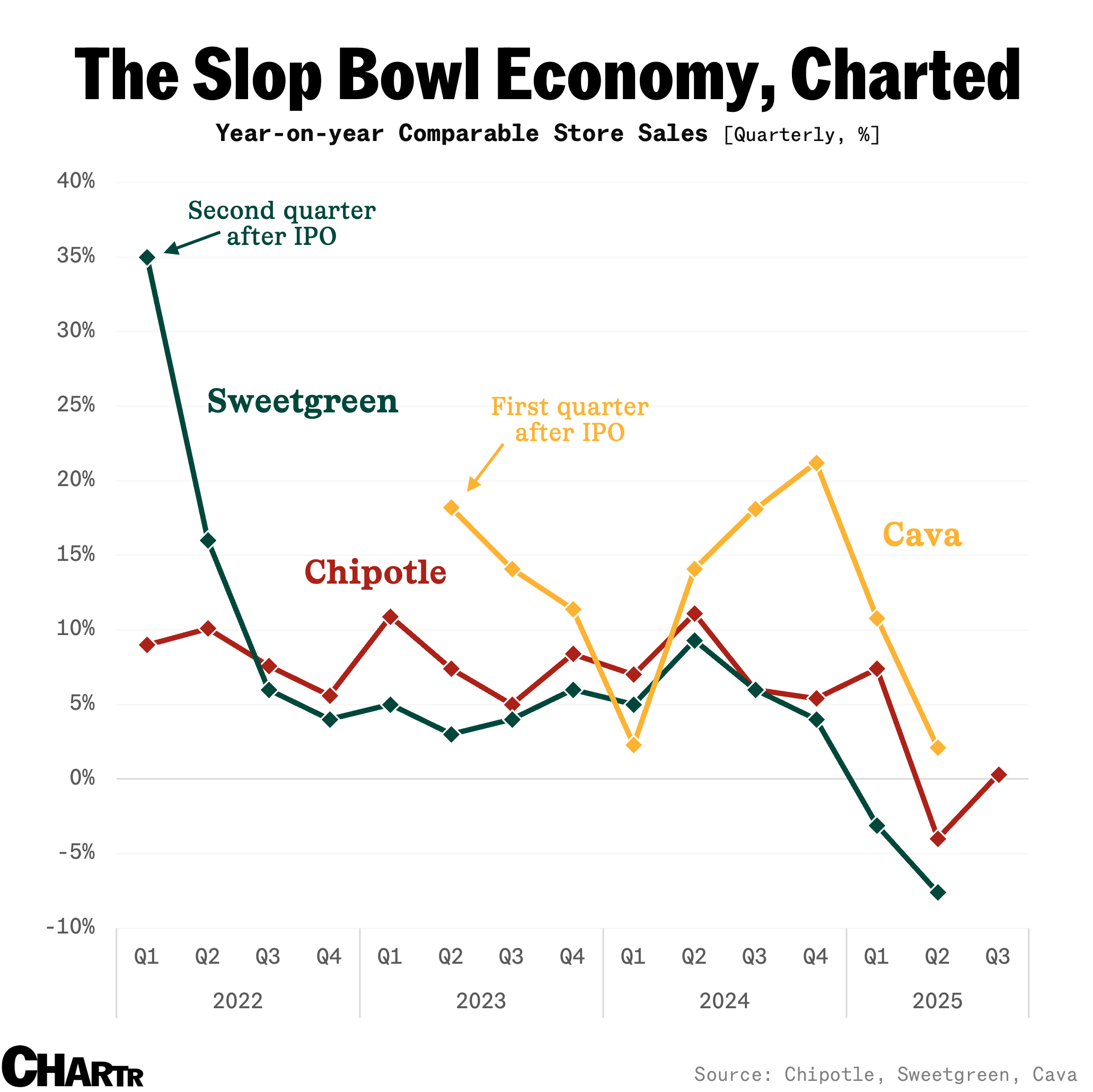
Slop bowl economy
Sherwood News

Not very bowl-ish

That continued drop comes in stark contrast to fast-casual counterparts Shake Shack and Burger King owner Restaurant Brands International, which gained on Thursday after posting better-than-expected growth in established stores, despite facing the same consumer challenges.

Per Chipotle’s latest earnings call, the deciding factor might have been the youngsters — with the CEO Scott Boatwright commenting that customers in their late 20s and early 30s are “particularly challenged” due to unemployment, student loan debt, and slower wage growth.

Go Deeper: Battle of the sad desk lunches: Both Cava and Sweetgreen want to become the next Chipotle

More Business

See all Business
9.3%

As the war with Iran produces the biggest spike in US gas prices since Hurricane Katrina, car retailer CarMax is continuing to see heightened interest in EVs, hybrids, and plug-in hybrids.

“From Feb 1st - March 1st (inclusive), compared to March 2nd to March 15th (inclusive), we saw a 9.3% lift in page views for these vehicles,” a spokesperson for the company told Sherwood News.

As industry insiders recently told us, EV interest climbs when gas prices rise. That appears to be holding true even without EV tax credits, which the Trump administration ended under its new budget package.

CarMax also saw EV searches spike in 2022, amid Russia’s invasion of Ukraine and the resulting oil price spike.

Walt Disney Chairman And CEO Bob Iger Rings Opening Bell At NY Stock Exchange

It’s the end of Disney’s Iger era (again)

Incoming CEO Josh D’Amaro is replacing Bob Iger on Wednesday, though Iger will remain a senior adviser through the end of the year.

$35.4B

The tariffs imposed by the Trump administration have cost automakers at least $35.4 billion since the start of 2025, according to a new analysis by Automotive News.

That total will continue to climb this year, since the Supreme Court’s February tariff ruling largely leaves the 25% levy on vehicles and auto parts untouched.

Toyota has taken the biggest hit, projecting more than $9 billion in tariff costs in its fiscal year ending this month, while Detroit’s big three automakers — Ford, GM, and Stellantis — were hit with a combined $6.5 billion tariff charge in 2025.

In the fourth quarter, automakers sold about 8% fewer imported vehicles in the US compared to the same period a year ago, per the Automotive News Research & Data Center.

Tariff charges come at a rough time for legacy carmakers, which are also scaling back EV plans following the Trump administration’s elimination of tax credits and fuel standard goals. According to Automotive News, the cost of EV write-downs and restructuring is, so far, nearly $70 billion.

Universal Studios Orlando Theme Park

Universal Studios is giving theaters a longer minimum exclusive run

Universal will now guarantee a minimum of five weekends before a movie hits home screens — which might help theater companies like AMC finally get back to profitability.

Latest Stories

Sherwood Media, LLC produces fresh and unique perspectives on topical financial news and is a fully owned subsidiary of Robinhood Markets, Inc., and any views expressed here do not necessarily reflect the views of any other Robinhood affiliate, including Robinhood Markets, Inc., Robinhood Financial LLC, Robinhood Securities, LLC, Robinhood Crypto, LLC, Robinhood Derivatives, LLC, or Robinhood Money, LLC. Futures and event contracts are offered through Robinhood Derivatives, LLC.