
Business
2024-04-09-1-uniqlo-is-booming-overseas

Plotting the Japanese brand’s global expansion

We ‘Qlo again

Japanese clothing brand Uniqlo, known for its range of high-quality basics to satisfy all of your “normcore” needs, is attempting to properly crack the American market again, with plans to open over 20 stores across North America in 2024 as part of its goal to reach more than 200 stores throughout the continent by the end of 2027.

As of parent company Fast Retailing’s latest count, there are just 59 Uniqlo branches in North America, after the retailer made a conscious effort to retreat in recent years, shutting stores in the region and taking time to learn what American shoppers really want (shoulder bags and crop tops, apparently).

That was a rare faux pas for a fashion brand that’s been growing rapidly since the first Uniqlo, back then the Unique Clothing Warehouse, opened its doors in Hiroshima 40 years ago. Thanks to its semi-utilitarian offerings, viral products like its immensely popular cross-body bag, and a catalog of impressive collaborations with everyone from Alexander Wang to Keith Haring, Uniqlo has carved out a slice of the market that’s way too big to be considered a niche.

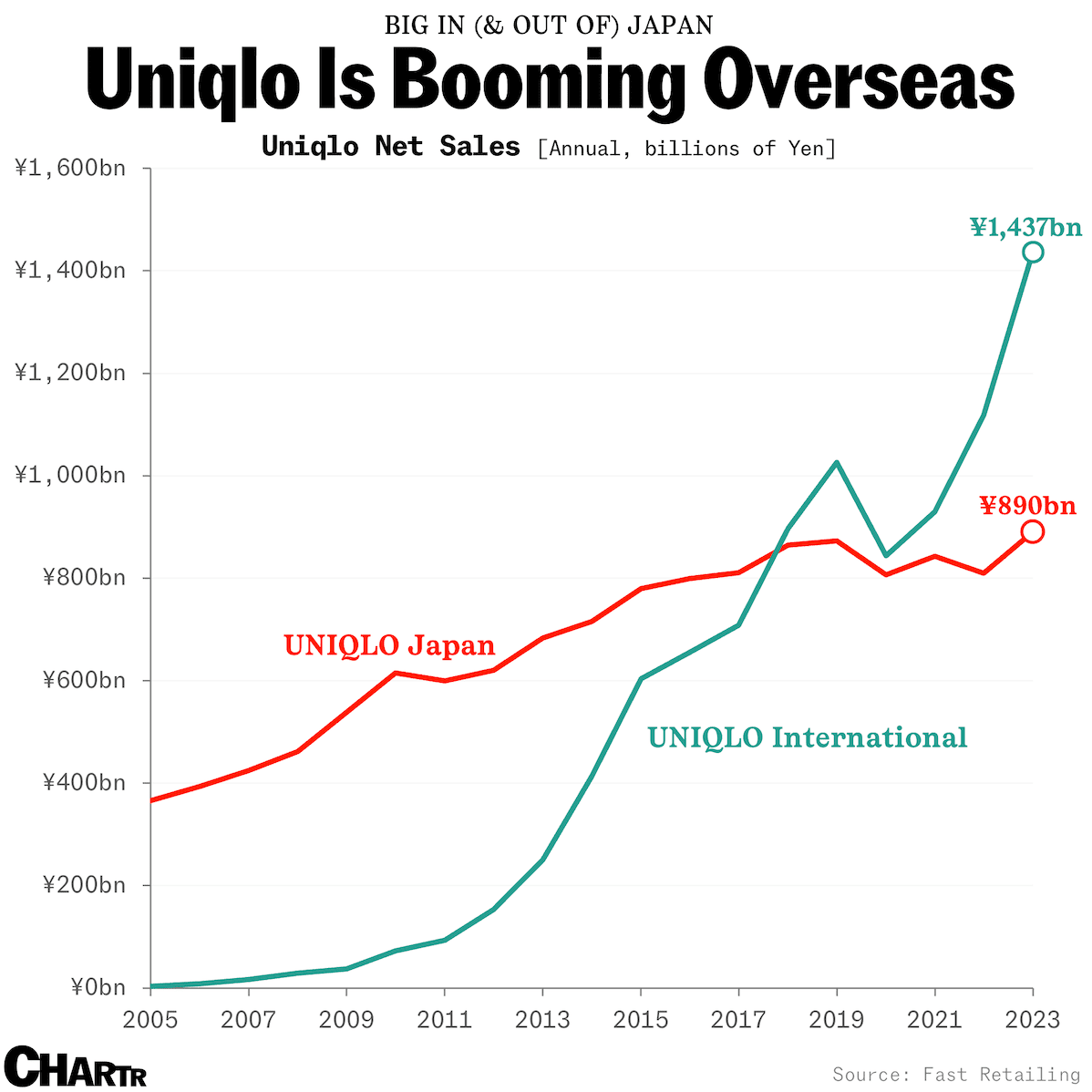
Today, the brand is one of — if not the — leading fashion retailers in Japan, with ~800 stores across its native country, and its international expansion has been equally rapid… even with a few hiccups in the US. Since 2005, when its first US store opened, Uniqlo International revenue has skyrocketed: sales abroad outstripped sales in Japan for the first time in 2018, growing to ¥1,437bn (~$9.5bn) by 2023, largely thanks to China and other Asian nations.

More Business

See all Business
The entrance of Allbirds seen from Hayes St. in San Francisco, Calif.

Allbirds, the once buzzy multibillion-dollar sneaker startup, is selling up for $39 million

That’s less than 1% of its peak market cap about four years ago.

Tom Jones3/31/26
business

JetBlue is raising its bag fees as fuel costs squeeze airlines

JetBlue will reportedly hike its bag fees, as the cost of jet fuel continues to climb amid the war in Iran. It’s the latest example of carriers finding ways to push rising costs onto travelers.

Last week, United Airlines CEO Scott Kirby said that if fuel prices remain elevated, fares would need to rise another 20% for his airline to break even this year.

As CNBC reported, when one airline raises fees, others tend to follow.

Earlier this month, JetBlue hiked its first-quarter outlook for operating revenue per seat mile to between 5% and 7%, saying that strong Q1 demand helped “partially offset additional expenses realized from operational disruptions and rising fuel costs.” Now, the carrier appears to be making moves to further boost revenue to offset those costs.

Earlier on Monday, JetBlue rival Alaska Air lowered its Q1 profit forecast. The refining margins for the carrier’s cheapest fuel option — sourced from Singapore and representing about 20% of Alaska’s overall supply — have spiked 400% since February.

JetBlue did not immediately respond to a request for comment.

As CNBC reported, when one airline raises fees, others tend to follow.

Earlier this month, JetBlue hiked its first-quarter outlook for operating revenue per seat mile to between 5% and 7%, saying that strong Q1 demand helped “partially offset additional expenses realized from operational disruptions and rising fuel costs.” Now, the carrier appears to be making moves to further boost revenue to offset those costs.

Earlier on Monday, JetBlue rival Alaska Air lowered its Q1 profit forecast. The refining margins for the carrier’s cheapest fuel option — sourced from Singapore and representing about 20% of Alaska’s overall supply — have spiked 400% since February.

JetBlue did not immediately respond to a request for comment.

Latest Stories

Sherwood Media, LLC produces fresh and unique perspectives on topical financial news and is a fully owned subsidiary of Robinhood Markets, Inc., and any views expressed here do not necessarily reflect the views of any other Robinhood affiliate, including Robinhood Markets, Inc., Robinhood Financial LLC, Robinhood Securities, LLC, Robinhood Crypto, LLC, Robinhood Derivatives, LLC, or Robinhood Money, LLC. Futures and event contracts are offered through Robinhood Derivatives, LLC.
