
Business
Lightbulb
Getty Images
PATENTLY UNFAIR

The US patent system could be getting a price hike — tech giants could be hit the hardest

President Trump floated a major change to the way America protects private intellectual property rights, which could hit IBM, Apple, Google, and others hard.

Hyunsoo Rim

Last week, the Trump administration teased an idea that could rewrite how America charges for patents — a move that would significantly boost federal revenue.

According to The Wall Street Journal, Commerce Department officials are weighing a new model that would charge patent holders 1% to 5% of a patent’s overall value each year. The goal? Raise billions of dollars to help reduce the nearly $2 trillion annual national deficit.

If enacted, it would mark a sharp break from the 235-year-old system, where inventors pay a series of fixed fees — typically around a few thousand dollars — regardless of the patent’s “worth.” Under the proposed model, annual fees could balloon for companies with large portfolios of high-value patents, like those in sectors such as semiconductors, AI, or biotech.

Indeed, the largest patent holders are already getting thousands of patents granted every single year.

Over the past decade, America’s patent landscape has been dominated by tech and chip giants like Samsung, TSMC, and Apple. IBM — once the perennial leader, with more than 71,000 patents granted since 2015 — has recently slipped in the ranks after deliberately scaling back its filings to focus on “high-quality” innovation.

A move toward value-based fees could dampen patent filings from these behemoths, as costs would scale with their market potential, while hitting smaller firms even harder, especially those unable to absorb the extra burden.
USPTO
Sherwood News

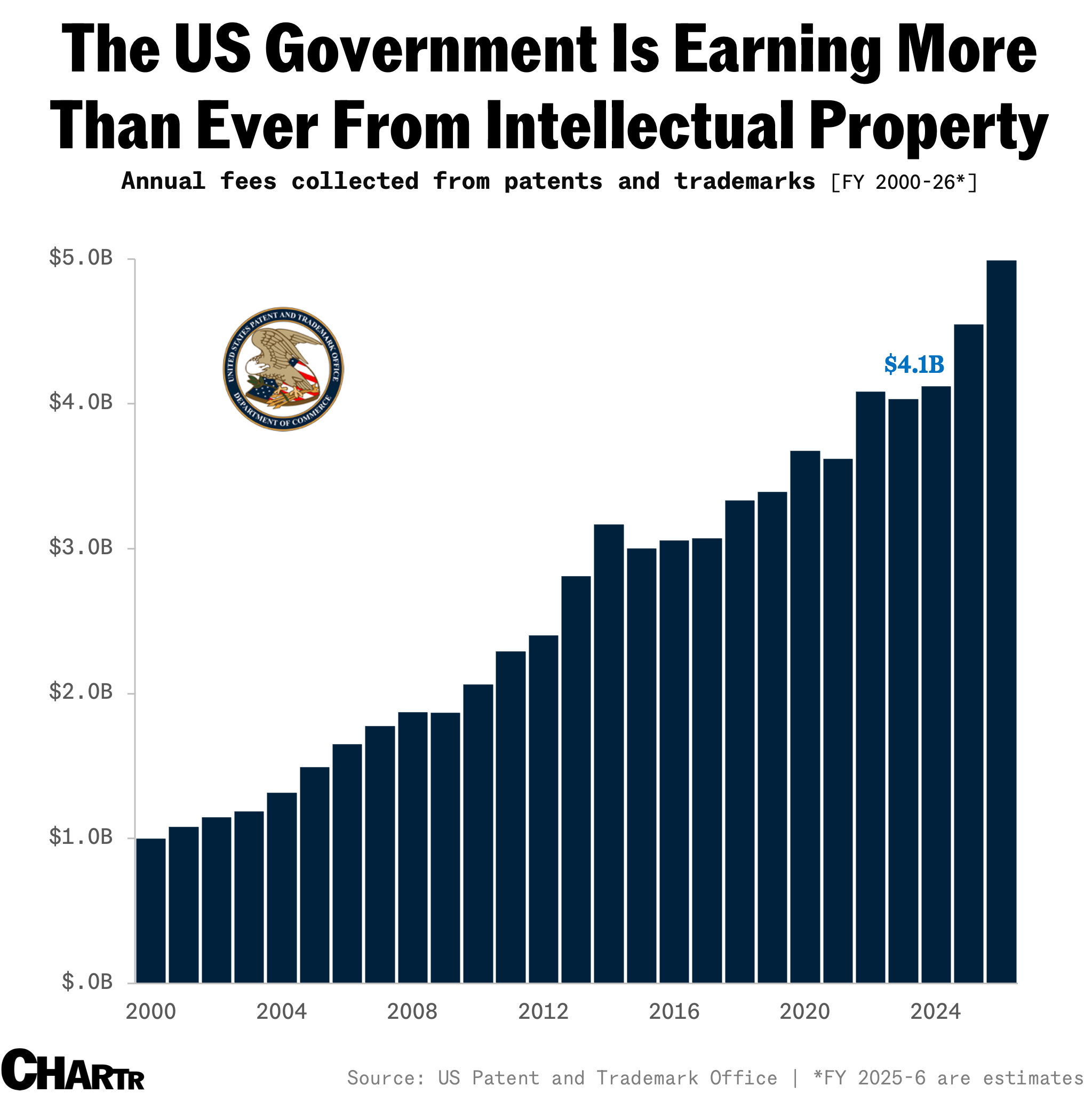
Meanwhile, the proposal comes as intellectual property revenues are already booming. Last year, the US Patent and Trademark Office collected $4.1 billion in patent and trademark fees — more than 4x what it brought in back in 2000. Unlike most federal agencies, the USPTO is self-funded, running on those fees rather than taxpayer dollars. The potential new model, however, could turn it into a broader revenue source for the government.

And the main challenge would be the math: namely, how do you exactly calculate what a patent is actually worth? Considering that no other country currently ties patent fees to market value, we can’t just borrow someone else’s formula.

More Business

See all Business
Family Watching Baseball On Tv

Netflix and Disney+ probably only added ad-tier subscribers this year, says Morgan Stanley

As streaming prices climb, ad-free subscribers are becoming a rarity.

Aldi Grand Opening

Discount stores are having a moment in America, drawing high- and low-income consumers alike

Everyone loves a deal in 2025 — and Aldi, Walmart, and Dollar Tree are all cashing in.

Millie Giles12/17/25
business

Report: OpenAI won’t pay a dime in cash for its 3-year licensing deal for Disney IP

More financial details behind the landmark deal that will grant OpenAI three years of access to Disney intellectual property are coming out, and they’re pretty surprising.

The deal will reportedly see OpenAI pay zero dollars in licensing fees, instead compensating Disney in stock warrants. It was previously reported that Disney would invest $1 billion into OpenAI as part of the agreement.

It’s very abnormal for Disney to grant anyone access to its massive IP library without a cash payment, and the entertainment juggernaut has been known to strike down even crocheted Etsy Yodas for infringing on its turf. In its fiscal year 2025, Disney booked more than $10 billion in revenue from licensing fees across merchandising, television, and theatrical distribution.

It’s very abnormal for Disney to grant anyone access to its massive IP library without a cash payment, and the entertainment juggernaut has been known to strike down even crocheted Etsy Yodas for infringing on its turf. In its fiscal year 2025, Disney booked more than $10 billion in revenue from licensing fees across merchandising, television, and theatrical distribution.

business

Ford says it will take $19.5 billion in charges in a massive EV write-down

The EV business has marked a long stretch of losing for Ford, and today the automaker announced it will take $19.5 billion in charges tied, for the most part, to its EV division.

Ford said it’s launching a battery energy storage business, leveraging battery plants in Kentucky and Michigan to “provide solutions for energy infrastructure and growing data center demand.”

According to Ford, the changes will drive Ford’s electrified division to profitability by 2029. The company will stop making its electric F-150, the Lightning, and instead shift to an “extended-range electric vehicle” that includes a gas-powered generator.

The Detroit automaker also raised its adjusted earnings before interest and taxes outlook to “about $7 billion” from a range of $6 billion to $6.5 billion.

Ford’s write-down is one of the largest taken by a company as legacy automakers scale back on EVs, giving EV-only automakers a market share boost.

Latest Stories

Sherwood Media, LLC produces fresh and unique perspectives on topical financial news and is a fully owned subsidiary of Robinhood Markets, Inc., and any views expressed here do not necessarily reflect the views of any other Robinhood affiliate, including Robinhood Markets, Inc., Robinhood Financial LLC, Robinhood Securities, LLC, Robinhood Crypto, LLC, or Robinhood Money, LLC.