Business
Lightbulb
Getty Images
PATENTLY UNFAIR

The US patent system could be getting a price hike — tech giants could be hit the hardest

President Trump floated a major change to the way America protects private intellectual property rights, which could hit IBM, Apple, Google, and others hard.

Hyunsoo Rim

Last week, the Trump administration teased an idea that could rewrite how America charges for patents — a move that would significantly boost federal revenue.

According to The Wall Street Journal, Commerce Department officials are weighing a new model that would charge patent holders 1% to 5% of a patent’s overall value each year. The goal? Raise billions of dollars to help reduce the nearly $2 trillion annual national deficit.

If enacted, it would mark a sharp break from the 235-year-old system, where inventors pay a series of fixed fees — typically around a few thousand dollars — regardless of the patent’s “worth.” Under the proposed model, annual fees could balloon for companies with large portfolios of high-value patents, like those in sectors such as semiconductors, AI, or biotech.

Indeed, the largest patent holders are already getting thousands of patents granted every single year.

Over the past decade, America’s patent landscape has been dominated by tech and chip giants like Samsung, TSMC, and Apple. IBM — once the perennial leader, with more than 71,000 patents granted since 2015 — has recently slipped in the ranks after deliberately scaling back its filings to focus on “high-quality” innovation.

A move toward value-based fees could dampen patent filings from these behemoths, as costs would scale with their market potential, while hitting smaller firms even harder, especially those unable to absorb the extra burden.
USPTO
Sherwood News

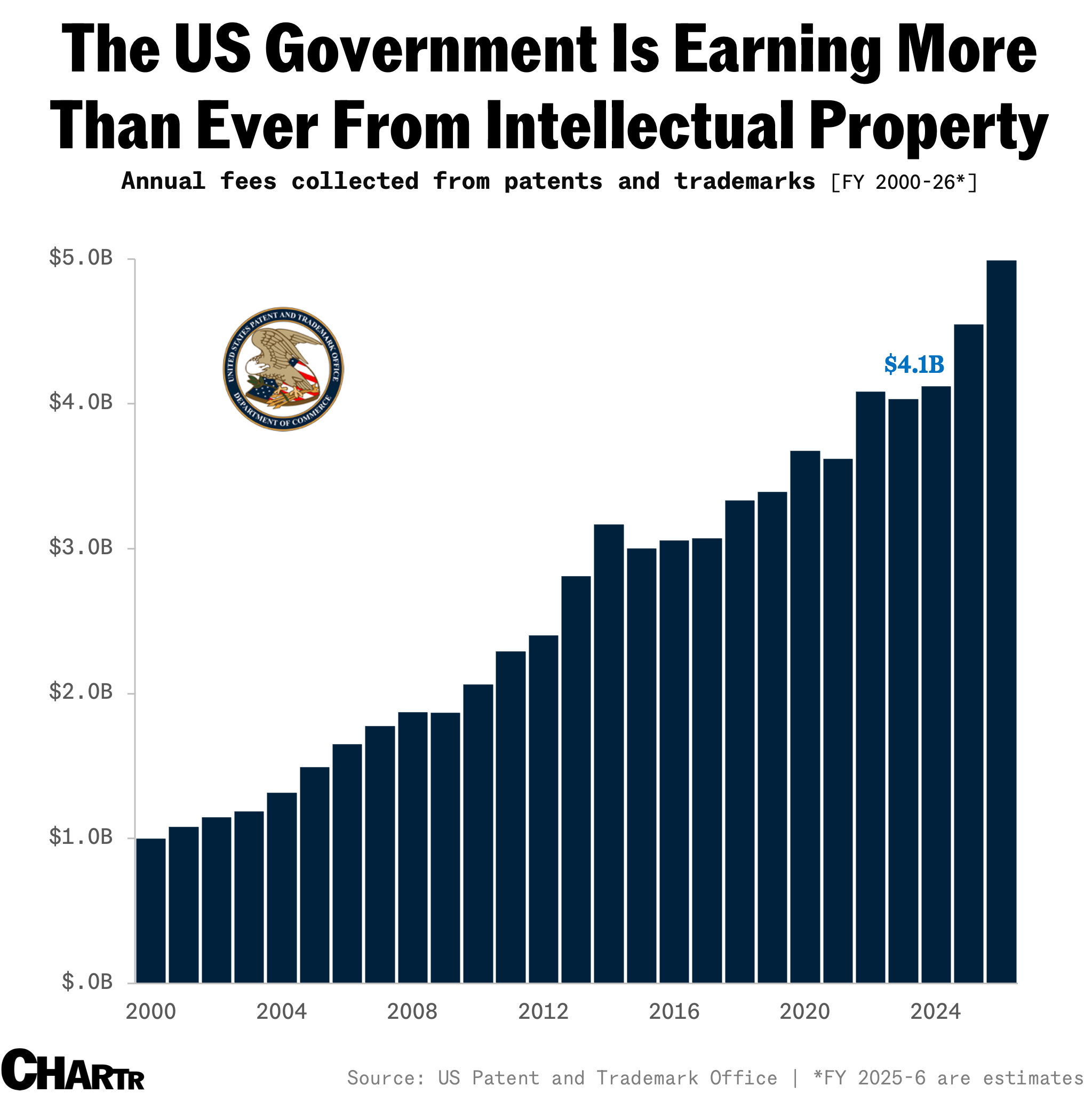
Meanwhile, the proposal comes as intellectual property revenues are already booming. Last year, the US Patent and Trademark Office collected $4.1 billion in patent and trademark fees — more than 4x what it brought in back in 2000. Unlike most federal agencies, the USPTO is self-funded, running on those fees rather than taxpayer dollars. The potential new model, however, could turn it into a broader revenue source for the government.

And the main challenge would be the math: namely, how do you exactly calculate what a patent is actually worth? Considering that no other country currently ties patent fees to market value, we can’t just borrow someone else’s formula.

More Business

See all Business
business

Texas sues Netflix, accusing streamer of spying on children and collecting user data without consent

The state of Texas filed a lawsuit Monday against streaming giant Netflix, alleging that the company has built a “behavioral-surveillance program of staggering scale.”

The suit alleges that Netflix is “deceptively designed” to be addictive, using features like autoplay to get viewers hooked, “mining those users for data, and then converting that data into lucrative intelligence for global advertising juggernauts.”

“When you watch Netflix, Netflix watches you,” the lawsuit reads.

“This lawsuit lacks merit and is based on inaccurate and distorted information,” Netflix said in a statement to Sherwood News. “Netflix takes our members’ privacy seriously and complies with privacy and data‑protection laws everywhere we operate.”

Texas is seeking civil penalties of “up to $10,000 per violation” of the Texas Deceptive Trade Practices-Consumer Protection Act, along with an additional penalty of up to $250,000 per violation involving a consumer aged 65 or older.

“Netflix is not the ad-free and kid-friendly platform it claims to be. Instead, it has misled consumers while exploiting their private data to make billions,” said Texas Attor­ney Gen­er­al Ken Pax­ton in the press release announcing the lawsuit.

Netflix did not immediately respond to a request for comment.

“This lawsuit lacks merit and is based on inaccurate and distorted information,” Netflix said in a statement to Sherwood News. “Netflix takes our members’ privacy seriously and complies with privacy and data‑protection laws everywhere we operate.”

Texas is seeking civil penalties of “up to $10,000 per violation” of the Texas Deceptive Trade Practices-Consumer Protection Act, along with an additional penalty of up to $250,000 per violation involving a consumer aged 65 or older.

“Netflix is not the ad-free and kid-friendly platform it claims to be. Instead, it has misled consumers while exploiting their private data to make billions,” said Texas Attor­ney Gen­er­al Ken Pax­ton in the press release announcing the lawsuit.

Netflix did not immediately respond to a request for comment.

business

Used car prices dip in April but remain at 2023 levels as gas prices surge

Used car prices ticked down in April, the first drop in 2026, according to fresh data from Cox Automotive.

Cox’s Manheim Used Vehicle Value Index, which tracks wholesale prices, dipped 1.6% in April from March, but remains around highs not seen since 2023 as shoppers react to surging gas prices.

“Affordability remains front and center, and that’s driving some increased demand for older vehicles... as well as changing the calculus for consumers shopping for EVs,” said Cox’s chief economist, Jeremy Robb.

As reported in March, used car retailers including CarMax have told Sherwood News that gas prices are driving more shoppers to look toward EVs. Cox’s EV index is up 7.2% from April 2025, compared to a 1.1% hike for its non-EV index.

Latest Stories

Sherwood Media, LLC produces fresh and unique perspectives on topical financial news and is a fully owned subsidiary of Robinhood Markets, Inc., and any views expressed here do not necessarily reflect the views of any other Robinhood affiliate, including Robinhood Markets, Inc., Robinhood Financial LLC, Robinhood Securities, LLC, Robinhood Crypto, LLC, Robinhood Derivatives, LLC, or Robinhood Money, LLC. Futures and event contracts are offered through Robinhood Derivatives, LLC.