Crypto
Walking The Divide: Nicosia, The World's Last Divided Capital
(STR/Getty Images)
dead-cat bounce?

Bitcoin faces $80,000 resistance level

“Out of the woods short-term? No. Bitcoin crossing $78K is a bounce, not a bottom,” according to Zaid Khan.

Bitcoin is struggling to hold the $78,000 level and faces resistance at the $80,000 level amid geopolitical tensions putting pressure on risk assets.

While there was quick optimism after bitcoin hit its highest level since early February, several analysts said the asset still faces headwinds.

“Out of the woods short-term? No. Bitcoin crossing $78K is a bounce, not a bottom. The tape moved, the structure didn’t. Until it reclaims the downtrend line drawn from the $126K cycle high on a weekly close, we treat this as a dead cat bounce, a mechanical rebound at a level the market was always going to defend once, not evidence the correction is over,” Zaid Khan, CEO of Manhattan Crypto Capital, told Sherwood News, adding that the most expensive mistake investors make in crypto is confusing a mechanical bid for a structural one.

Short-term (in the next 4 to 12 weeks), Khan said he’s skeptical of the bounce, and the reasons they are “not chasing” include that $78,000 is a reflex level, not a conviction level.

“Systematic desks, CTAs [commodity trading advisers], and short covers are mechanically programmed to bid in this zone. A bounce here is plumbing, not thesis,” he said.

In addition, Khan said that bitcoin is still trading below the downtrend line from $126,000, weekly momentum is still cooling, and there’s no accumulation signature in the volume.

“Price lifted through air — that’s not the same as buyers showing up,” he said.

In terms of potential risks, Khan cited a sustained macro risk-off regime, which would extend the correction beyond the first bounce. ETF flow reversals and liquidity thinness, as “weekend, and low-volume sessions distort both the bounces and the breakdowns,” could also put pressure on the asset, he said.

Finally, the consensus trap. “When everyone exhales at the same time, that’s usually the setup for the next leg lower, not the bottom,” Khan said.

Khan is watching for a weekly close above the downtrend line from $126,000, with an expanding range, which could open the path to $202,748.
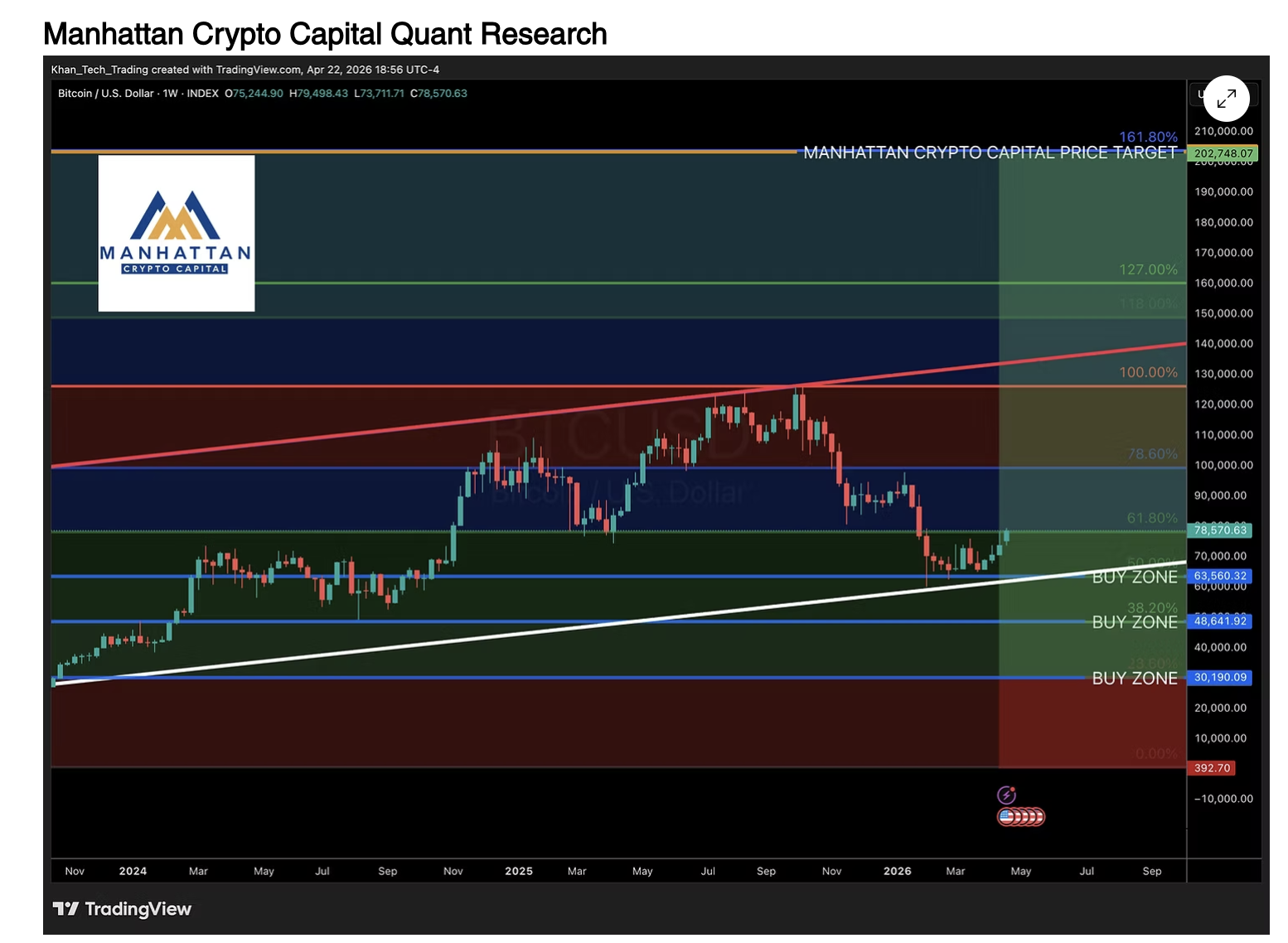
Manhattan Crypto Capital chart
(Zaid Khan/Manhattan Crypto Capital)

“$63,560 — our first accumulation band. Highest-probability test zone. $48,642 — structural support. A weekly close below here and we flip defensive, rotating capital into private credit, gold, or cash,” Khan said.

Khan noted that they remain structurally bullish over the 12- to 24-month term, as a ~38% drawdown from the $126,000 peak is a normal feature of bitcoin bull cycles, not a warning.

“Our composite Quant Regime Score is 63/100, with Risk-On at 58 versus Risk-Off at 42 — constructive, not euphoric. The cycle is paused, not over,” he said.

Other analysts agreed that headwinds remain for bitcoin, including what Glassnode analysts call the “next wall”: the short-term holder cost basis. This stands just over $80,000 and “represents the average acquisition price of investors who purchased within the last 155 days, a cohort historically proven to be the most price-sensitive in the market,” they said.

As price nears their break-even level, “the behavioral incentive to exit positions intensifies, making this zone a natural source of distribution pressure,” they said.
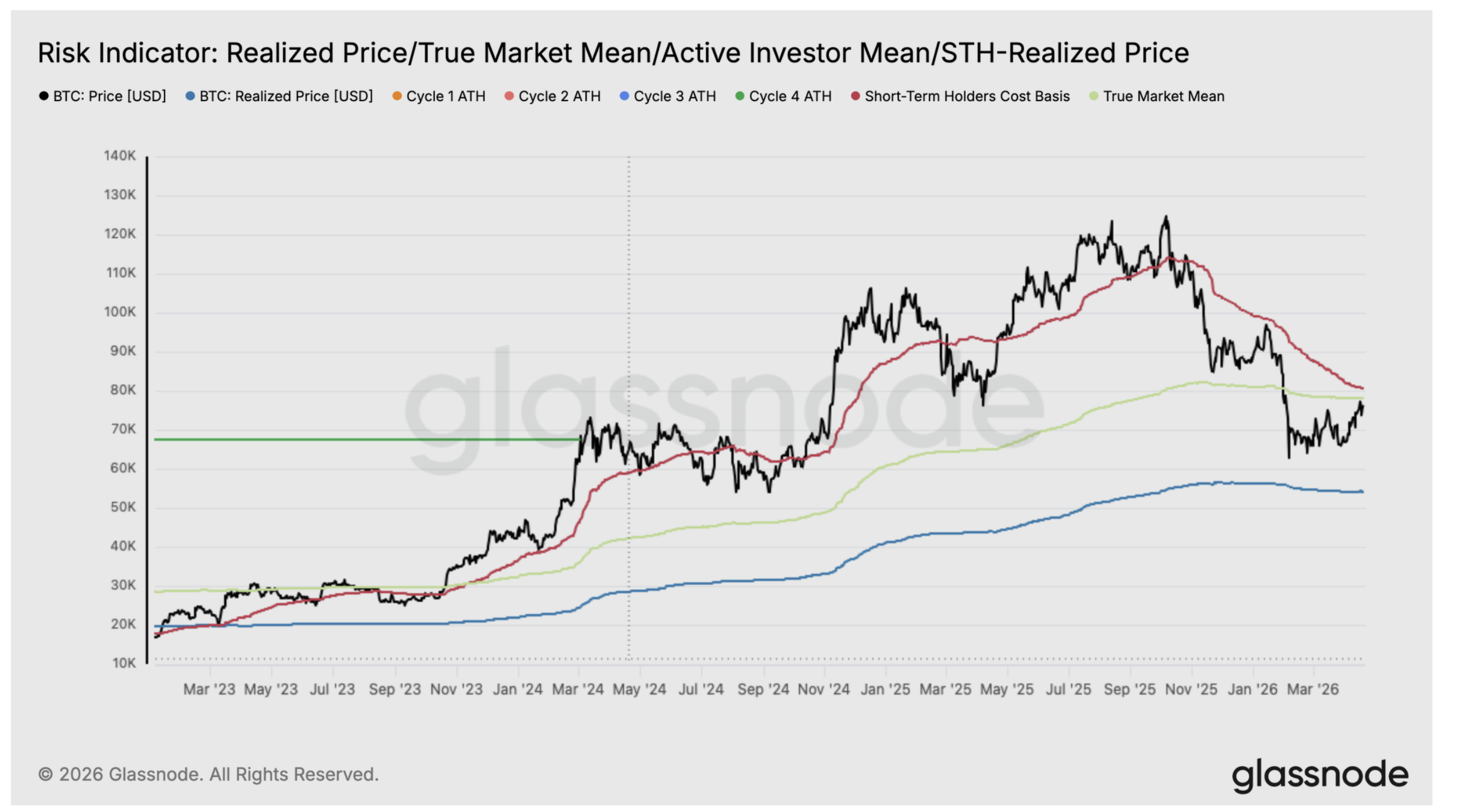
glassnode btc chart april 23
(Glassnode)

“This pattern suggests that the $78k–$80.1k zone represents significant near-term resistance, while $70k is increasingly assuming the role of a developing mid-term support floor as the market works through this overhead supply,” they said.

More Crypto

See all Crypto
crypto

Justin Sun sues Trump-backed World Liberty over frozen tokens

Crypto billionaire Justin Sun, owner of the world’s most expensive banana, was named an adviser to World Liberty Financial the day after investing $30 million in the project. (He’d later boost that with $45 million more.) Sun has long been a supporter of President Trump, and has not once, but twice topped a competition to amass the most $TRUMP coins. But it seems even for Sun, the gold has turned brass.

Sun announced on social media that he’s filed a lawsuit in a California federal court against the crypto project backed by Trump. 

The lawsuit alleges World Liberty engaged in an “illegal scheme to seize property” and “positioned itself as the new boogeyman” by stripping Sun of his governance rights, threatening to burn his WLFI tokens, and freezing his stash, which at times were worth $1 billion, according to the complaint dated on Tuesday. 

“I have tried in good faith to resolve this situation with the World Liberty project team without resorting to litigation,” Sun wrote in a lengthy X post on Tuesday night. “But the project team has refused my requests to unfreeze my tokens and restore my rights as a token holder. They have left me with no choice but to turn to the courts.”

The complaint also alleged that World Liberty appears to be in financial trouble, citing concerns over whether the project can repay an on-chain loan that was collateralized by using, at the time, $5 billion worth of WLFI. The token reached an all-time low less than two weeks ago.

Despite the escalation with World Liberty, Sun said the lawsuit does not change his feelings about Trump or his administration. “I have always been — and remain — an ardent supporter of President Trump and his Administration’s efforts to make America crypto friendly,” he said. 

The lawsuit alleges World Liberty engaged in an “illegal scheme to seize property” and “positioned itself as the new boogeyman” by stripping Sun of his governance rights, threatening to burn his WLFI tokens, and freezing his stash, which at times were worth $1 billion, according to the complaint dated on Tuesday. 

“I have tried in good faith to resolve this situation with the World Liberty project team without resorting to litigation,” Sun wrote in a lengthy X post on Tuesday night. “But the project team has refused my requests to unfreeze my tokens and restore my rights as a token holder. They have left me with no choice but to turn to the courts.”

The complaint also alleged that World Liberty appears to be in financial trouble, citing concerns over whether the project can repay an on-chain loan that was collateralized by using, at the time, $5 billion worth of WLFI. The token reached an all-time low less than two weeks ago.

Despite the escalation with World Liberty, Sun said the lawsuit does not change his feelings about Trump or his administration. “I have always been — and remain — an ardent supporter of President Trump and his Administration’s efforts to make America crypto friendly,” he said. 

$290M

On Saturday, ethereum-based protocol KelpDAO, known for liquid restaking, was exploited for $290 million, the largest hack of 2026 in the decentralized finance ecosystem. 

“Preliminary indicators suggest attribution to a highly-sophisticated state actor, likely DPRK’s Lazarus Group,” LayerZero said in its statement explaining the attack. KelpDAO issues rsETH, while LayerZero provides network infrastructure that allows users to move KelpDAO’s rsETH between blockchains.

The configuration of KelpDAO’s exploited application, powered by LayerZero, relied on a single decentralized verifier network (DVN), responsible for verifying the integrity of cross-chain messages. 

The industry best practice is for protocols to use a multi-DVN setup to prevent a unilateral point of trust or failure. A properly hardened configuration would have required consensus across multiple independent DVNs, rendering this attack ineffective even in the event of any single DVN being compromised,” LayerZero stated, essentially placing the blame on the restaking protocol for using a single-DVN setup.

The exploiters executed an RPC-spoofing attack and performed DDoS attacks to manipulate the single DVN instance into confirming transactions “that never in fact took place.” The LayerZero team said, “Operating a single-point-of-failure configuration meant there was no independent verifier to catch and reject a forged message.

Meanwhile, KelpDAO is preparing to dispute LayerZero’s account and place the blame on the latter, per a CoinDesk report.

Spilling over

The exploit has since impacted the wider crypto landscape.

The attackers successfully drained 116,500 rsETH from KelpDAO’s bridge, allowing them to deposit $249.7 million of the token to DeFi’s largest lending protocols and withdraw $228.2 million worth of different cryptocurrencies, wETH and wstETH, on-chain data from Arkham Intelligence shows.

Aave, the largest lending protocol, has frozen several markets and is now facing a liquidity crunch.

On Aave’s v3, the ETH, USDT, and USDC markets, which have a combined reserve size of $10.7 billion, have each reached a 100% utilization rate, as total borrowed equals total supplied. When borrows are maxed, users cannot withdraw their supplied liquidity.

The pseudonymous head of strategy at DeFi lending platform Spark, @MonetSupply, wrote on X, There has been a ~$300 million increase in borrowing with USDT collateral in just the past day since the rsETH exploit.

On-chain folks are spooked

The attack comes in the same month that Drift, a solana-based trading venue, suffered from an over $270 million hack. Saturday’s attack also follows worries stemming from Anthropic’s unreleased AI model Mythos, which “is capable of identifying and then exploiting zero-day vulnerabilities in every major operating system.” 

Even though the major cryptocurrencies have not seen their prices move substantially in the last 24 hours, crypto participants have been spooked, evident by the capital exiting the decentralized finance ecosystem.

DeFi saw its total value locked decrease by $13 billion over the weekend to $85.64 billion at the time of writing, its lowest point since April last year, data from DefiLlama shows. 

“OK — Kelpdao hacker, how much you want? Let’s just talk. With KelpDAO’s help, of course. It’s simply not worth it to sacrifice both Aave and KelpDAO and let them go down over this hack. You can’t spend $300 million anyway,” said Justin Sun, founder of the Tron blockchain, who has been beefing with the President Trump-backed World Liberty team. 

Latest Stories

Sherwood Media, LLC produces fresh and unique perspectives on topical financial news and is a fully owned subsidiary of Robinhood Markets, Inc., and any views expressed here do not necessarily reflect the views of any other Robinhood affiliate, including Robinhood Markets, Inc., Robinhood Financial LLC, Robinhood Securities, LLC, Robinhood Crypto, LLC, Robinhood Derivatives, LLC, or Robinhood Money, LLC. Futures and event contracts are offered through Robinhood Derivatives, LLC.