Bitcoin falls below $66,000 as Trump’s Iran extension fails to boost market sentiment
Bitcoin is on track to book its sixth consecutive month in the red.
Bitcoin has held up relatively well compared to other risk assets since the start of the Middle East conflict, but it’s suffering today alongside the broader market as pessimism grows that a resolution will be reached any time soon.
Bitcoin sank below $66,000 Friday morning, a level not seen since March 8, as it’s dropped more than 5% in the past 24 hours.
With a few days to go, bitcoin is down over 1% in March and looks likely to register its sixth consecutive month in the red, data from CoinGlass shows.
The landscape is bleak for bitcoin ETFs as well, as they registered $171.22 million in outflows on Thursday, the largest daily outflow since March 6 and on track for their first weekly outflow since February 20, according to SoSoValue.
Meanwhile, crypto liquidations reached $515 million in the past 24 hours, with bitcoin seeing $221 million in liquidations, the bulk of them in long positions.
Zaid Khan, CEO of Manhattan Crypto Capital, told Sherwod News that he is watching for the high-probability breakdown window around April 26 (plus or minus two days) once this headline premium evaporates.
“A decisive close below $68,000 would accelerate straight into our primary buy zone at $56,702–$53,577, with secondary demand at $48,522–$41,805,” Khan said. That said, longer-term, Khan noted that the firm’s macro model remains firmly bullish, with a $202,748 price target by mid-2027.
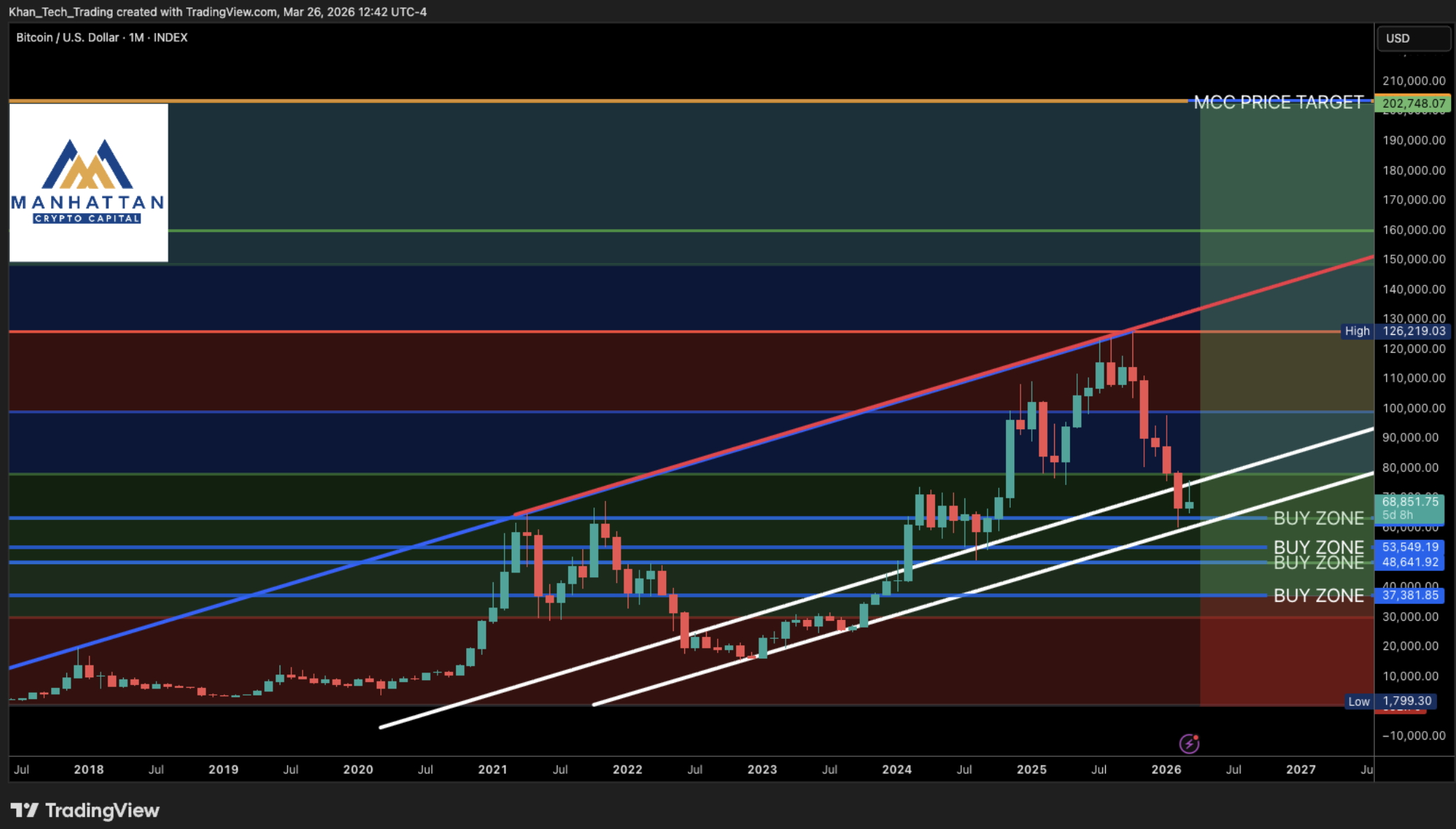
“Near-term noise is simply the market handing us the next high-conviction accumulation window,” he said.
Dean Chen, an analyst at Bitunix, told Sherwood that in the near term, if war dynamics remain “delayed but unresolved” and rate expectations continue to tighten, bitcoin is more likely to sustain high-frequency range-bound volatility, sweeping liquidity between $65,000 and $72,000 to facilitate position redistribution.
“A true directional breakout will require alignment across key macro variables, rather than being triggered by any single event,” Chen said.
Finally, today’s $14 billion in options expiry, representing 40% of open interest on Deribit, is also adding volatility, though it’s not overriding the macro and geopolitical narrative, several analysts told Sherwood.
Pratik Kala, portfolio manager and head of research at Apollo Crypto, told Sherwood that prices typically stay pinned at certain levels based on flow, but those levels disappeared after this expiry and we are seeing more of a directional move down.
“Reasons for it are hard to pinpoint; all we see is a market that is running more freely after this expiry,” Kala said.
When asked how low bitcoin might drop to, Kala said he had “no idea.”
“War-dependent,” he said.