Crypto
Senate Banking Committee Hears Testimony From Various Nominees For Economic And Housing Positions
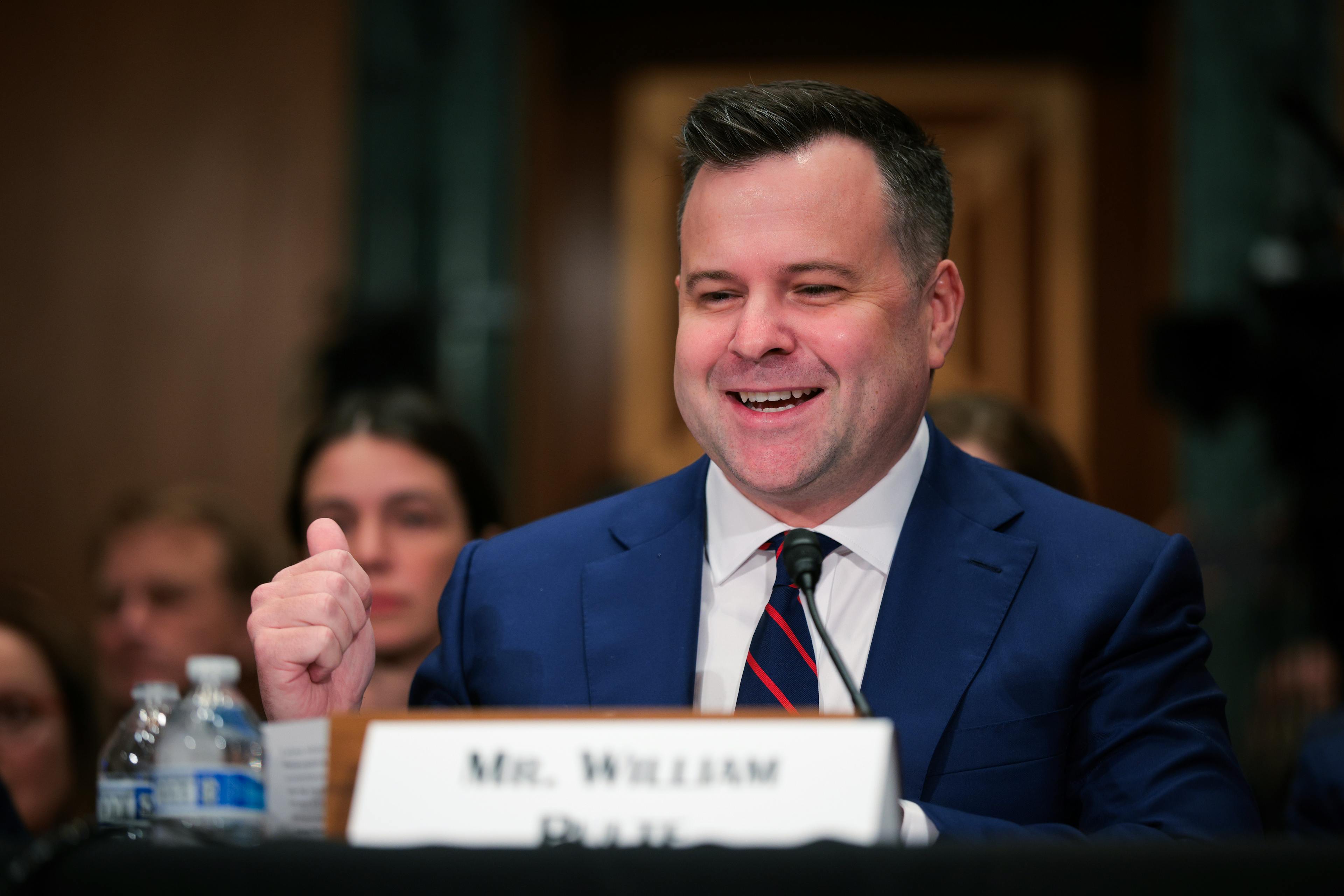
William Pulte testifies at the Senate Banking Committee (Kayla Bartkowski/Getty Images)

What it means that FHFA has ordered Fannie and Freddie to “count cryptocurrency” for home loans

The director of the Federal Housing Finance Agency ordered the mortgage giants to prepare a proposal on the matter.

Sage D. Young

William Pulte, the director of the Federal Housing Finance Agency, instructed mortgage heavyweights Fannie Mae and Freddie Mac to prepare a proposal for their businesses to include cryptocurrency as an asset for a home mortgage “without conversion of said cryptocurrency to U.S. dollars,” the order stated

Fannie Mae and Freddie Mac, government-sponsored mortgage companies that provide liquidity to the mortgage market, guarantee the majority of the 51 million mortgages in the US.

Pulte’s order is a stark contrast from Fannie Mae’s 2025 Selling Guide, which states “virtual currency may not be used for the deposit on the sales contract (earnest money) for the purchase of the subject property.” 

Move could change home ownership

“This is a really revolutionary moment that’s going to change home ownership forever,” according to Jason Brett, a former Federal Deposit Insurance Corporation regulator who also worked the treasury on the Home Affordable Modification Program. 

Members of Gen Z, who have a higher inclination to hold cryptocurrencies compared to previous generations, have been dismayed about home affordability, but the order could allow them to leverage their crypto to get a single-family mortgage loan, Brett told Sherwood News. 

Yaël Ossowski, deputy director at the Consumer Choice Center and a fellow at the Bitcoin Policy Institute, told Sherwood that the order is a massive signal to entrepreneurs, lenders, and potential homebuyers that cryptocurrency assets can act as “an explicit entry point in the mortgage finance industry.”

Ossowski continued, “This reform simply recognizes the thriving and revolutionary potential of bitcoin and crypto assets, unlocking the potential of home ownership for millions of American savers, investors, and technology enthusiasts.”

He expects that the order will set guidelines for the rest of the industry, with Brett arguing that private loan providers will follow Freddie and Fannie’s lead and start allowing cryptocurrency assets in their loan assessments. 

The time frame is “probably” about a year away, as it’s a first step in a long process, Brett said, which includes the loan giants learning more about how to measure the risks in the asset class. 

Austin Campbell, adjunct professor at NYU Stern School of Business and founder of Zero Knowledge Consulting, told Sherwood, “If done well, this is likely a good thing… The question will be implementation. Like all volatile assets, there should be haircuts.” 

He continued, “If I’m trying to assess creditworthiness based on ability and willingness to pay, an asset with 60%-plus drawdowns needs a haircut — as in, if you value cash at 100% of the amount, you might value BTC at 50% of the amount.” 

Bitcoin, which is the largest crypto by market cap at over $2 trillion, has experienced many substantial drops in price. For example, in 2021, the cryptocurrency was trading near the $69,000 mark before falling below $17,000 in 2022. 

Self-custodied crypto not included

The order also directs Fannie Mae and Freddie Mac “to consider only cryptocurrency assets that can be evidenced and stored on a U.S.-regulated centralized exchange.” 

Nick Neuman, the CEO and cofounder of self-custody provider Casa, took issue with this element. He told Sherwood that this “is a mistake because self-custody is fundamentally about property rights. And property rights are a core American value.” 

“It’s easy to think that only assets held on exchange can be verified as actually owned by the individual. But thanks to cryptography, it’s trivial to verify that assets held in self-custody are owned by a given individual,” Neuman said. “I hope we can help the FHFA and Director Pulte understand that people holding their own keys is the future of asset security, and the US can continue to be forward-thinking by recognizing that right in its regulatory framework.” 

More Crypto

See all Crypto
crypto

Ethereum exits: Investors depart its ETFs and the Ethereum Foundation shrinks (again)

On Monday, two researchers announced they were leaving the nonprofit organization tasked with supporting the second-largest blockchain network, adding to a growing exodus from the Ethereum Foundation.

Carl Beek, who helped architect the early design of ethereum’s beacon chain, will end his seven-year tenure with the foundation at the end of the month, while research scientist Julian Ma, who focused on product and growth work, has also decided to leave after four years.

Beek and Ma deepen a recent bout of turnover. Last week, the foundation said in a blog post that lead developers Barnabé Monnot and Tim Beiko are moving on from the organization. In April, Josh Stark, who was on the Ethereum Foundation leadership team for five years, left, as did Trent Van Epps, who organized Protocol Guild, which provides funding to core developers. The string of departures has raised concerns among those in the ecosystem.

“There have been a lot of disagreements about where ETH should move, whether from an issuance or architectural standpoint,” Laurens Fraussen, a research analyst at data provider Kaiko, told Sherwood News. “I’d assume the people leaving are either looking for greener pastures or don’t agree with the way the EF is being run.”

The foundation exodus comes as investors exit from ethereum ETFs. The investment vehicles saw more than $86 million in outflows on Monday, making six straight days of outflows, the longest streak since March, according to SoSoValue.

Meanwhile, an address identified as Galaxy Digital has a $2.3 million short position on ethereum using 20x leverage on Hyperliquid, data from blockchain analytics firm Nansen shows. The price of ethereum stands just under $2,110 as of 12:10 p.m. ET. With an entry point of $2,203, the firm has an unrealized gain of $102,000.

crypto

Ethereum falls faster than bitcoin as crypto tape turns red

The second-largest cryptocurrency is nearing the $2,100 mark, declining more than 9% in the last seven days, a steeper decrease than its older sibling bitcoin, which is also suffering.

Ethereum ETFs have had five consecutive days of outflows combining for $255 million, data from SoSoValue shows.

Meanwhile, Goldman Sachs and Harvard University both filed 13Fs showing each pulled back their exposure to ethereum.

Goldman now holds nearly $178 million in BlackRocks iShares Ethereum Trust ETF, down from $679 million, according to its latest 13F filing. It also exited its $394 million position in the Fidelity Ethereum Fund as well as a smaller position in ETHZilla, while adding $67 million of the iShares Staked Ethereum Trust ETF.

Harvard completely trimmed its ethereum exposure. The endowment did not report any ethereum ETF holdings in its latest 13F filing, submitted Friday, but showed an $86.8 million position in BlackRocks iShares Ethereum Trust ETF in its previous 13F filing in February.

But ethereum bulls remain: treasury behemoth BitMine Immersion Technologies continued its accumlation of ethereum, albeit at a slower pace. Over the past week, we acquired 71,672 ETH, Chairman Tom Lee said in a Monday press release. We view the recent pullback of ETH to below $2,200 as an attractive opportunity. The firms unrealized loss now exceeds more than $7.3 billion.

Traders aren’t so bullish: prediction market-implied odds of ethereum breaking $2,500 in May stand at just 7%, a sharp drop-off from a week ago, when the probability was at 57%.

(Event contracts are offered through Robinhood Derivatives, LLC — probabilities referenced or sourced from KalshiEx LLC or ForecastEx LLC.)

Latest Stories

Sherwood Media, LLC and Chartr Limited produce fresh and unique perspectives on topical financial news and are fully owned subsidiaries of Robinhood Markets, Inc., and any views expressed here do not necessarily reflect the views of any other Robinhood affiliate, including Robinhood Markets, Inc., Robinhood Financial LLC, Robinhood Securities, LLC, Robinhood Crypto, LLC, Robinhood Money, LLC, Robinhood U.K. Ltd, Robinhood Derivatives, LLC, Robinhood Gold, LLC, Robinhood Asset Management, LLC, Robinhood Credit, Inc., Robinhood Ventures DE, LLC and, where applicable, its managed investment vehicles.