Crypto
crypto

Circle plunges on report of proposal prohibiting platforms from offering yield payments

Circle, the firm behind the second-largest stablecoin, USDC, sank over 18.5% after journalist Eleanor Terrett posted on X that lawmakers are considering a proposal that would prohibit platforms such as exchanges and brokers from offering yield payments for holding stablecoins. Shares of US-based crypto exchange Coinbase, which has benefited from its ties to Circle and holds a minority interest in the stablecoin issuer, also fell on the report.

Stablecoin competitor Tether also announced signing a “Big Four” accounting firm to complete a full independent financial statement audit today, aimed at providing assurance that USDT is fully backed and highly liquid, the company’s press release said. The firm has never before allowed an independent audit, which has long plagued the company as investors questioned whether USDT is actually backed by its reserves.

The amount of Circle’s USDC in circulation sits at $81 billion, less than half the figure of the industry leader, Tether, whose USDT stablecoin sits at $184.2 billion, data from blockchain analytics firm Artemis shows

Stablecoin competitor Tether also announced signing a “Big Four” accounting firm to complete a full independent financial statement audit today, aimed at providing assurance that USDT is fully backed and highly liquid, the company’s press release said. The firm has never before allowed an independent audit, which has long plagued the company as investors questioned whether USDT is actually backed by its reserves.

The amount of Circle’s USDC in circulation sits at $81 billion, less than half the figure of the industry leader, Tether, whose USDT stablecoin sits at $184.2 billion, data from blockchain analytics firm Artemis shows

More Crypto

See all Crypto
crypto

NYSE teams up with Securitize to create 24/7 tokenized securities market

Securitize, known for bringing real-world assets onto blockchain rails, has signed a memorandum of understanding with the New York Stock Exchange to develop 24/7 tokenized securities markets. 

The tokenization company will become NYSE’s first digital transfer agent, enabling it to mint digital tokens native on a blockchain that represent shares for stocks and ETFs, The Wall Street Journal reports

“This is about building tokenization in a way that works within real market structure, with the protections, controls, and operational integrity required for public securities,” Securitize cofounder and CEO Carlos Domingo said in a statement. 

The news comes after Securitize, backed by BlackRock and Ark Invest, announced plans last year to go public through a SPAC deal with Cantor Equity Partners at a $1.25 billion valuation. 

The partnership between Securitize and the NYSE makes the tokenization ecosystem increasingly crowded — crypto exchange Kraken is working with Nasdaq to offer tokenized stocks and other exchange-traded products, while S&P Dow Jones announced last week licensing the S&P 500 for a derivative contract on perpetual blockchain network Hyperliquid

Tokenization refers to the process of representing financial assets, such as stocks and private credit, through digital tokens that live on blockchain networks. The global market for tokenization stands at $26.5 billion, multiples higher from one year ago, when the figure sat at $7.8 billion, per data from analytics platform rwa.xyz.

“This is about building tokenization in a way that works within real market structure, with the protections, controls, and operational integrity required for public securities,” Securitize cofounder and CEO Carlos Domingo said in a statement. 

The news comes after Securitize, backed by BlackRock and Ark Invest, announced plans last year to go public through a SPAC deal with Cantor Equity Partners at a $1.25 billion valuation. 

The partnership between Securitize and the NYSE makes the tokenization ecosystem increasingly crowded — crypto exchange Kraken is working with Nasdaq to offer tokenized stocks and other exchange-traded products, while S&P Dow Jones announced last week licensing the S&P 500 for a derivative contract on perpetual blockchain network Hyperliquid

Tokenization refers to the process of representing financial assets, such as stocks and private credit, through digital tokens that live on blockchain networks. The global market for tokenization stands at $26.5 billion, multiples higher from one year ago, when the figure sat at $7.8 billion, per data from analytics platform rwa.xyz.

crypto

Ethereum rises amid market rally, but traders remain unconvinced price can break $2,500

Ethereum jumped 6.4% to trade at the $2,170 level on Monday morning, resulting in $208 million worth of liquidations in the last 24 hours with over 60% coming from short positions. 

That said, traders are not convinced the token has enough fuel to climb above $2,500. Prediction market-implied odds of ethereum trading above $2,500 in March have increased from 6% to 23% this morning, but the probability was 70% seven days ago. 

(Event contracts are offered through Robinhood Derivatives, LLC — probabilities referenced or sourced from KalshiEx LLC or ForecastEx LLC.)

Rather, the bearish mood remains, with traders pricing in an implied 67% probability the price of ethereum slips as low as $1,750 this year.

The price action comes as ethereum ETFs registered their first weekly outflow in March, as $59.9 million exited the investment funds last week, per SoSoValue

Elsewhere, the largest ethereum treasury firm, BitMine Immersion Technologies, announced acquiring 65,341 tokens last week worth around $141.8 million at current prices, bringing the value of its total ethereum holdings to $10.1 billion. The firm also stated it is the largest staking entity in the world, with over 67% of its ethereum stockpile contributing to the network’s security, according to a company press release.

“As many have noticed, crypto and particularly ETH have outperformed the broader market since the Iran war commenced, with ETH rising 18% and outperforming equities,” BitMine Chairman Tom Lee said in a statement. Lee added, “This is a marked contrast to Gold (a traditional store of value), which has fallen more than 15%. Crypto is demonstrating itself to be a good ‘war time’ store of value.” 

BitMine’s unrealized loss on its ethereum purchases currently stands at nearly $7 billion, per DropsTab data.

crypto

Altcoin trading activity has lost its mojo

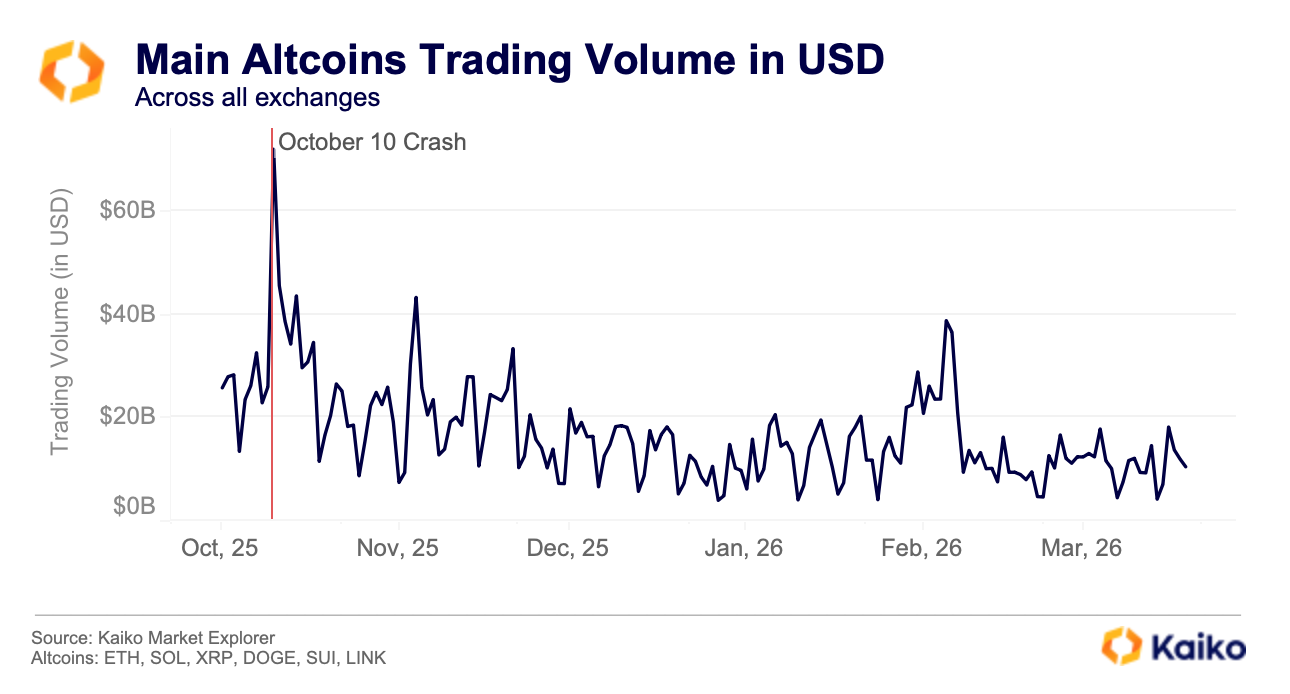
Non-bitcoin cryptocurrencies have seen their trading volume plummet in the past five months. The combined trading volume of ethereum, XRP, solana, dogecoin, SUI, and chainlink has decreased by 60% since crypto’s October 10 liquidation event, according to Thomas Probst, a research analyst at crypto markets data provider Kaiko.

Main Altcoins Trading Volume in USD
The trading volume of ETH, SOL, XRP, DOGE, SUI, and LINK.

For all altcoins, spot trading volume on Binance has declined between 80% and 85% to $7.7 billion, while altcoin volume on other exchanges has dropped to $18.8 billion, down from a range of $63 billion to $91 billion in October, a Friday report from Decrypt found, citing data from CryptoQuant.

“This trend may be explained by a contraction in market liquidity over the same period,” Probst told Sherwood News. “This phenomenon is also reflected in the average 1% market depth, which stood at approximately $2.6 million before the October 10 crash and is now closer to $1.7 million when aggregated across ETH, XRP, SOL, SUI, and LINK.” 

Market depth is used by investors and traders to gauge the scale of liquidity in a market. 1% market depth refers to the amount of liquidity needed to move the market by 1%. 

CoinGlass’s Altcoin Season Index, a measure to assess the performance of non-bitcoin cryptocurrencies, has been sitting above 50 this week, suggesting that the current market is neither in a bitcoin dominant phase nor an altcoin season.

Latest Stories

Sherwood Media, LLC produces fresh and unique perspectives on topical financial news and is a fully owned subsidiary of Robinhood Markets, Inc., and any views expressed here do not necessarily reflect the views of any other Robinhood affiliate, including Robinhood Markets, Inc., Robinhood Financial LLC, Robinhood Securities, LLC, Robinhood Crypto, LLC, Robinhood Derivatives, LLC, or Robinhood Money, LLC. Futures and event contracts are offered through Robinhood Derivatives, LLC.