Crypto
Bitcoin?
Bitcoin sign (Artur Widak/Getty Images)

Gemini: Nearly a third of bitcoin’s circulating supply is held by centralized entities

Major institutional and custodial entities hold over 6,145,000 bitcoin, worth more than $600 billion.

An eye-popping 30% of bitcoin’s circulating supply is concentrated in 216 centralized entities, “reflecting both expanding institutional adoption and deepening custodial centralization,” a new report from Gemini and Glassnode found.
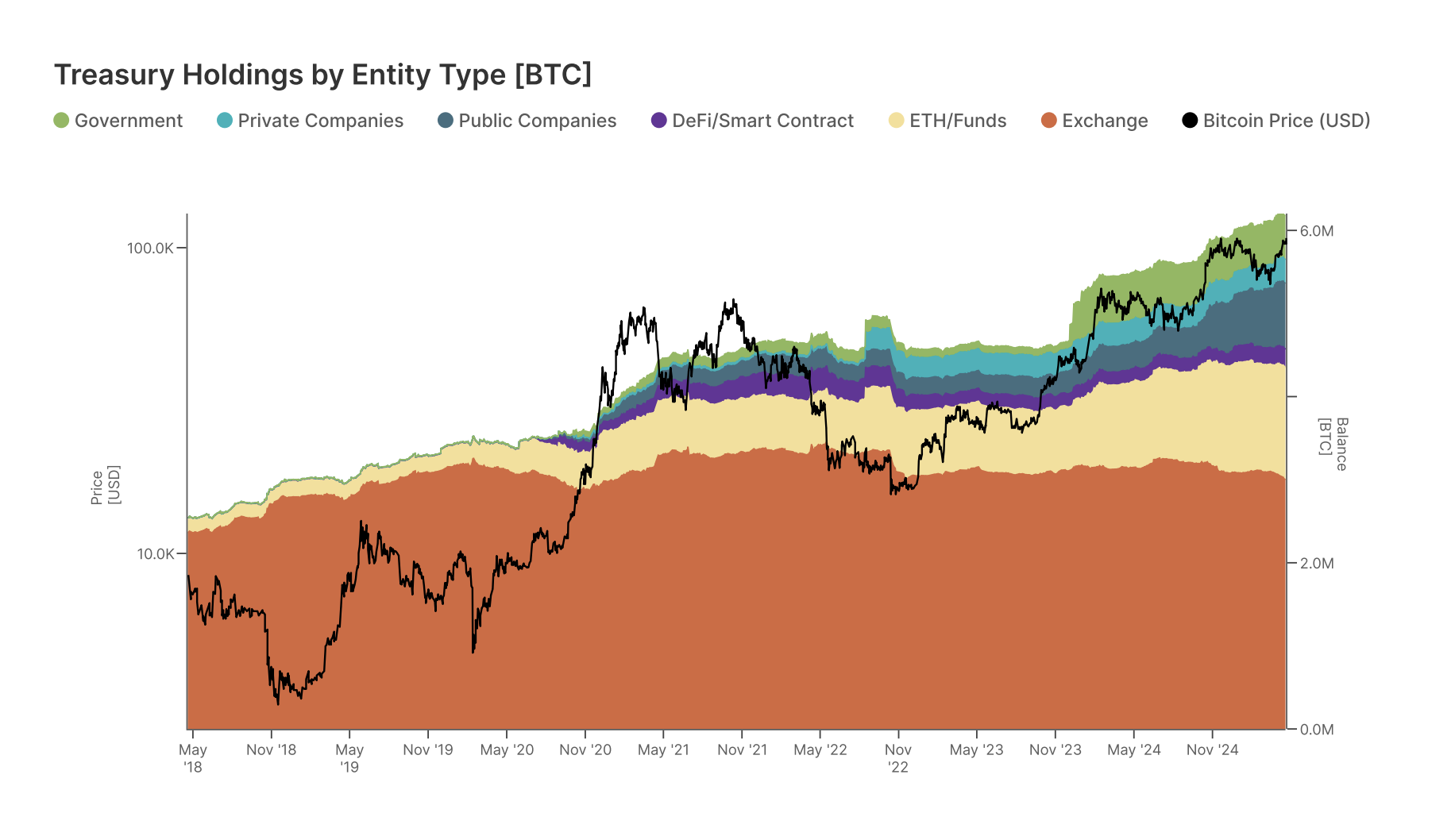
BTC holdings
(Gemini)

The report notes that “the total Bitcoin held across major institutional and custodial entities has surged to 6,145,207 BTC, representing an increase of 924% in supply held by centralized entities over the past decade.”

Patrick Liou, a principal at Gemini, told Sherwood News that within that 30% figure, the two leading categories are centralized exchanges and ETFs/funds.

2025 has been the year of bitcoin treasuries, and Gemini expects growth in bitcoin adoption for public and private companies to be faster this year than ever. The report noted there are 101 public companies with bitcoin treasuries as of publication.

“The investment thesis of bitcoin is resonating with many of these companies, and the positive impacts on share price after bitcoin adoption make the argument even more compelling,” Liou said.

In addition to exchanges, ETFs, and public companies, other centralized members of the category include private companie­s and governments. The US is the largest sovereign holder, with 207,189 bitcoin.

An interesting data point is that “across nearly all institutional categories — excluding private companies — the top three entities control between 65% to 90% of total holdings.” 

This figure underscores the “dominance of early adopters in the Bitcoin treasury space,” according to the report, which adds that “pioneers have shaped the early trajectory of adoption.”

The overall concentration of assets among a few centralized entities is worrisome for some.

“When Satoshi first mined his first bitcoin, it is hard to imagine they would have liked a scenario in which not only bitcoin would be held in an ever-increasing number of centralized entities — but also by the very tradfi entities addressed in the Bitcoin Whitepaper,” Hadley Stern, chief commercial officer of Marinade, told Sherwood. 

Stern said bitcoin concentration is a concern among some market observers, especially as it pertains to companies using debt financing to accumulate bitcoin.

“The fear is that if there is significant enough market volatility, there could be some form of a margin call that then leads to a forced selling of large amounts of bitcoin and serious price implosion,” Stern added.

On the flip side, he concluded, this can all be viewed as part of a process of increasing bitcoin adoption, and the adoption of crypto assets more broadly.

More Crypto

See all Crypto
28

The decentralized finance ecosystem had a brutal April, logging the highest monthly number of exploits ever at 28 hacks, with exploiters siphoning off a total of $635.2 million, data from DefiLlama shows. 

The two largest exploits in April occurred on ethereum-based protocol KelpDAO and solana-native trading venue Drift. The incidents rattled on-chain users, as the total value locked in DeFi across all networks dropped from a monthly high of $99.5 billion to $84.3 billion on Friday. 

“It’s a real problem, and if AI proponents (thinking specifically of Anthropic’s claims about Mythos) are to be believed, it’s only going to get worse,” according to Fredrick Collins, CEO of crypto analytics platform Velo.xyz. Collins argued that these exploits act as a significant limiter of institutional appeal, pointing to TheBlock’s report last week that JPMorgan held a similar view. 

“It’s simple — for many people, having any chance that you lose your entire investment or balance in something supposed to be ‘safe’ is too much to bear,” Collins told Sherwood News. 

However, not everyone thinks the recent hacks will curb interest from institutions. Nicolai Søndergaard, a research analyst at blockchain data firm Nansen, said to Sherwood, “I do not think these hacks will be a limit to institutional capital given the impact of AI and the speed at which threats appear stretch far beyond this industry.” 

Søndergaard continued, “Crypto to me seems to have been hit harder as many projects perhaps wanted to get a product out there quickly and didn’t invest enough in security, even with companies around to audit.” 

DeFi aims to enable internet users to have access to financial services, such as borrowing, lending, and trading, without any centralized intermediaries.

crypto

Riot Platforms rises following Q1 revenue beat

The bitcoin miner turned data center operator released first-quarter earnings that surpassed expectations for revenue. Shares built on strong gains from Thursday’s session in after-hours trading following the results.

Riot Platforms reported:

  • Q1 revenue of $167.2 million, growing 3.6% from the same quarter a year ago and surpassing analysts’ expectations of $131 million.

  • A diluted loss per share of $1.44, much worse than analysts’ consensus estimate of a $0.72 loss, which includes unrealized loss on its bitcoin holdings.

The bulk of companys revenue stems from its bitcoin mining activity, which made up $111.9 million in the quarter, while its data center housing revenue stood at $33.2 million, per its press release.

The first quarter of 2026 marks an inflection point for Riot. CFO Jason Chung said on Thursday in the firms Q1 earnings conference call, With the delivery of our first 5 megawatts to AMD this quarter, Riot is now an active data center operator, and for the first time, our top line now includes contracted lease revenue from an investment-grade tenant.

The earnings report comes the same week the company announced amending its $200 million credit agreement with Coinbase by replacing a floating interest rate with a fixed rate, according to an SEC filing dated on Monday.

Latest Stories

Sherwood Media, LLC produces fresh and unique perspectives on topical financial news and is a fully owned subsidiary of Robinhood Markets, Inc., and any views expressed here do not necessarily reflect the views of any other Robinhood affiliate, including Robinhood Markets, Inc., Robinhood Financial LLC, Robinhood Securities, LLC, Robinhood Crypto, LLC, Robinhood Derivatives, LLC, or Robinhood Money, LLC. Futures and event contracts are offered through Robinhood Derivatives, LLC.