Crypto
Heart
(Getty Images)

Solana getting “new heart” in biggest upgrade ever

The Alpenglow upgrade revamps solana’s consensus engine to decrease transaction finality from 12.8 seconds to 150 milliseconds, bringing the blockchain network closer to its goal of being an on-chain Nasdaq.

Solana is gearing up for its biggest upgrade ever. 

Last week, community members voted overwhelmingly in favor of Alpenglow (aka SIMD-0326) to implement a new consensus mechanism for the solana blockchain. Of those who participated in the governance process, 98.3% approved the upgrade, 1% voted against, and the remaining abstained, a solana vote tracker shows.

“Changing the consensus mechanism for a live blockchain is like a heart transplant during a marathon (or sprint, in solana’s case),” explained Rafal Klich, a research analyst for institutional staking provider Chorus One. “The chain will have a ‘new heart’ designed to meet the demands of internet capital markets,” Klich said to Sherwood News. 

Kairos Research cofounder Ian Unsworth told Sherwood, “The way I think about Alpenglow is switching out a good engine with an even better, more nimble one.” 

He added, “Taking apart your entire chain’s consensus for the sake of improvement is quite amazing, especially considering the size and activity solana facilitates today.”

Solana’s decentralized exchange trading volume reached about $693 billion in the first half of the year, making it the top network by the metric, outpacing ethereum, bitcoin, tron, and avalanche, per data pulled from blockchain analytics firms Artemis and DefiLlama.
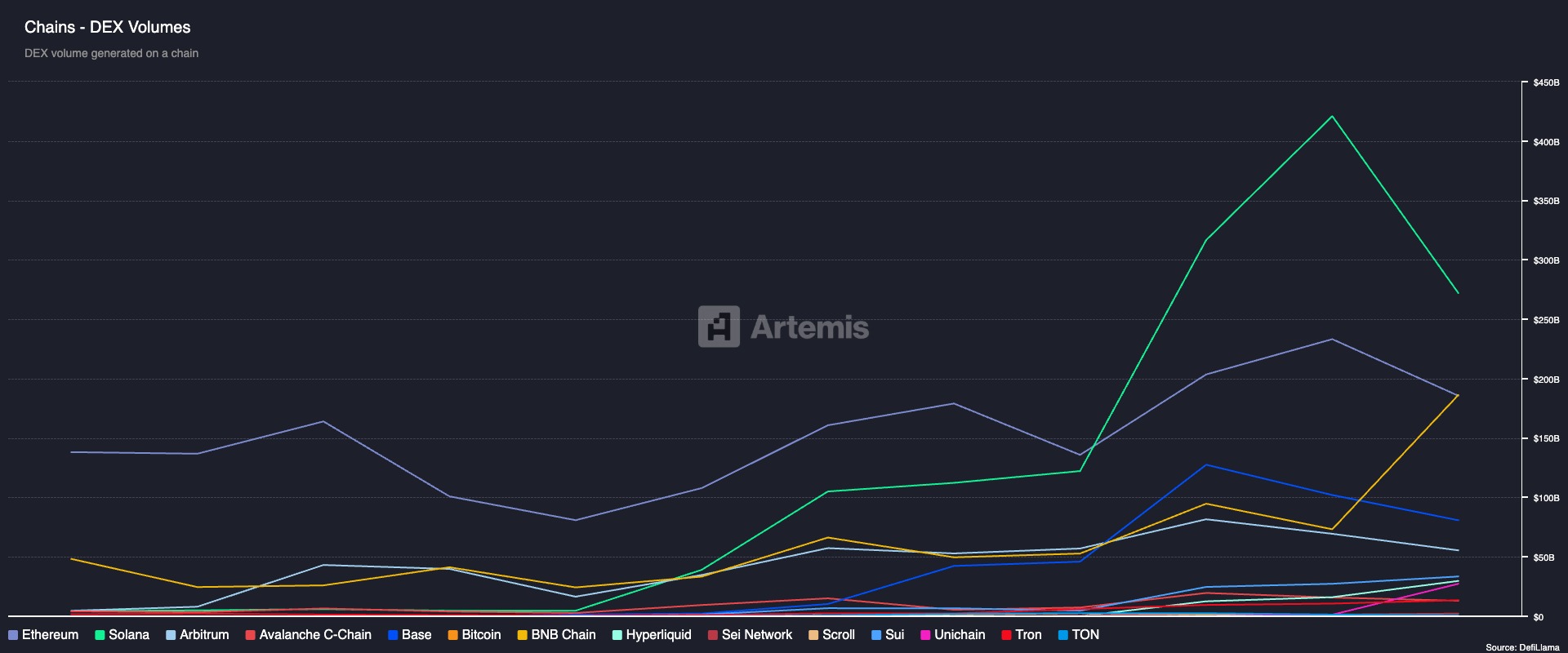
DEX volume for various blockchains by each quarter
DEX volume for various blockchains by each quarter (Credit: Artemis)

Kairos Research, which runs a solana validator, voted in favor of Alpenglow. Unsworth explained, “We view it as a pragmatic approach to rethinking solana’s consensus, which ultimately results in faster finality and potentially stronger liveness.”

Decreasing transaction finality to 150 milliseconds

The upgrade is expected to reduce the network’s transaction finality, the time when a transaction is recorded on a blockchain and after which it cannot be modified. 

Pre-Alpenglow, a transaction finalizes on the blockchain in about 12.8 seconds, but post-Alpenglow, the time would be cut to 150 milliseconds, putting solana into direct contention with centralized exchanges in terms of speed, said Jon Rotbard, an investor at venture capital firm CoinFund. 

This brings solana “potentially in striking distance of supporting the vision of a chain for executing and settling ‘everything’ on the L1 (payments, trading, capital formation, etc.),” Rotbard argued. 

Alpenglow allows solana to take a step closer to its goal of being an on-chain Nasdaq by introducing a new resilience model that allows the network to maintain operations even if 20% of its validators are malicious and an additional 20% are offline, Klich said. 

“Alpenglow brings consensus latency to a level comparable with Web2 applications while strengthening the system’s security posture, scalability, and economic fairness,” the proposal stated.

Benefiting users

The upgrade is expected to benefit all users, including retail, advanced traders, market makers, and financial applications. With 150-millisecond finality, solana is closer to institutional-grade trading, opening the door for central limit order books and tighter spreads, Chorus One’s Klich predicts. The biggest gain should accrue to various financial applications, though. 

Decentralized finance protocols “become safer, since liquidations and oracle updates can happen in near real time, reducing the risk of bad loans,” Klich continued. “Beyond trading and DeFi, payments may become more viable as near instant finality makes solana more attractive for payment applications.”

Roger Wattenhofer, head of research at solana development firm Anza, told Sherwood, “Pretty much anything that needs a fast finality will be possible with Alpenglow.”

Unsworth noted that end users won’t notice a substantial difference outside of improved reliability. “As a user, you tend to remember when things didn’t work more than they do — so this should just lead to more slightly better, more consistent user experiences,” he added. 

The upgrade comes in the same year that the network’s native cryptocurrency reached an all-time high of $292.

Even though Alpenglow is the blockchain’s most substantial technical change in its history, Unsworth doesn’t think the upgrade will change the way investors underwrite solana as an investment. 

“The larger things to watch that I think will impact price action will be DATs [digital asset treasuries] which have been announced. I know there is an open question around how much of those are in-kind contributions vs. fresh capital which will purchase SOL on the open market,” Unsworth said to Sherwood. 

The second big-ticket item are exchange-traded funds. Even though the only two cryptocurrencies to have ETFs in the US are bitcoin and ethereum, the US Securities and Exchange Commission is currently reviewing several spot solana ETFs. (There’s already a solana ETF in Canada). 

On August 30, Bloomberg Intelligence ETF analyst James Seyffart said a number of updated solana ETF filings were sent to the SEC, including ones from VanEck, Grayscale, Fidelity, CoinShares, and Bitwise.

More Crypto

See all Crypto
crypto

Strategy dips following mixed Q1 earnings

Strategy, the largest corporate bitcoin holder, with 818,334 bitcoin, reported its first-quarter earnings, missing analysts’ earnings per share estimates, but beating on revenue. Shares dipped in after-market trading. 

For the first three months of 2026, Strategy reported:

  • Revenue from its legacy software business of $124.3 million, above analysts’ consensus estimate of $121 million.

But the main focus is on its bitcoin operations. Strategy, with a $65 billion market cap, purchased its bitcoin at an average price of $75,537. The company reported a $14.46 billion unrealized loss on its digital assets in its first quarter, following bitcoin’s descent over the past three months, according to an April 8-K filing.

This compares to an unrealized loss on digital assets of $5.91 billion for the first quarter of 2025.

It also reported a bitcoin yield of 9.4% in 2026 YTD, and a bitcoin gain of $4.97 billion in 2026 YTD.

Ahead of earnings, the company skipped buying bitcoin this week, the second weekly break this year.  

Proceeds from STRC, Strategy’s perpetual preferred equity instrument, launched in July 2025, have enabled the firm to maintain its acquisition pace despite bitcoin’s tumble this quarter. This includes a massive purchase of 34,164 bitcoin for $2.54 billion in April, its largest acquisition since November 2024. STRC raised $5.58 billion, a 189% growth year to date 2026,

In April, TD Cowen analysts reiterated their “buy” rating on Strategy, as their “top digital asset pick,” with a $385 price target, saying the continued innovation at the instrument level “remains a key differentiator supporting long‑term shareholder value creation.”

crypto

TON springs on news Telegram will act as a “driving force” for the network

Toncoin, the native token for The Open Network, has jumped more than 26% in the last 24 hours after Telegram CEO Pavel Durov said the popular messaging app will play a larger role in the ecosystem.

Telegram will become the largest validator for The Open Network and replace the TON Foundation “as the driving force behind TON,” Durov wrote in a Monday message shared on Telegram and X.

Digital assets within the TON ecosystem have also rallied on the news, with canine-based coin DOGS rising 81% and gaming token NOTCOIN increasing 14%. Despite the ongoing rally, TON hitting $1.80 is still a far cry from its all-time high of $8.25 set in 2024, data from CoinGecko shows.

The Open Network is a layer 1 blockchain that last year became the exclusive network for Telegram’s mini apps ecosystem, which includes an embedded crypto wallet.

Jakob Palmstierna, president of crypto trading firm GSR, said the announcement is more akin to a reunion than a pivot. “TON was originally created to be Telegram’s financial infrastructure, and the foundation spinout was largely a regulatory workaround,” Palmstierna told Sherwood.

He added, “Telegram stepping in now is simply completing the road map, turning one of the world’s largest messaging platforms into a true super app with a native monetary layer.”

Bitwise research analyst Ish Asad told Sherwood, “Telegram has already been the primary driver and source of usage for the TON chain, and this new development should further strengthen their alignment.”

crypto

Bullish soars on $4.2 billion deal to acquire transfer agent Equiniti

Shares of crypto exchange Bullish spiked on news that the firm agreed to acquire transfer agent Equiniti for $4.2 billion, comprising $1.85 billion of assumed debt and $2.35 billion in Bullish stock consideration.

The deal is Bullish’s latest effort to build out its tokenized securities capabilities for around-the-clock trading and instant settlement, per a Tuesday press release.

Equiniti is one of the largest transfer agents, providing services to around 3,000 companies including Warren Buffett’s Berkshire Hathaway, luxury automobile maker Rolls-Royce, and credit ratings giant Moody’s, according to a report from The Wall Street Journal.

Tokenization is a once-in-a-generation shift in how capital markets operate, the defining infrastructure trend of the next 25 years, according to Bullish CEO Tom Farley, who was the former president of the New York Stock Exchange. I believe it uniquely positions us to lead the transition to tokenized securities, Farley continued in a statement.

Equiniti is one of the largest transfer agents, providing services to around 3,000 companies including Warren Buffett’s Berkshire Hathaway, luxury automobile maker Rolls-Royce, and credit ratings giant Moody’s, according to a report from The Wall Street Journal.

Tokenization is a once-in-a-generation shift in how capital markets operate, the defining infrastructure trend of the next 25 years, according to Bullish CEO Tom Farley, who was the former president of the New York Stock Exchange. I believe it uniquely positions us to lead the transition to tokenized securities, Farley continued in a statement.

Latest Stories

Sherwood Media, LLC produces fresh and unique perspectives on topical financial news and is a fully owned subsidiary of Robinhood Markets, Inc., and any views expressed here do not necessarily reflect the views of any other Robinhood affiliate, including Robinhood Markets, Inc., Robinhood Financial LLC, Robinhood Securities, LLC, Robinhood Crypto, LLC, Robinhood Derivatives, LLC, or Robinhood Money, LLC. Futures and event contracts are offered through Robinhood Derivatives, LLC.