Crypto
Saylor and a big bitcoin
Michael Saylor (Joe Raedle/Getty Images)
DATS the Question

Strategy overtakes BlackRock in bitcoin holdings as digital treasury landscape weakens

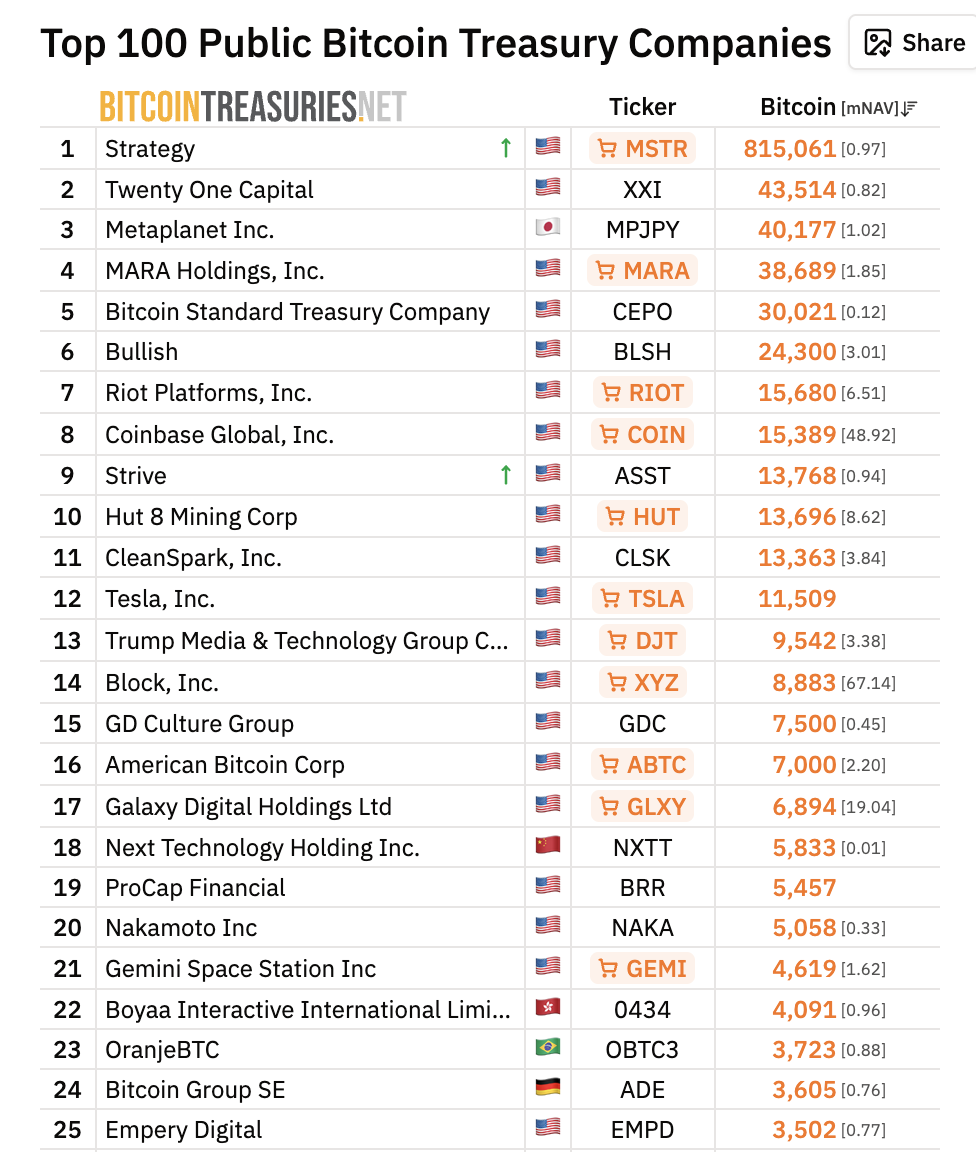
With its latest acquisition of 34,164 bitcoin, Strategy now holds 815,061 bitcoin — about 4% of the total bitcoin supply.

The landscape of digital asset treasury (DAT) companies has changed almost as rapidly as its explosive ascent last year, and cracks have begun to show in this ecosystem, with many participants on life support.

As bitcoin’s price tumbled, some DATs have sold off their bitcoin holdings to prop up their operations, trading at discounts relative to their mNAV (which is a company’s market cap divided by the value of its crypto asset holdings) and sliding down the bitcoin stockpile leaderboard along the way.

One thing hasn’t changed, however: Strategy remains the leader of the pack. And today, the largest corporate bitcoin holder overtook BlackRock’s iShares Bitcoin Trust in holdings.

With its latest acquisition of 34,164 bitcoin, Strategy now holds 815,061 bitcoin, about 4% of the total bitcoin supply. In contrast, IBIT, the most successful bitcoin ETF, with $64.63 billion in assets under management, holds 802,823 bitcoin.

This marks the company’s third-largest acquisition since it started accumulating bitcoin in August 2020, and the largest since November 2024. It’s on track to reach 1 million bitcoin by November, according to Bitcoin Treasuries.

Daniel Bara, director of the Olympus Association, told Sherwood News that while this is a leaderboard milestone, “I would not call it a watershed in any structural sense.”

“Strategy overtaking IBIT is a function of its equity issuance outpacing IBIT’s inflows, and both can reverse. IBIT had over $8 billion in net inflows in Q1 even as BTC fell roughly 20% over the quarter, so the demand for ETF exposure is intact,” he said.

Last week, bitcoin ETFs recorded $996.38 million in inflows, their largest weekly inflow since the week of January 15, per SoSoValue, underscoring renewed institutional interest.

For its latest bitcoin acquisitions, Strategy used proceeds from its STRC and STRK stock offerings (launched in July 2025 and January 2026, respectively), enabling the company to maintain its acquisition pace despite bitcoin’s tumble.

But as Ishmael Asad, a research analyst at Bitwise, noted, STRC’s growth has been sudden and increases dependence on bitcoin price appreciation over shorter time horizons as the company’s dividend obligation expands.

“As Strategy and other DATs continue accumulating, this could become a growing risk if the market does not see meaningful appreciation any time soon,” Asad said.

Strategy’s mammoth stash also brings another issue to the forefront: its concentration of holdings.

“Michael Saylor now has the power to affect the price of BTC simply by pausing purchases. Unlike ETFs, which are passive vehicles, MSTR and other DATs are active buyers of bitcoin. This makes them far more influential in setting marginal demand,” Nic Puckrin, cofounder of Coin Bureau, told Sherwood.

DATs the problem?

On a broader level, the fragility of the DAT model is becoming increasingly apparent, and as firms stop HODLing, it could put further pressure on bitcoin.

In March, Nakamoto — which has failed to rise above $1 a share since getting a delisting warning in December — sold 284 bitcoin for $20 million, at $70,422, a 40% cut from its $118,171 average cost. The company is hoping a reverse stock split will boost its stock, which is down 30% year to date.

MARA Holdings, which was once the second-largest bitcoin holder, announced last month that it sold 15,133 bitcoin as it pivots (like many miners) to AI, dropping it to fourth place.

Other DATs that have recently sold some of their bitcoin holdings include Empery Digital and Exodus Movement, while Genius Group sold all of its bitcoin.

Here’s how things have shifted since bitcoin hit its all-time high last October:
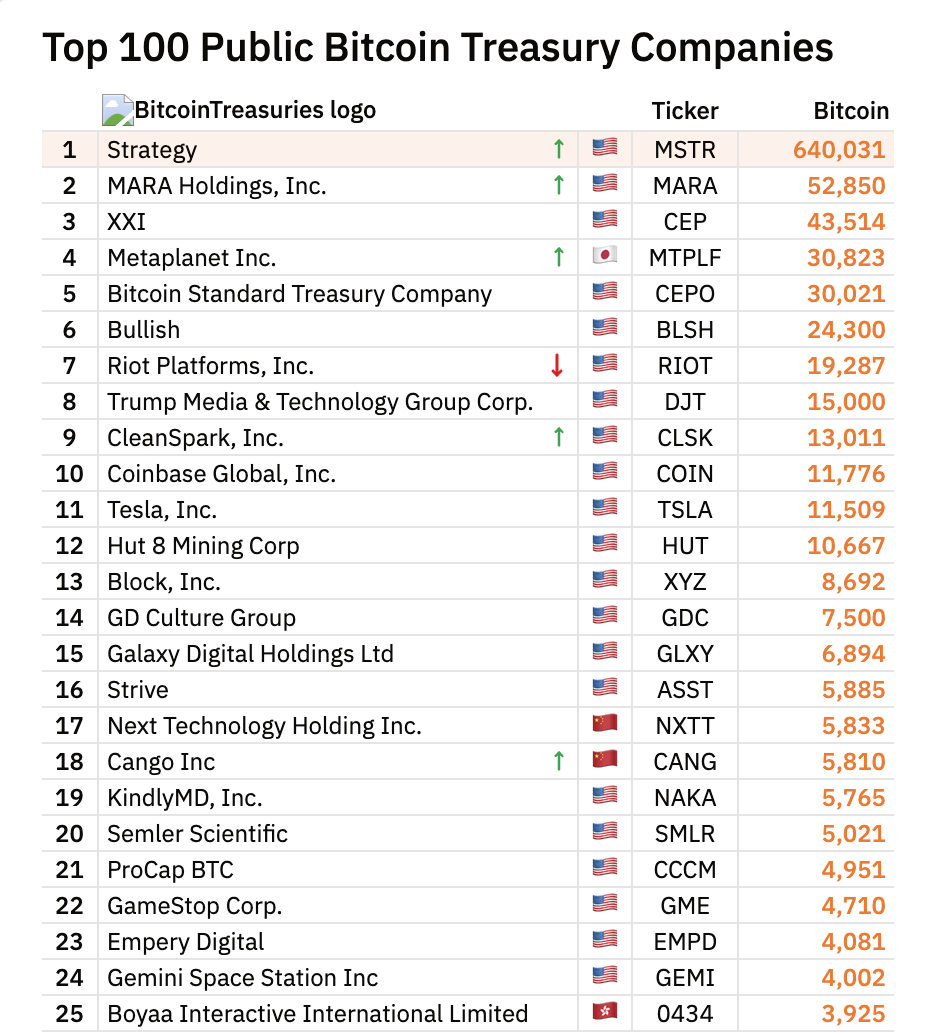
BTC stockpiles, October 2025
BTC stockpiles, April 2026

“There is absolutely a risk of contagion from bitcoin DATs like Nakamoto selling their holdings. With many entering the space at the top of the market in 2025, the longer bitcoin stays around current levels, the more pain they will feel. Corporate selling is one of the largest risks to bitcoin’s price this year,” Puckrin said, adding that if geopolitical conditions continue to weigh on risk assets and bitcoin, other DATs could start losing conviction in BTC, and at that point, it can quickly become a liquidation cascade scenario.

On the other hand, Puckrin said, the timing of new entrants into the market, such as Adam Back’s Bitcoin Treasury Standard Company (BSTR), set to go public via a SPAC with Cantor soon, is far better than many other DATs, given where bitcoin’s price is right now.

“But the corporate treasury strategy is still a risky one and must be structured as well as MSTR to remain afloat throughout the downturn,” he added.

What’s next for DATs?

While it remains to be seen if DATs’ bitcoin off-loading could significantly affect the asset’s price, the DAT model is not sustainable long-term for many, Wave Digital Assets’ head of international portfolio management, Rajiv Sawhney, said.

“Simply put, many of the DATs did not have viable business models or generate recurring revenue in a differentiated way. We’ll likely see a significant contraction, from hundreds of players today to a much smaller group,” Sawhney said, adding that this dynamic opens up a huge opportunity for M&A and consolidation in the space.

“The stronger players will be able to acquire bitcoin cheaply through equity acquisitions,” Sawhney said.

Olympus’ Bara also said that beyond looming consolidation, “because the math forces it,” exits are most likely among smaller DATs without continuous access to capital markets.

“New entrants like BSTR prove that capital still wants exposure to this category, but BSTR and Twenty One are launching with the same accumulation playbook, distributed through the same Cantor SPAC pipeline,” he said.

Finally, some experts, such as Beau Turner, CEO and cofounder of Abundant Mines, told Sherwood that many of the DATs that came on the scene to mimic Strategy were “just a trend.”

“Outside of Strategy and Metaplanet and Strive Inc., I see very few examples of truly robust business models. The companies with unique positioning and moats will find themselves surviving and thriving in the long run. The companies building a DAT because it seems like a good trend to participate in will, over the long run, be left in the dust,” Turner said.

More Crypto

See all Crypto
$290M

On Saturday, ethereum-based protocol KelpDAO, known for liquid restaking, was exploited for $290 million, the largest hack of 2026 in the decentralized finance ecosystem. 

“Preliminary indicators suggest attribution to a highly-sophisticated state actor, likely DPRK’s Lazarus Group,” LayerZero said in its statement explaining the attack. KelpDAO issues rsETH, while LayerZero provides network infrastructure that allows users to move KelpDAO’s rsETH between blockchains.

The configuration of KelpDAO’s exploited application, powered by LayerZero, relied on a single decentralized verifier network (DVN), responsible for verifying the integrity of cross-chain messages. 

The industry best practice is for protocols to use a multi-DVN setup to prevent a unilateral point of trust or failure. A properly hardened configuration would have required consensus across multiple independent DVNs, rendering this attack ineffective even in the event of any single DVN being compromised,” LayerZero stated, essentially placing the blame on the restaking protocol for using a single-DVN setup.

The exploiters executed an RPC-spoofing attack and performed DDoS attacks to manipulate the single DVN instance into confirming transactions “that never in fact took place.” The LayerZero team said, “Operating a single-point-of-failure configuration meant there was no independent verifier to catch and reject a forged message.

Meanwhile, KelpDAO is preparing to dispute LayerZero’s account and place the blame on the latter, per a CoinDesk report.

Spilling over

The exploit has since impacted the wider crypto landscape.

The attackers successfully drained 116,500 rsETH from KelpDAO’s bridge, allowing them to deposit $249.7 million of the token to DeFi’s largest lending protocols and withdraw $228.2 million worth of different cryptocurrencies, wETH and wstETH, on-chain data from Arkham Intelligence shows.

Aave, the largest lending protocol, has frozen several markets and is now facing a liquidity crunch.

On Aave’s v3, the ETH, USDT, and USDC markets, which have a combined reserve size of $10.7 billion, have each reached a 100% utilization rate, as total borrowed equals total supplied. When borrows are maxed, users cannot withdraw their supplied liquidity.

The pseudonymous head of strategy at DeFi lending platform Spark, @MonetSupply, wrote on X, There has been a ~$300 million increase in borrowing with USDT collateral in just the past day since the rsETH exploit.

On-chain folks are spooked

The attack comes in the same month that Drift, a solana-based trading venue, suffered from an over $270 million hack. Saturday’s attack also follows worries stemming from Anthropic’s unreleased AI model Mythos, which “is capable of identifying and then exploiting zero-day vulnerabilities in every major operating system.” 

Even though the major cryptocurrencies have not seen their prices move substantially in the last 24 hours, crypto participants have been spooked, evident by the capital exiting the decentralized finance ecosystem.

DeFi saw its total value locked decrease by $13 billion over the weekend to $85.64 billion at the time of writing, its lowest point since April last year, data from DefiLlama shows. 

“OK — Kelpdao hacker, how much you want? Let’s just talk. With KelpDAO’s help, of course. It’s simply not worth it to sacrifice both Aave and KelpDAO and let them go down over this hack. You can’t spend $300 million anyway,” said Justin Sun, founder of the Tron blockchain, who has been beefing with the President Trump-backed World Liberty team. 

crypto

Bitcoin jumps to highest level since February, boosted by optimism over reopening of Strait of Hormuz

Bitcoin finally broke out of the tight range it’s been stuck in for weeks, rising to just below the $78,000 mark, a level not reached since early February, as risk-on sentiment floods back into the market.

The jump comes on the heels of Iran and the US announcing the reopening of the Strait of Hormuz on Friday morning, which sent oil prices down and the stock market higher.

The renewed optimism for a deal with Iran and the end of the Middle East conflict also sent crypto stocks jumping, with Strategy, the largest corporate bitcoin holder, up more than 13% late Friday morning.

Wave Digital Assets’ head of international portfolio management, Rajiv Sawhney, told Sherwood News that its all about the Strait of Hormuz. Markets are interpreting it as a win. Its a knee-jerk reaction given positioning and expectations. As such, while bitcoin was able to tick higher, the $80K level will be the real barometer we need to cross for me to feel confident that this relief rally has legs, he said, adding that until then, hes remaining cautiously optimistic that risk assets can close at these levels. 

Nic Puckrin, cofounder of Coin Bureau, told Sherwood that we’re seeing a classic short squeeze as heavy short positions in bitcoin are being liquidated, adding that the next resistance level to watch is $79,000. 

“If we get past that and close the week above this level, $90k becomes a real possibility in the medium term. However, if the rally gets rejected at this level, we could remain stuck in the range between $65k and $75k that held bitcoin hostage for months,” Puckrin added.

Underscoring the cautious comeback, Bloomberg reported that from a derivatives market perspective, “traders remain largely defensive.”

“Funding rates for perpetual futures contracts, a key measure of whether leveraged traders are betting on higher or lower prices, were negative. Hefty premiums are also being paid for put options providing downside protections at $60,000 and $50,000, respectively,” Bloomberg reported.

Bitfinex analysts told Sherwood that the liquidation heat map shows dense shorts leverage stacked between $76,000 and $78,000. 

“Clearing this range opens a substantial air gap in the unspent realized price distribution up to $82,000,” they said, adding that the next level they are watching is $83,000, a “significant wall at the short-term holder realized price.”

crypto

OP token rises after payments card provider Ether.fi finalizes migration to the layer 2 network

OP, the governance token for OP Mainnet, has increased as much as 5% since Tuesday night following news that Ether.fi, a decentralized finance protocol known for providing noncustodial crypto payment cards, completed its migration to the ethereum layer 2 blockchain network. 

Ether.fi’s move resulted in around $220 million in total value locked coming to OP Mainnet, the largest single TVL event in the network’s history, as well as over 70,000 payment cards and more than 300,000 accounts, according to a blog post from Ether.fi

Originally on alternative layer 2 network Scroll, Ether.fi made the switch to OP Mainnet due to lower median transaction fees of $0.00001 and sub-250-millisecond finality times. 

“To ship what comes next, we needed infrastructure that could handle real-time payments at consumer volume,” Ether.fi CEO Mike Silagadze told Sherwood News. “OP Mainnet delivered on every dimension. Three days to migrate $220M with no downtime answered the question. Now we get to build.” 

The migration comes about two months after Coinbase-incubated blockchain Base announced moving away from Optimism’s OP Stack. 

Latest Stories

Sherwood Media, LLC produces fresh and unique perspectives on topical financial news and is a fully owned subsidiary of Robinhood Markets, Inc., and any views expressed here do not necessarily reflect the views of any other Robinhood affiliate, including Robinhood Markets, Inc., Robinhood Financial LLC, Robinhood Securities, LLC, Robinhood Crypto, LLC, Robinhood Derivatives, LLC, or Robinhood Money, LLC. Futures and event contracts are offered through Robinhood Derivatives, LLC.