

HIGH SPIRITS
Aperology
How Aperol became the “it” drink of the summer season
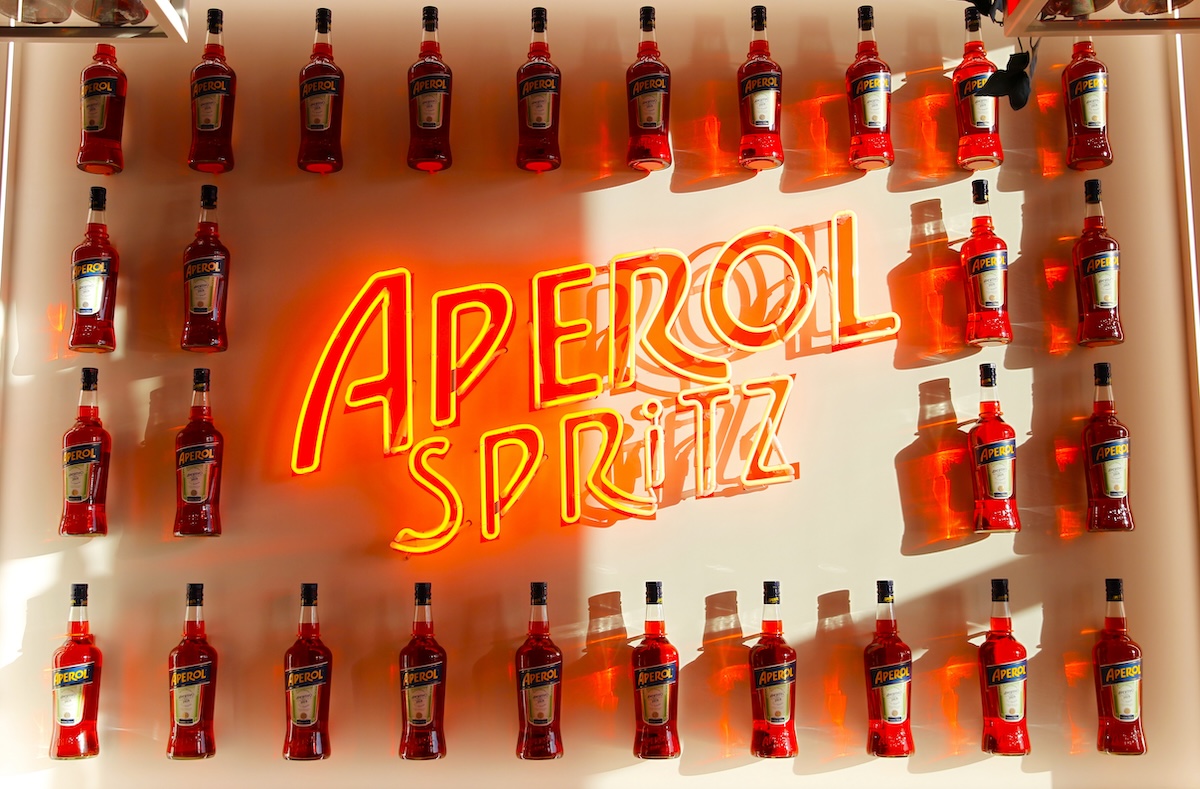
You’ll be seeing a lot of orange glasses this summer, thanks to a concentrated marketing effort from the 164 year-old Campari Group
As we stock up on sunblock, many will also be filling up ice trays to freshen up their favorite tipples during the upcoming summer months. And, if this year is anything like the last few, we can expect terrace tables, barbecue benches, picnics, and patios to be swamped by a sea of vibrant orange.
Indeed, the craze for Aperol Spritz — the Italian-born apéritif cocktail that’s taken over bars, restaurants, and liquor cabinets the world over — shows few signs of stopping, with sales growing another 6% in Q1 2024… building on the 44%+ growth notched the year before. Not bad for a 105 year-old drink.
Aperology
While many people may recall a time when aperitivo was just a term that someone brought back after spending a few weeks in Italy, the Spritz boom has now reached places far beyond the back-alley bars and humble osterias where the drink originated.
“Spritz” is a catchall term for a cocktail that is 3 parts prosecco, 2 parts bitter liqueur, and 1 part seltzer, poured into an ice-filled glass and topped with a slice of orange (or, if you’re a purist, an olive). Its origins date back to 19th century Venice, when Austrians occupying the city introduced the custom of adding sparkling water to their wine, known as “Spritzen”... but the trend of adding a bitter liqueur into the mix didn’t start until many years later.
In 1919, in the city of Padua, brothers Luigi and Silvio Barbieri created Aperol, now the most famous Spritz bitter, from orange peel, herbs and spices. Due to its low alcohol volume (11% ABV), Aperol was initially marketed towards health-conscious drinkers and women (its slogan in the ‘30s was “Signora! Aperol keeps you thin"). However, by the ‘80s, it had been firmly integrated into aperitivo culture — the Italian tradition of having refreshments in the post-work, pre-dinner period — throughout the Veneto region.
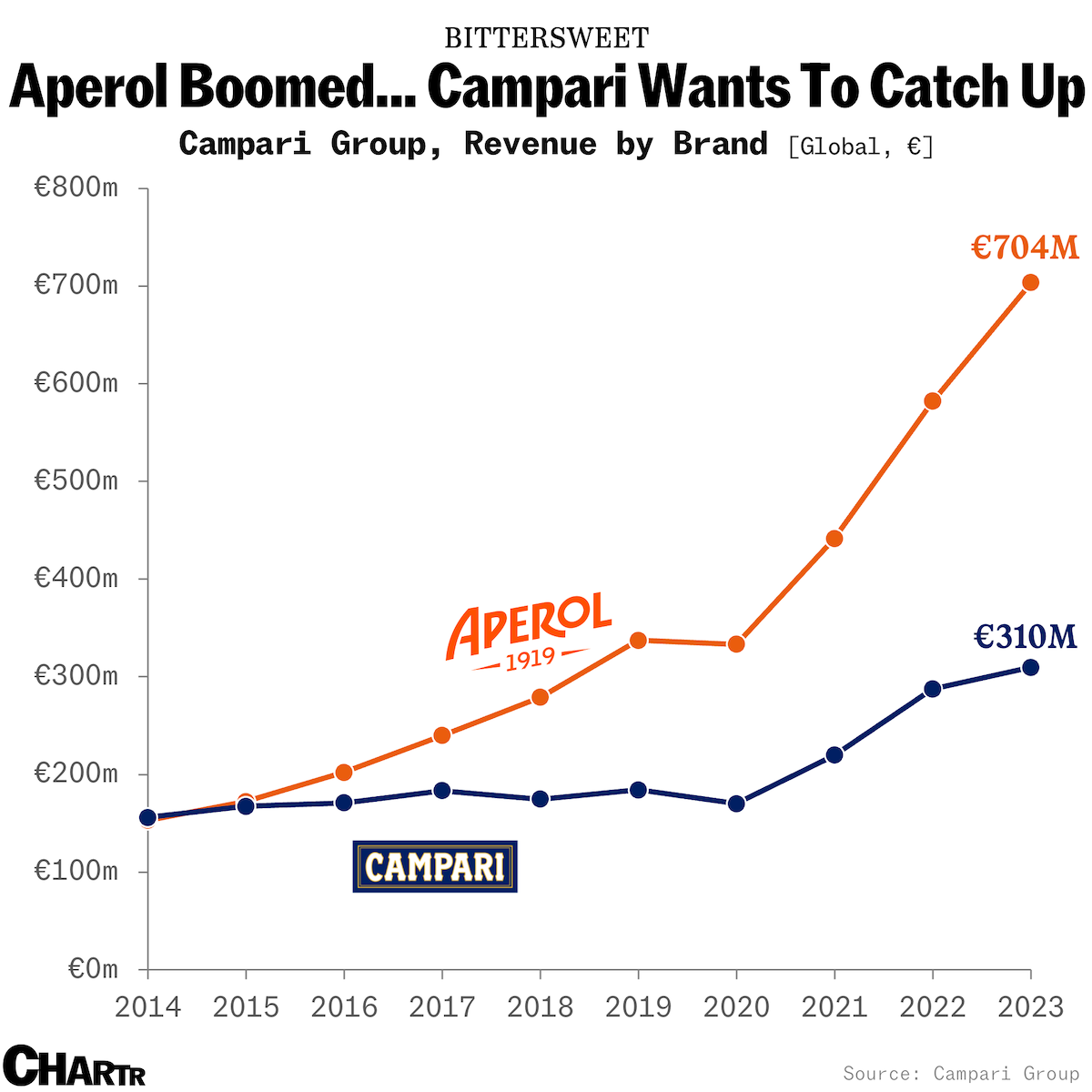
The Campari Group, who started making their namesake crimson apéritif back in 1860, took notice of Aperol’s success, acquiring the brand in 2003. From there, the liqueur giant ran alcohol marketing 101 with one goal: make Aperol Spritz cool. A chart of Aperol’s sales suggests that they pulled it off.
Selling summer
Aperol’s renaissance, which contributed €704M ($764M) in revenue to Campari Group last year, was no accident. After bringing the drink to bars in modish Milan — presenting it in a stylish glass that gave the Spritz visibility amongst Italy’s fashionable youth, not least because of the drink’s vivid color — Campari began a global push for the brand.
Cropping up at events in New York and Palm Springs in the mid 2010s, Aperol-orange merchandising — including sunglasses and scooters — eventually became a fixture of major tickets like the Governors Ball. Ever since, Aperol has been seen at countless American summer parties, even sponsoring the US Open last year. It helps, of course, that the drink is about as “Instagrammable” as it gets. Every click of a camera taking a selfie and every clink of a bright-orange wine glass is music to Campari Group’s marketing department’s ears, who wanted to sell Aperol as “sunshine in a glass”.
Cin-cin!
Of course, lots of drinks are a vibrant color, and on its own being bright orange isn’t particularly powerful… but being associated with the golden-hour drinking culture of Italy is. Conjuring scenes of sun-soaked terrazzos, Aperol’s marketing team doesn’t shy away from the association: according to the NYT, they even decorated a Hamptons bus with the phrase “So it’s orange-y and bubbly at the same time. Plus it’s super popular in Italy, so you know it’s good.” Images of the Italian dream portrayed in recent popular media like The White Lotus, Succession, and Normal People, haven’t hurt either.
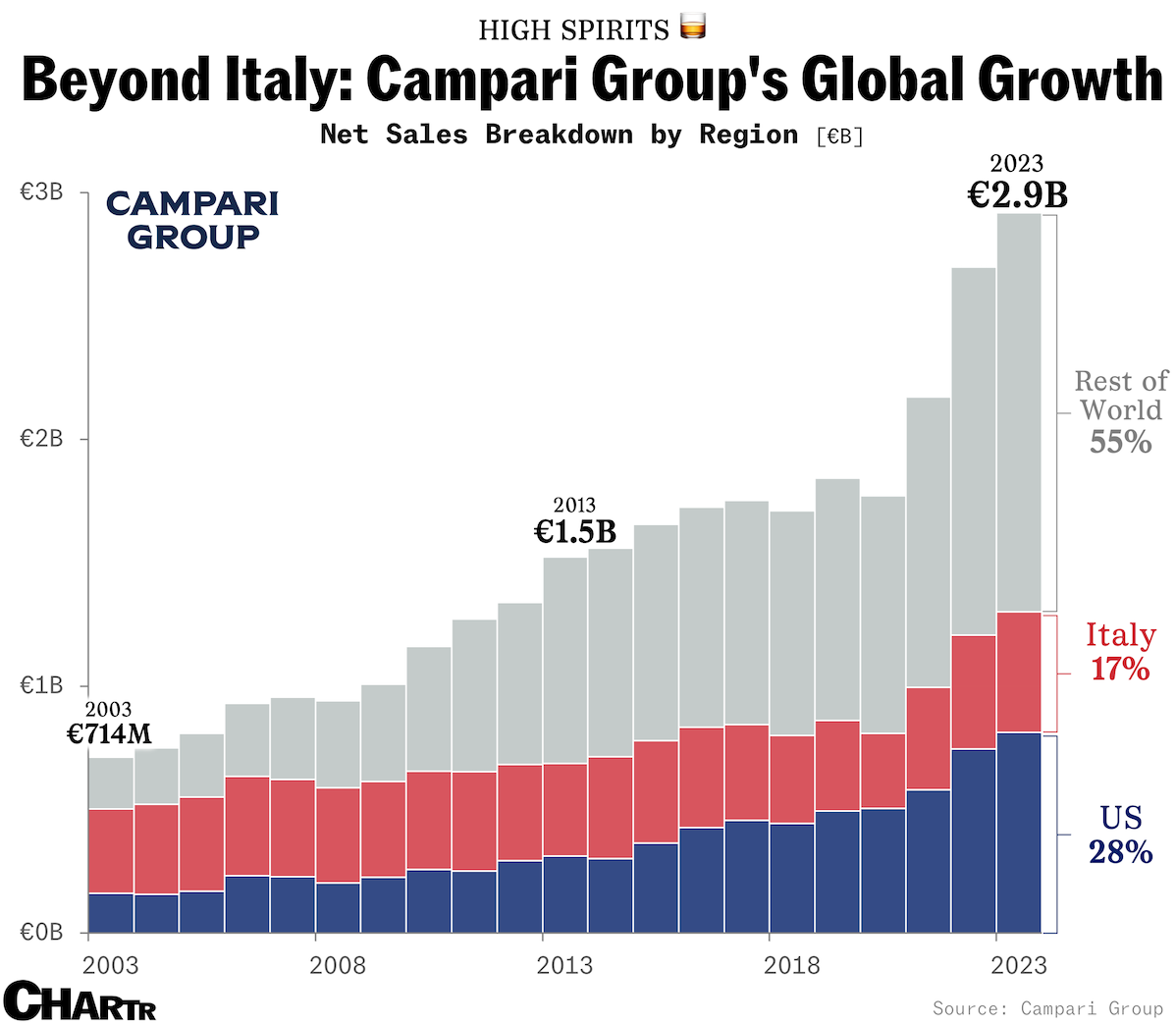
The marketing blitz paid off. In 2003, Italy accounted for 48% of the company’s sales. Fast forward to today, and the company’s home nation is just 17% of total sales, thanks to a worldwide expansion that’s taken the group — which is also home to SKYY Vodka, Wild Turkey Whiskey, Courvoisier, and dozens of other spirits — north of €2.9B (~$3.1B) in revenue. In the last 5 years, sales in the US are up 82%.
A large portion of the company’s stateside success is linked to Aperol’s lift-off, with shipments of the orange spirit to the US increasing from 9K cases in 2010 to 390K cases in 2022. Sales of the Group’s eponymous aperitif have also been growing, with 227K cases of Campari — a spirit arguably most famous for its use in a Negroni cocktail — shipped to the US in 2022, twice as many as were sent in 2015.
5 o’clock somewhere
As you’d expect, sales of Aperol peak every summer, with Google data supporting this seasonality. Searches for classic cocktails like “mojito” and “martini” have remained consistently popular across the past 2 decades, with the former peaking in the summer (when heat demands minty refreshment) and the latter in the winter.
Last year, though, there were more searches for “aperol” than “mojito” for the first time. Aperol’s seasonality only adds to the theory that summer sells… particularly when the product in question is photogenic.
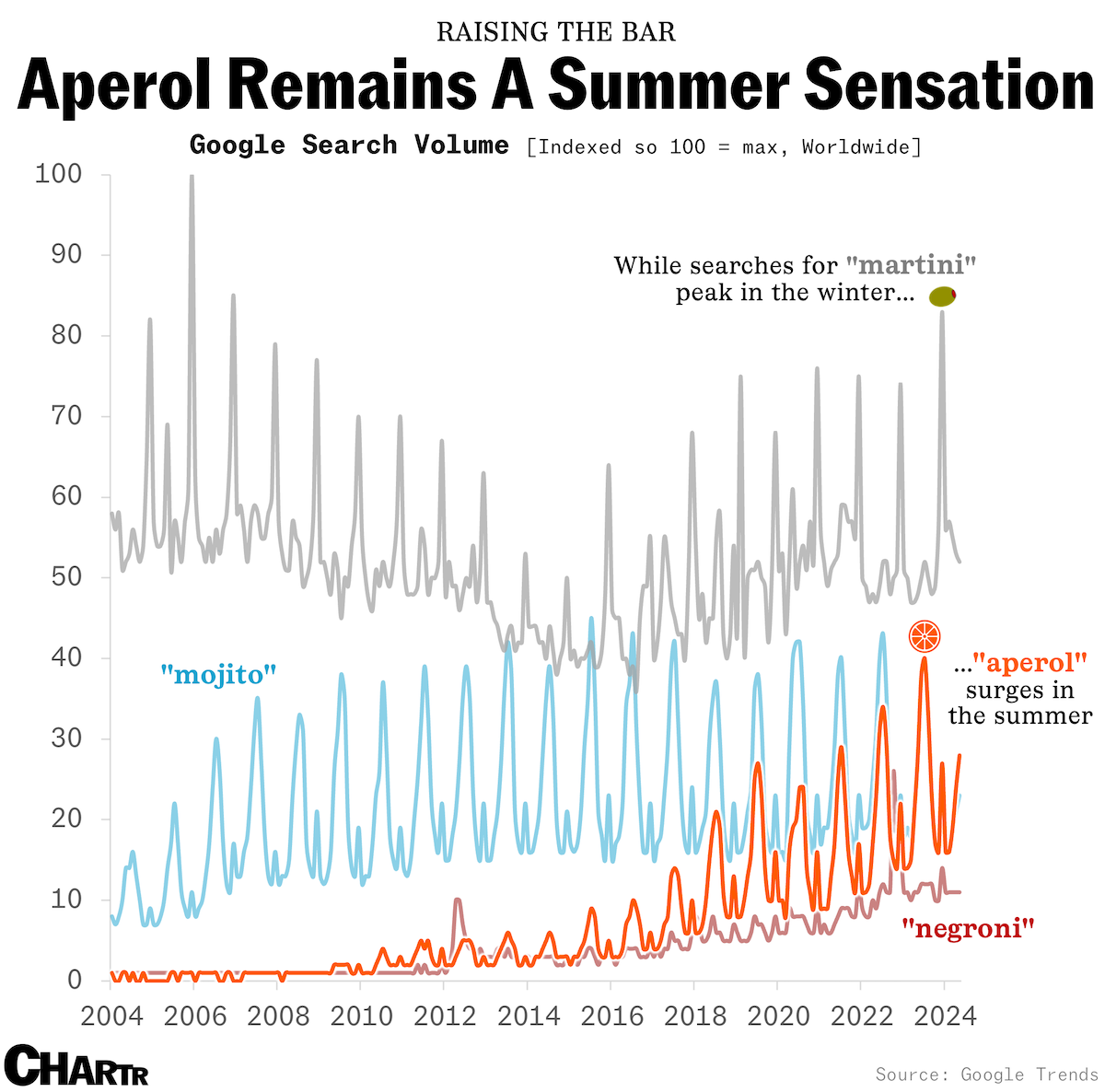
The Campari-based “negroni” has seen a steadier rise with less-defined periodicity… a feature that the company’s marketing team are actually keen to embrace for Aperol as well. Indeed, Aperol’s latest marketing efforts have included efforts to “deseasonalize” the drink, with the company staging pop-ups at après-ski events and winter venues.
The Great Moderation
Even so, Campari Group’s recent annual report raised concerns that the broader alcohol market could be rocky moving forward, citing the rising demand for low- and no-alcohol alternatives.
The growing trend, especially amongst younger people, towards reducing or cutting out alcohol is a threat to Campari Group — and all of its competitors — as consumers diverge from casual boozing, with an August 2023 Gallup poll showing that 39% of US adults now consider moderate drinking as unhealthy. But, the sentiment of treating yourself remains strong amongst US consumers, even in the midst of economic uncertainty: a McKinsey survey found that 36% of pollees still intended to splurge on restaurants, dining out, and bars.
Indulging with a drink in the sun after a long day? That's a universal language… and it’s one that Aperol’s marketing team speaks very well.