
Culture
Man Reading Magazine on Train
Getty Images
GLOSSED OVER

Print magazines aren’t dead — in 2024, they’ve just gone premium

Advertising dollars continue to go online, but some print magazines are seeing revivals as luxury leisure products.

Millie Giles

Generation after generation have experienced the shifting sands of media. We’ve seen video kill radio; CDs kill cassettes; DVDs kill VCR, before streaming killed DVDs — and, for the last decade, we’ve watched (often from behind a screen) the digital-media boom size itself up against long-declining print publications.

According to Magna data cited by Bloomberg, at its peak in 2007, annual advertising revenues from print publications were as high as $19.5 billion in the US. Since then, the industry has turned a new page, with almost every ensuing year bringing in less advertising revenue than the one before.
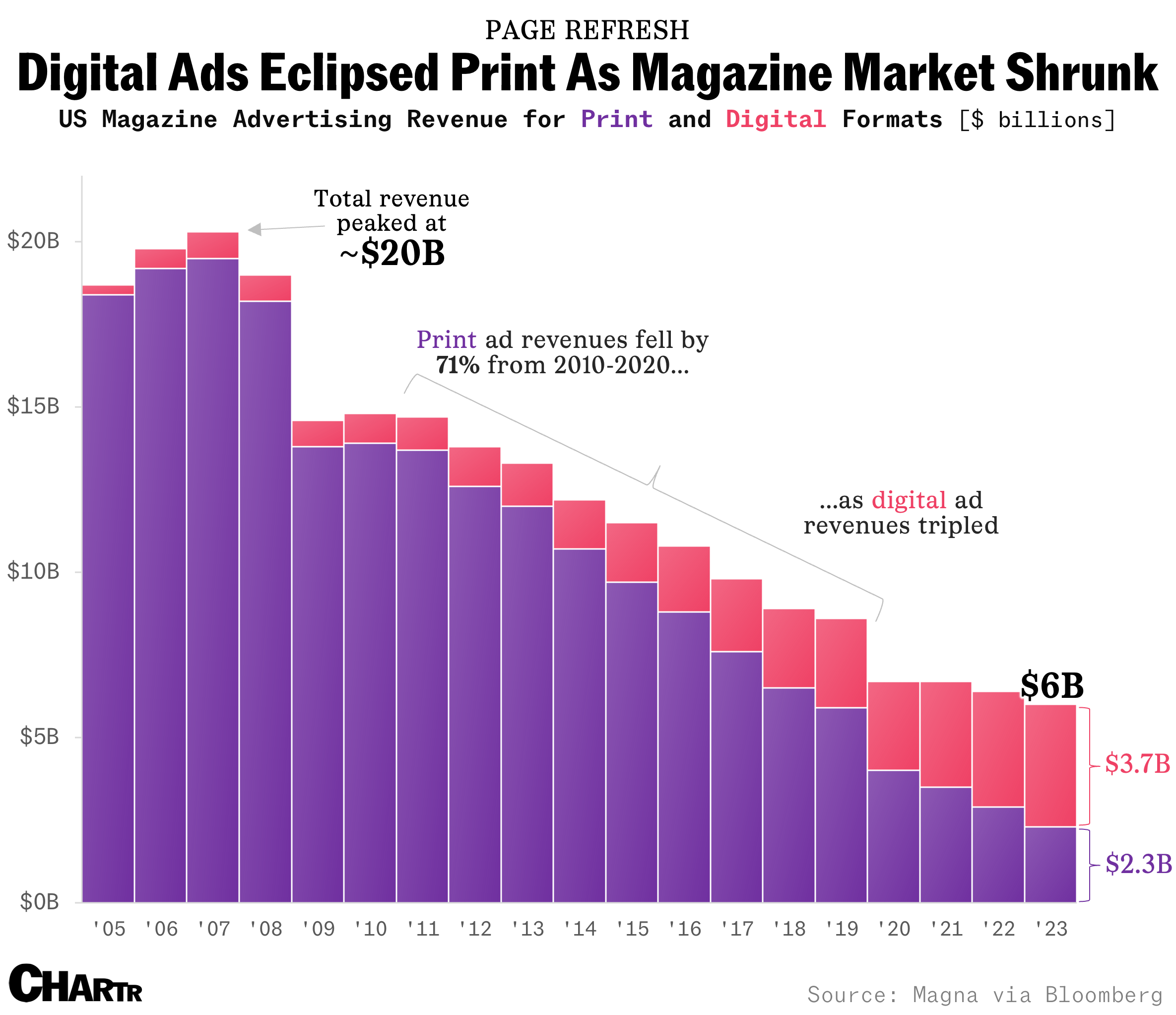
Print advertising chart
Sherwood News

Perhaps, though, as Amanda Mull argued in an insightful Bloomberg article published last Thursday, this year has not seen print die at the hands of digital as one might have anticipated. Instead, just like film cameras, bookstores, and vinyl records, print media is seeing something of a revival, with established magazines rebranding from ubiquitous digests to more specialized luxury “leisure products.”

While the golden age of print is well behind us — the same Bloomberg piece reported that even mega-publisher Condé Nast is “no longer a magazine company,” per its CEO — an increasing number of legacy media outlets announced plans to revamp previously ditched physical print offerings in 2024, including NME, Nylon, Vice, Life, and The Onion. Moreover, some digital-born publications are now also giving print a chance, with Vox Media’s The Cut launching its first-ever Fall Fashion print issue this September.

However, keeping widespread attention isn’t the primary objective of print magazines anymore. As outlined by Mull, the success of enduring print publications (The New Yorker, Vogue, Architectural Digest, etc.) relies on their readers’ distinct interests, tastes, and intellects to sustain sales. Indeed, the rise in the number of small-scale indie publications going to print offers some proof that the value of a readership now lies in quality rather than quantity — a virtue that appeals to advertisers, who’ve grown conscious that the often more affluent, tuned-in readership of some print publications are harder to engage with online.

In fact, the print medium is now increasingly used as a marketing tool itself: according to the report, the Costco Connection is one of America’s most successful magazines today, with a monthly circulation of more than 15 million.

More Culture

See all Culture
culture

The most popular male and female names in the US, according to the latest Census

New data published Tuesday by the US Census Bureau has revealed the most common names provided in the 2020 Census, in the first release to include forename data since 1990.

As described in the brief, Michael was the most popular name for males in the US, with roughly 3.5 million American men reporting having this name or a close variant. This is up from fourth place in the 1990 Census, when the top US male name was James — though there were still 3 million Jameses in 2020’s tally.

Despite a three-decade gap, Mary remained the top name for American females in both censuses, with the 2020 survey counting almost 1.8 million females with this given name. Interestingly, Mary was one of just two predominantly female names that broke the top 10 given names in the US, with the overall list dominated mostly by male monikers.

Most popular names US census 2020 chart
Sherwood News

In all, American females had far more first-name diversity than male counterparts: 16% of US males had one of the top 10 most frequent names among men, compared with 7.8% of women. Zooming out, almost 3x as many given names were needed to cover a quarter of the US female population than that of males.

culture

6 months after hiking Game Pass prices by 50%, Xbox determines it may be too expensive

Microsoft’s new Xbox chief, Asha Sharma, thinks the division’s recent price hikes have been a mistake, per an internal memo to employees seen by The Verge.

“Short term, Game Pass has become too expensive for players, so we need a better value equation,” Sharma’s memo reportedly read.

It’s an interesting take, given that Xbox hiked the price of its Game Pass subscription by 50% in October, before Sharma took over. The memo is a signal that Sharma’s tenure — which began in February, taking the industry by surprise — will include some big changes for Microsoft’s gaming strategy.

Whether Game Pass prices will drop is not yet clear. Last month, The Information reported that Sharma and Netflix co-CEO Greg Peters have “kicked around ideas” about potential bundles. That would fit with Netflix’s renewed gaming ambitions.

Xbox Game Pass Chartr
(Sherwood News)

It’s an interesting take, given that Xbox hiked the price of its Game Pass subscription by 50% in October, before Sharma took over. The memo is a signal that Sharma’s tenure — which began in February, taking the industry by surprise — will include some big changes for Microsoft’s gaming strategy.

Whether Game Pass prices will drop is not yet clear. Last month, The Information reported that Sharma and Netflix co-CEO Greg Peters have “kicked around ideas” about potential bundles. That would fit with Netflix’s renewed gaming ambitions.

Xbox Game Pass Chartr
(Sherwood News)

Latest Stories

Sherwood Media, LLC produces fresh and unique perspectives on topical financial news and is a fully owned subsidiary of Robinhood Markets, Inc., and any views expressed here do not necessarily reflect the views of any other Robinhood affiliate, including Robinhood Markets, Inc., Robinhood Financial LLC, Robinhood Securities, LLC, Robinhood Crypto, LLC, Robinhood Derivatives, LLC, or Robinhood Money, LLC. Futures and event contracts are offered through Robinhood Derivatives, LLC.