
Markets
How does the US federal government make and spend its money. chart.
Sherwood News

America spent more than $880 billion just on interest on its debt last year

No wonder Moody’s stripped the US of its last AAA rating.

America’s perfect credit era is officially over — marking the end of a century-long run.

On Friday, Moody’s downgraded the US credit rating from its highest AAA grade to Aa1, citing “large annual fiscal deficits and growing interest costs.” The move follows earlier cuts from S&P in 2011 and Fitch in 2023, driven by rising debt concerns and political gridlock.

Now, for the first time since 1917, the US no longer holds top-tier ratings from any of the major agencies — trailing the 11 countries that still boast the highest grading from all three, a group that includes Australia, Denmark, Germany, and Canada.

Moodys

With the clock ticking on America’s $36 trillion debt ceiling (which could be breached as soon as August) the national debt continues to climb, as it has done for decades. According to the Congressional Budget Office, the US public debt stood at 98% of GDP last year, and is set to surpass the WWII peak by 2029, hitting 119% by 2035.
How does the US federal government make and spend its money. chart.
Sherwood News

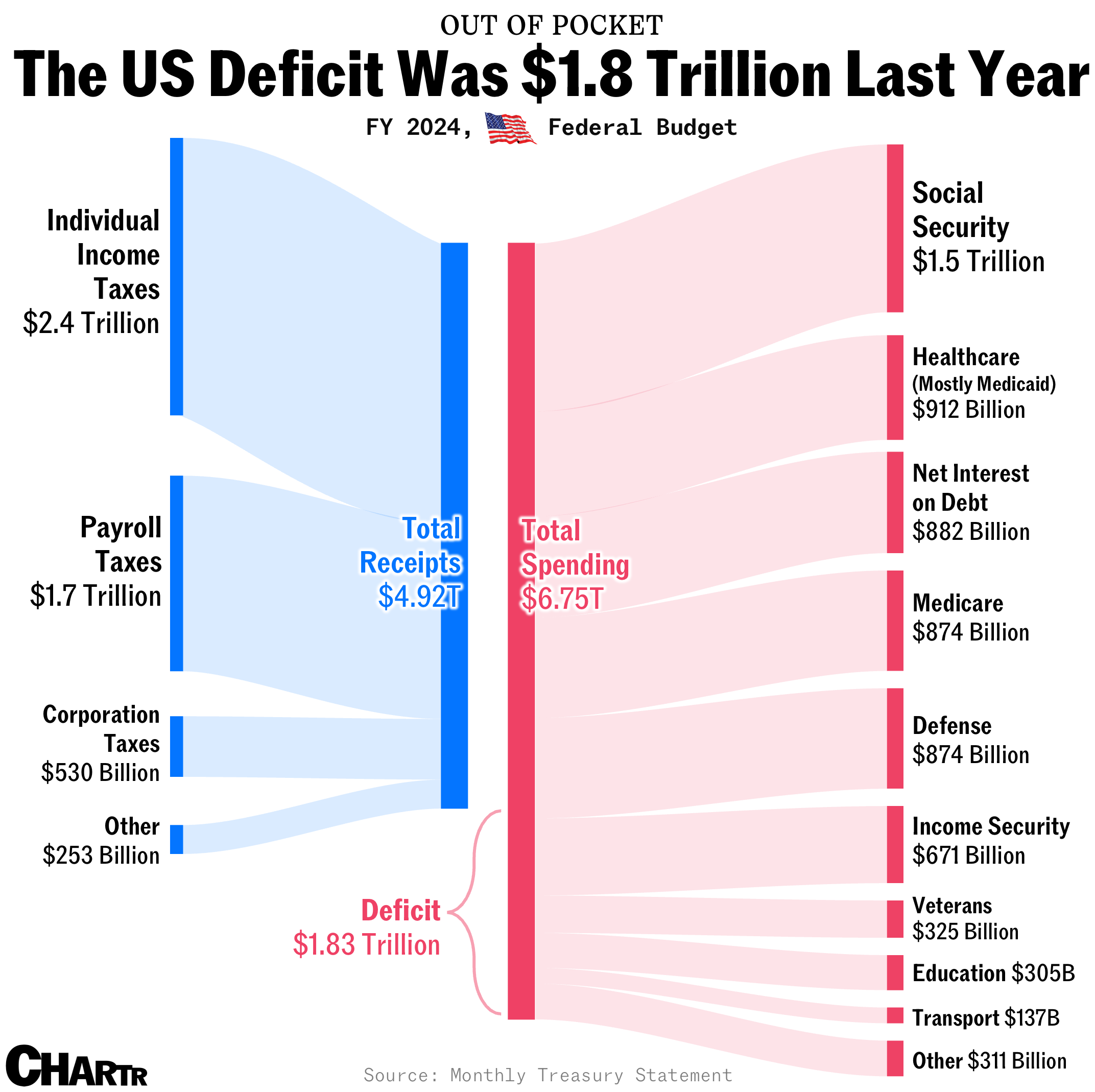
What might be of particular concern to the number crunchers at Moody’s is not just the current level of federal debt, but how quickly it’s growing. Last year, the deficit was $1.8 trillion, more than 6% of GDP. The interest payments on debt alone were some $882 billion, greater than the defense and Medicare budgets.

The latest tax cuts and spending push — or, as President Trump calls it, “the big, beautiful bill” — could add another ~$4 trillion to the federal deficit over the next decade, with Moody’s now projecting that the debt-to-GDP ratio could surge to 134% by 2035.

In an interview with NBC yesterday, Treasury Secretary Scott Bessent shrugged off the downgrade, calling Moody’s a “lagging indicator.” But the markets took note, with the 30-year Treasury yield topping 5% this morning, a level last seen in late 2023.

More Markets

See all Markets
Policeman with Piercing Eyes

Take-Two’s “GTA 6” forecast feels absurdly conservative

Take-Two issued a 2027 net bookings forecast about $1 billion below Wall Street’s estimates. The stock is falling on Friday.

The D-Wave 2X quantum system, is operated at the NASA Advanced Supercomputing facility's Quantum Artificial Intelligence Laboratory at NASA's Ames Research Center in Mountain View, Calif., as seen on Tuesday December 8, 2015.

Quantum computing CEOs hope “validating” government backing proves their technology is no longer speculative

The government funding is a push to boost the foundational elements of quantum computing to get the industry ready for prime time. The CEOs of Infleqtion and D-Wave give us their thoughts.

markets

Ross Stores surges as Q1 results beat expectations, full-year guidance raised

Ross shares are rising after the company delivered strong Q1 results, with sales topping Wall Street’s projections.

The stock soared 6.3% just after the open.

Key numbers:

  • Earnings per share of $2.02 vs. $1.47 year over year (estimate: $1.72).

  • Sales of $6.01 billion, up 21% year over year (estimate: $5.61 billion).

  • Comparable sales growth of 17% (estimate: 8.58%).

CEO Jim Conroy attributed the results to better traffic in stores. “Customer traffic was the primary driver of the strong sales trend as compelling merchandise assortments, higher customer acquisition and engagement from our ongoing marketing initiatives, and an improved in‑store experience are resonating with shoppers.”

The company also noted that transaction volume grew across all key demographics, including “income levels, ethnicities, and age groups, including younger customers.” Sales were also likely buoyed by standard seasonal tailwinds, including consumer spending from tax refunds.

Backed by the strong quarter, the company lifted its full-year targets. Ross now projects same-store sales growth of 6% to 7%, up from the prior forecast of 3% to 4%, topping Wall Street’s estimate of 4.64%. It boosted its annual EPS guidance to a range of $7.50 to $7.74, versus the prior outlook of $7.02 to $7.36.

Ross Stores has been one of the retail sector’s standout performers this year, rising around 20% year to date as of Thursday’s close.

markets

Imax surges on report it’s approached entertainment companies for a sale

Imax is on pace for its best trading day since 2021 following a Wall Street Journal report that it’s exploring a sale. Shares are up more than 15% in premarket trading on Friday.

The premium screen company has reportedly approached entertainment companies for a deal, though talks are early and may not come to fruition. Imax has been boosted in recent years by its higher ticket prices — a K-shaped trend in movie theaters — and last year accounted for more than 5% of domestic box office sales.

Theatrical release windows have become a large debate in Hollywood this year, amid the bidding war between Paramount and Netflix for Warner Bros. Discovery. It’s unclear if an entertainment buyer would favor its own films for Imax over a rival’s.

In the first quarter, Imax booked $81.4 million in sales, beating Wall Street expectations but down about 6.5% from last year, when China’s “Ne Zha 2” smashed records.

markets

AMD rises as CEO forecasts massive 5-year CPU demand growth

AMD’s shares are rising in premarket trading after CEO Lisa Su delivered an optimistic demand forecast, predicting that the global market for CPUs will grow by more than 35% annually over the next five years, according to Nikkei Asia.

About six months ago or 12 months ago, nobody was talking about CPU shortages,” Su said at an event in Taipei. But as [AI] inferencing and agentic AI have really started to ramp up, the CPU market [will] continue to grow very much. Over the next five years, we see the CPU market growing at over 35% each year, and this is an area where were seeing very strong demand.

The comments come as the computing demands of AI agents (in particular, the so-called orchestration of tasks) increase the need for CPUs in running models.

AMD also said this week it plans to invest more than $10 billion into Taiwan’s AI ecosystem alongside supply chain partners as it ramps production capacity for next-generation AI infrastructure. This investment will support the manufacturing ramp of AMDs sixth-generation EPYC CPUs, code-named Venice.

Su added that CPU supply is now “tight” as inference demand accelerates, while bottlenecks are emerging across memory, power availability, and advanced packaging.

AMD shares have climbed sharply this year amid broader enthusiasm around AI infrastructure spending. The stock has risen more than 100% year to date. During AMDs last earnings call, management told investors it now sees the server CPU total addressable market reaching $120 billion or more by 2030, according to Yahoo Finance.

Latest Stories

Sherwood Media, LLC and Chartr Limited produce fresh and unique perspectives on topical financial news and are fully owned subsidiaries of Robinhood Markets, Inc., and any views expressed here do not necessarily reflect the views of any other Robinhood affiliate, including Robinhood Markets, Inc., Robinhood Financial LLC, Robinhood Securities, LLC, Robinhood Crypto, LLC, Robinhood Money, LLC, Robinhood U.K. Ltd, Robinhood Derivatives, LLC, Robinhood Gold, LLC, Robinhood Asset Management, LLC, Robinhood Credit, Inc., Robinhood Ventures DE, LLC and, where applicable, its managed investment vehicles.

