
Markets
Co-founder and CEO of Anthropic, Dario Amodei
Cofounder and CEO of Anthropic Dario Amodei (Chesnot/Getty Images)

Anthropic is releasing its new model to select companies to get a head start on cyber defense

Fortune reported that the Claude developer would be doing this in late March.

Anthropic said it was releasing “Mythos Preview,” a version of its new AI model, to a select group of mostly tech companies (and JPMorgan) so they can get to work on protecting against cyberattacks.

Shares of CrowdStrike and Palo Alto Networks, two cybersecurity firms on this list, caught a bid on this news.

Anthropic dubbed this initiative “Project Glasswing” with the goal to “secure the world’s most critical software.”

Those cybersecurity stocks had faced heavy selling pressure in late March when a leaked Anthropic document reviewed by Fortune warned that its new model would be so powerful that malicious actors could launch potentially indefensible cyberattacks.

That same report also said that Anthropic would be releasing Mythos early to cybersecurity firms to help them bolster their defenses... which is exactly what Project Glasswing is doing.

It’s been a busy 24 hours for Anthropic, with the Claude developer announcing an expansion of its partnership with Google and Broadcom for AI compute and saying that its run-rate revenue surpassed $30 billion, up from about $9 billion at the end of 2025.

Some of that jump could be juiced by Meta’s engineers, whose AI usage may be serving as another example of Goodhart’s law (per this report from The Information). That being said, there’s clearly some breadth, and not just depth: Anthropic said the number of business customers spending over $1 million on an annualized basis has doubled since February to above 1,000.

As an aside, sincere congratulations to Jamie Dimon and JPMorgan for effectively being recognized as a tech company, something every bank has wanted to be known as for at least a decade. Per Anthropic’s press release:
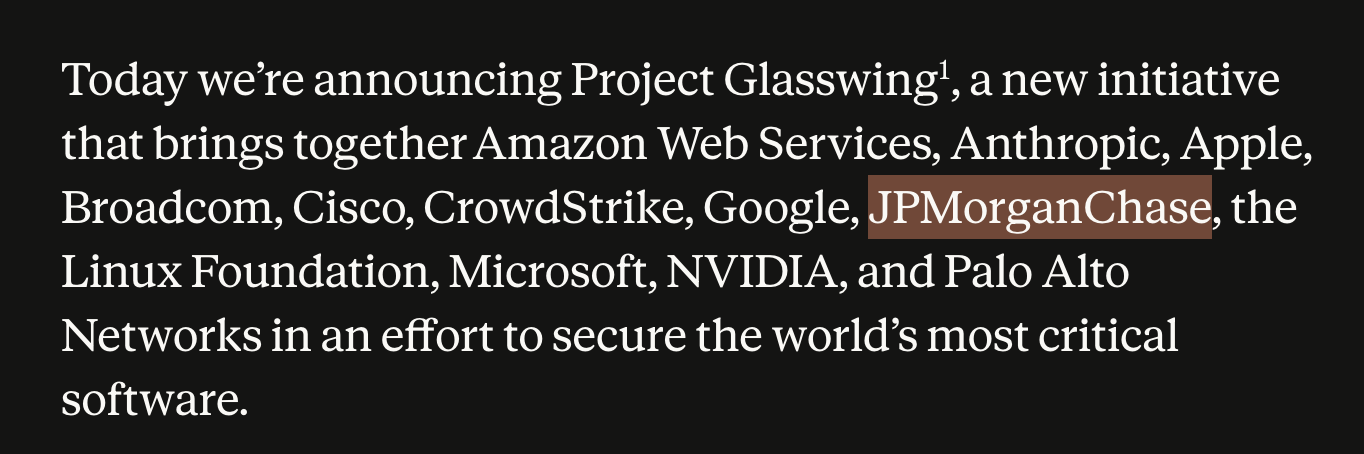

JPM a tech company
Source: Anthropic

More Markets

See all Markets
markets

Samsung’s massive Q1 fails to lift Sandisk, other data center plays

Almost all memory stocks slipped Tuesday, despite getting a positive update on the massive flood of money pouring into the sector from the AI build-out, as the potential escalation of the US war with Iran Tuesday evening overshadowed Samsung’s blowout numbers.

Korean chip giant Samsung Electronics reported preliminary Q1 results showing operating profit up by 755% compared to Q1 2025, trouncing pretty elevated expectations for a gain of about 550%.

Samsung is the world’s largest producer of NAND and DRAM chips. Once considered low-value commodity inputs to tech products, NAND and DRAM prices have exploded over the last six months amid a hyperscaler scramble to secure chips that can manage the surfeit of data produced by AI.

The same dynamics have made memory plays like Sandisk, Western Digital, and Micron some of the best-performing stocks in the S&P 500 over the last 12 months.

But other than Seagate Technology Holdings, those stocks were down Tuesday as of 11:15 a.m. ET, as the surge in oil prices and ongoing war with Iran muted much of the AI data center trade excitement. Bellwethers like Nvidia and hyperscalers like Oracle and Meta were struggling early, as were data center input makers like Corning and Coherent, AI power plays like GE Vernova, Vertiv Holdings, and even hard-hat builders of the shells that house all those AI servers.

On the other hand, some so-called optical stocks — makers of fiber-optic connections that quickly shift data between users, hyperscalers, and all around data centers themselves — were up. Lumentum and Arista Networks, two popular optical stocks, were showing resilience.

Samsung is the world’s largest producer of NAND and DRAM chips. Once considered low-value commodity inputs to tech products, NAND and DRAM prices have exploded over the last six months amid a hyperscaler scramble to secure chips that can manage the surfeit of data produced by AI.

The same dynamics have made memory plays like Sandisk, Western Digital, and Micron some of the best-performing stocks in the S&P 500 over the last 12 months.

But other than Seagate Technology Holdings, those stocks were down Tuesday as of 11:15 a.m. ET, as the surge in oil prices and ongoing war with Iran muted much of the AI data center trade excitement. Bellwethers like Nvidia and hyperscalers like Oracle and Meta were struggling early, as were data center input makers like Corning and Coherent, AI power plays like GE Vernova, Vertiv Holdings, and even hard-hat builders of the shells that house all those AI servers.

On the other hand, some so-called optical stocks — makers of fiber-optic connections that quickly shift data between users, hyperscalers, and all around data centers themselves — were up. Lumentum and Arista Networks, two popular optical stocks, were showing resilience.

markets

Paramount surges on bullish options activity, 1 day after $24 billion Gulf backing report

Paramount Skydance shares surged more than 9% shortly after markets opened on Tuesday, on pace for their best day since news that the company had emerged victorious in the Warner Bros. bidding war broke in late February.

The entertainment giant is being propelled by bullish options activity, with about 17,000 call options having changed hands as of 10:03 a.m. ET, already ahead of the 20-day average for a full session.

The market move comes a day after reports that three Gulf sovereign wealth funds would back Paramount’s offer for WBD to the tune of $24 billion. Those working on the deal don’t expect the Gulf funds’ involvement to spark any additional regulatory reviews.

markets

Intel rises on news it will join Elon Musk’s Terafab project

US chipmaking icon Intel announced that it’s joining Tesla CEO Elon Musk’s ambitious Terafab chipmaking project, sending the stock up early Tuesday.

As Sherwood News’ Rani Molla reported late last month:

“Terafab aims to bring all aspects of chip production — from design to fabrication to packaging — under one roof. Musk said the facility is intended to produce up to 1 terawatt of compute annually. The plant would manufacture inference chips for Tesla’s Robotaxis and Optimus robots, as well as custom AI chips for space-based applications, including solar-powered AI satellites. Morgan Stanley estimates the project could cost $35 billion to $45 billion in capital expenditure, likely shared between Tesla and SpaceX.”

That would be a healthy chunk of change for Intel to access, and could offer an opportunity to turn around both the finances and the narrative surrounding Intel’s struggling foundry chipmaking operations.

Latest Stories

Sherwood Media, LLC produces fresh and unique perspectives on topical financial news and is a fully owned subsidiary of Robinhood Markets, Inc., and any views expressed here do not necessarily reflect the views of any other Robinhood affiliate, including Robinhood Markets, Inc., Robinhood Financial LLC, Robinhood Securities, LLC, Robinhood Crypto, LLC, Robinhood Derivatives, LLC, or Robinhood Money, LLC. Futures and event contracts are offered through Robinhood Derivatives, LLC.
