
Markets
U.S. President Trump Meets With Japanese Business Leaders In Tokyo
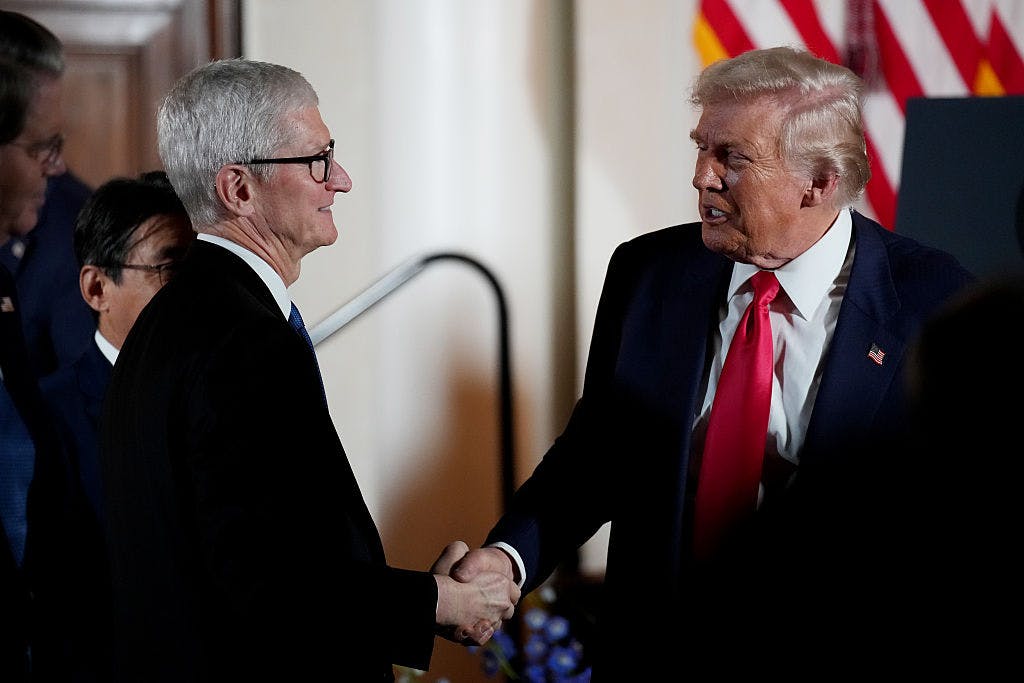
US President Donald Trump shakes hands with Apple CEO Tim Cook at the US Ambassador’s Residence in Tokyo, Japan (Andrew Harnik/Getty Images)

Apple and Nvidia are showing how China failures are no barrier to unparalleled stock market success

China-exposed companies are crushing the S&P 500 this year. That’s because “China-exposed company” is just another term for “high-growth company.”

Luke Kawa

Nvidia and Apple are the two most valuable publicly traded companies in the world. 

One big thing the two tech behemoths have in common: they’ve ascended to those lofty heights despite their China businesses being in the penalty box this year.

Tariffs have weighed on Apple’s operations and its sales in Greater China are down year on year in eight of its last nine quarters. Nvidia has been effectively shut out of China’s AI market for much of the year due to export restrictions.

And yet...

Apple’s latest earnings report propelled the company to hitherto unseen heights despite sales in Greater China coming in at $14.5 billion, 11.8% shy of estimates and down 3.6% year on year.

Today, Nvidia CEO Jensen Huang said he doesn’t know if he’ll ever be able to sell Blackwell chips to China. But that hasn’t stopped the chip designer from booking more than $500 billion in orders for its Blackwell and Rubin AI GPUs through next year.

The state of the US economy and markets in 2025:

Success, despite a lack of ability to boost sales in the world’s second-largest economy, tells us two very different things about these two market leaders.

For Apple, it speaks to its moat, brand, and platform, which enable Services revenues to continue to climb.

Even if the iPhone upgrade cycle is less about how good the new phones are and more about how old customers’ existing phones are — iPhone buyers are a loyal bunch.

Update for Apple’s Q1 guidance: I upgraded to the iPhone 17 Pro yesterday to stay in the blue bubble gang. Even as a relative luddite, getting one new piece of Apple hardware every couple years, that’s still meant my monthly bill for its services — Apple Music and iCloud, mainly — has trended higher.

In short, Apple is a reminder of how robust the megacap tech titans’ businesses are before we even think about any returns from their aggressive AI build-outs.

On the other hand, Nvidia is all about that AI boost — which has been meaningfully accelerated by the hundred of billions that most megacap tech leaders (Apple, ironically, being a notable exception) are eager to spend to develop and implement this new technology. And they’re able to do that because of how strong their existing businesses are!

These ascensions to $4 trillion (and beyond!) market caps in spite of China challenges isn’t just an Apple and Nvidia story, but rather is broadly reflected in the performance of most US stocks that have elevated sales exposure to the world’s second-largest economy.

A Goldman Sachs basket of Russell 1000 companies with elevated sales exposure to China (excluding the semiconductor industry) has outperformed that benchmark meaningfully year to date.

And semiconductors, which are excluded from that aforementioned basket because they’d otherwise dominate it, are doing even better.

These firms, in spite of elevated trade tensions and tariff levels between the US and China, have seen forward earnings estimates climb by far more than the average large-cap US stocks this year. These days, a “China-exposed” company is just a “high-growth” company by another name.

More Markets

See all Markets
markets

Alphabet gains on report that Anthropic’s committed to spending $200 billion on cloud services over the next 5 years

Shares of Google are catching a bid in postmarket trading after The Information reported that Anthropic plans to spend $200 billion on Google Cloud over the next five years, citing a person with knowledge of the situation.

That would amount to more than 40% of its $462 billion backlog as of the end of Q1, which nearly doubled from $240 billion in Q4.

The relationship between the two companies has been deepening in recent weeks, with Google reportedly planning to invest up to $40 billion in Anthropic, but this reports puts a firm price tag on how much the AI chatbot developer will be paying out to the hyperscaler.

Last year, when it was revealed that Oracle’s remaining performance obligations were dominated by OpenAI, the stock gave back some of its massive advance. Counterparty and concentration risk has been an overhang on the cloud giant ever since.

That’s a stark contrast to how traders are behaving today. It’s a sign of how Alphabet is seemingly on much more secure financial footing than Oracle (even after today’s debt offerings!), and also, probably, implies that Anthropic is a more reliable customer than OpenAI. In addition, as The Information noted, Google has more ways to make money off its relationship with Anthropic than Oracle does with OpenAI.

Anthropic has been a victim of its own success: the popularity of Claude Code and Cowork have revealed compute constraints and left users frustrated by caps. In response, the Claude developer has embarked upon a mad scramble for compute, striking or expanding deals with CoreWeave, Amazon, Google, and Broadcom.

OpenAI, on the other hand, is now billing the billions it’s burned on securing compute as a competitive advantage.

markets

Tempus AI drops after reporting better-than-expected Q1 results

Cancer diagnostics company and retail shareholder favorite Tempus AI reported better-than-expected Q1 adjusted EBITDA, earnings, and sales numbers late Tuesday, but the stock still slumped in the after-hours session.

The company reported:

  • Q1 revenue of $348.1 million vs. FactSet’s expectation of $345.4 million.

  • An adjusted loss per share of $0.13 vs. the $0.20 loss per share estimated.

  • Adjusted EBITDA of -$2.83 million vs. expectations for -$4.95 million, per FactSet.

Since going public nearly two years ago, Tempus has been a volatile stock that has both doubled — and cratered — on multiple occasions. That spectacle has at times captured the attention of retail traders who’ve tried to ride the waves.

The surf has been bad lately, with the shares down about 8% so far this year, and down roughly 50% from its record high on October 8, 2025.

markets

Advanced Micro Devices gains as CPU and GPU demand drive better-than-expected Q2 sales guidance

Advanced Micro Devices is powering higher in postmarket trading after reporting Q1 results that exceeded expectations across the board along with Q2 sales guidance higher than what Wall Street had penciled in.

In Q1, the Lisa Su-run company reported:

  • Revenue of $10.2 billion (compared to analyst estimates of $9.9 billion and guidance for $9.5 billion to $10.1 billion).

  • Adjusted earnings per share of $1.37 (estimate: $1.28).

For Q2, management projected sales in a range of $10.9 billion to $11.5 billion (estimate: $10.5 billion) with an adjusted gross margin of about 56% (estimate: 55.3%).

Customer engagement for AMD’s AI chips and racks is “strengthening,” according to CEO and Chair Lisa Su, with “leading customer forecasts exceeding our initial expectations and a growing pipeline of large-scale deployments providing us with increasing visibility into our growth trajectory.”

The chip giant is not just the No. 2 in GPUs but also CPUs, which appear to be in shortage thanks to compute demands of AI agents.

AMD was up 80% from March 30 through Tuesday’s close, and its 250% gain over the past year has left Nvidia and Broadcom’s 70% and 110% rallies, respectively, in the dust.

markets

Match Group earnings beat Wall Street’s expectations

Tinder is so back.

Match Group rose more than 4% in postmarket trading Tuesday after reporting Q1 earnings that beat Wall Street’s expectations. The dating app conglomerate reported:

  • Revenue of $864 million (compared to analyst estimates of $854.8 million and guidance for $850 million to $860 million).

  • Adjusted EBITDA of $343 million (estimate: $317.3 million, guidance for $315 million to $320 million).

  • Adjusted earnings per share of $0.68 (estimate: $0.61).

  • 13.5 million current paying users (estimate: 13.6 million).

The company has been seeking to diversify its user base. “Winning women is critical to us,” CEO Spencer Rascoff told the Financial Times, speaking about the app Tinder in April. “[Achieving] gender parity is very challenging, but we absolutely need to do a better job of driving outcomes for women.”

Though Match doesn’t disclose gender breakdowns, market intelligence platform Sensor Tower estimates that 75% of Tinder’s users are men.

Match also sees queer men as part of this effort to grow its user base. In April, the dating app company invested 100 million in Sniffies, a competitor to Grindr.

In its press release on Tuesday, the company noted a turnaround with Gen Z on Tinder — the dating app that makes up the bulk of its revenue — which is a clear signal that Tinder’s ecosystem is strengthening.

With Tinder’s revenue up 2% year over year, the company can breathe a sigh of relief, as it won’t have to lean as heavily on high-growth Hinge (up 28% year over year).

For Q2 2026, Match Group expects total revenue of $850 million to $860 million, in line with analyst estimates of $856 million. 

Meanwhile, the company’s competitor, Bumble, reported on Tuesday a 14% decrease in revenue year over year and a 21% decrease in paying users in the first quarter.

markets

Lucid reports worse-than-expected Q1 loss, revenue

Luxury EV maker Lucid reported its first-quarter earnings after markets closed on Tuesday. Its shares fell more than 2% after-hours, following a 6.5% drop at close.

For Q1, Lucid reported:

  • An adjusted loss of $2.82 per share, compared to the $2.53 loss per share expected by Wall Street analysts polled by FactSet.

  • $282.5 million in revenue, versus the $358.5 million consensus estimate.

Last month, Lucid announced that it produced 5,500 vehicles in Q1 and reaffirmed its full-year production guidance of between 25,000 and 27,000 vehicles.

The company also highlighted its upcoming midsize SUV, with “expected pricing starting under $50,000.” The vehicle is expected to launch before the end of the year and compete with Rivian’s R2 and Tesla’s Model Y.

Q1 marks the first earnings report for new CEO Silvio Napoli, who took over for interim CEO Marc Winterhoff (who’d led the company for more than a year following Peter Rawlinson’s exit). Lucid recently announced an expansion of its robotaxi partnership with Uber, which is now its second-largest shareholder after Saudi Arabia’s PIF sovereign wealth fund.

Lucid shares have had a long stretch of poor performance amid various dilutive events and a broader contraction across the EV industry. The stock is down about 80% from a recent high in July 2025 and down about 40% year to date. As of Tuesday afternoon, the company’s roughly $2.1 billion market cap is less than a quarter of the approximately $9.5 billion that Saudi Arabia’s PIF has sunk into it.

Latest Stories

Sherwood Media, LLC produces fresh and unique perspectives on topical financial news and is a fully owned subsidiary of Robinhood Markets, Inc., and any views expressed here do not necessarily reflect the views of any other Robinhood affiliate, including Robinhood Markets, Inc., Robinhood Financial LLC, Robinhood Securities, LLC, Robinhood Crypto, LLC, Robinhood Derivatives, LLC, or Robinhood Money, LLC. Futures and event contracts are offered through Robinhood Derivatives, LLC.

