Markets
Apple market cap gain chart
Sherwood News

Apple is the world’s most valuable company again, after gaining $400 billion yesterday

The iPhone maker rose more than 15% on its best day since 1998.

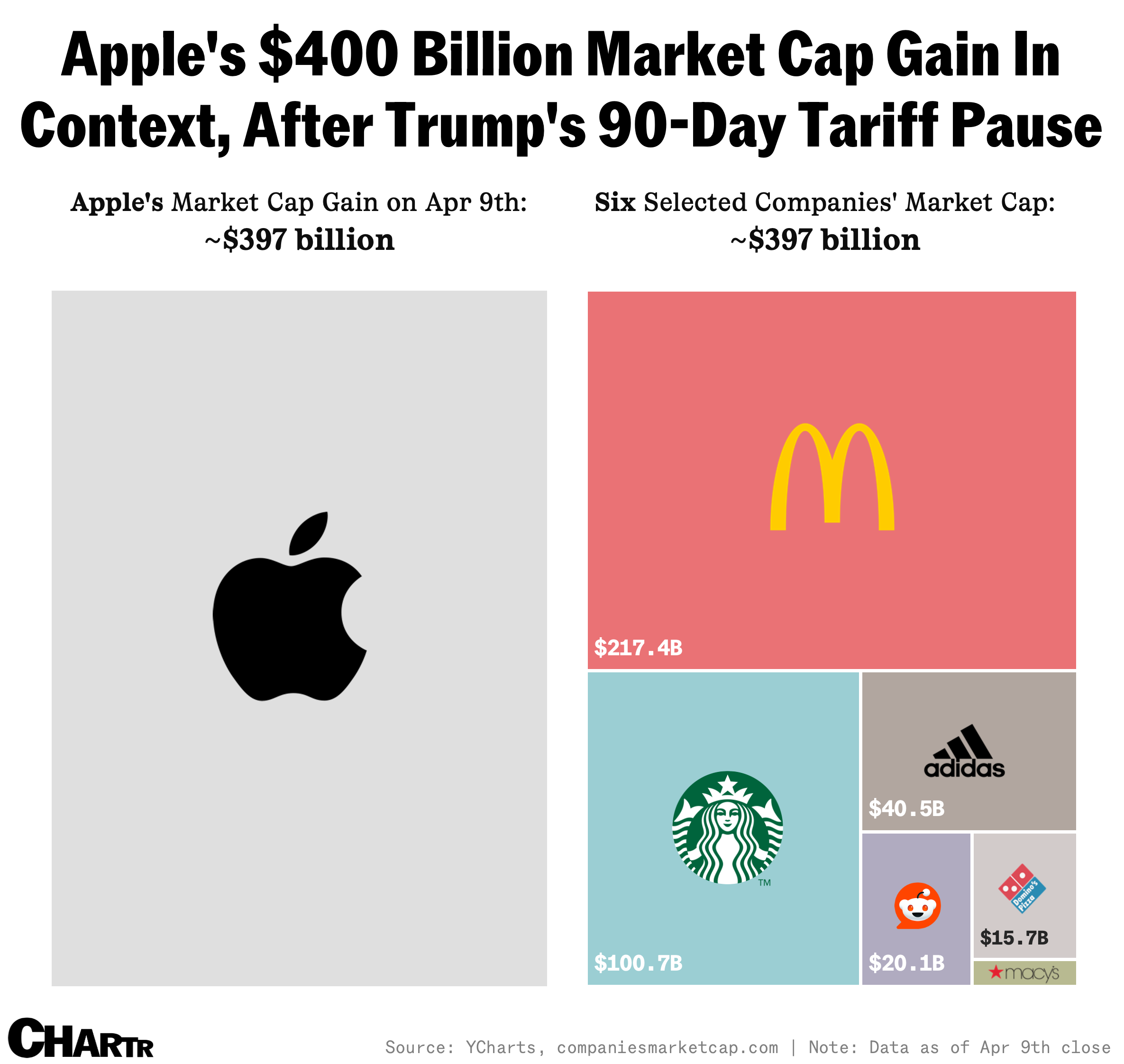
Apple just added nearly $400 billion to its market cap, with shares soaring more than 15% on Wednesday — the company’s biggest single-day gain since 1998, per CNBC.

To put that jaw-dropping ~$400 billion surge into perspective, it’s nearly as much as the market cap of Netflix ($404 billion) and just shy of a slew of consumer giants like McDonald’s, Starbucks, Adidas, and Domino’s combined.
Apple market cap gain chart
Sherwood News

Obviously, the rally was only really possible on the back of Apple’s worst four-day slide since 2000, which wiped out nearly a year’s worth of market gains, triggered by fears around President Trump’s sweeping reciprocal tariffs.

Yesterday’s surprise announcement of a 90-day pause on those tariffs seriously flipped Apple investors’ collective mood, though how long that will last is unclear. The proposed levies would still slam Apple’s sprawling overseas supply chain, which stretches across Vietnam, India, Malaysia, and Ireland, if they land in July.

On the face of it, Apple fans imitated the wider market yesterday by acting like China — where 90% of iPhones are produced — didn’t just get hit by a fresh 125% reciprocal tariff, up from the previous 104%, amid the wider reprieve. The company itself doesn’t have the luxury of operating under the same illusions, having ramped up production in India before being forced to hurriedly ship 600 tons of iPhones back earlier this week.

Despite Wednesday’s surge, Apple shares are still down 5% over the past week, though it has at least reclaimed its crown from Microsoft as the world’s most valuable company... for now.


More Markets

See all Markets
markets

AI server cluster maker Penguin Solutions takes flight

Small-cap AI server cluster maker Penguin Solutions surged Thursday after posting better-than-expected Q2 revenue and profit numbers Wednesday after the close, along with an increase in full-year sales and profit guidance.

The company, which was known as Smart Global Holdings until July 2024, has positioned itself as a provider of “end-to-end AI infrastructure solutions.”

Its Advanced Computing division designs and sells computers, cabling, and cooling systems, the server racks and clusters of racks AI data centers need. Its other main division sells flash and DRAM memory products.

It’s a pretty small company, with a fully diluted market cap of just over $1 billion and roughly 2,900 employees, according to FactSet.

The stock is volatile. Penguin dove during last year’s tariff tantrum that followed “Liberation Day” in April. Then it turned tail and doubled through early October amid a surge of call options activity, which tends to reflect retail interest. From the October peak, it then plunged by about 50%, before Thursday’s renaissance.

For what it’s worth, call options activity in Penguin is pretty busy today, too — relatively speaking — with roughly 2,625 traded as of 1:15 p.m. ET. That’s the most since early January, when the company last reported quarterly numbers. The average volume over the previous 25 trading sessions is about 325 calls a day, FactSet data shows.

The company, which was known as Smart Global Holdings until July 2024, has positioned itself as a provider of “end-to-end AI infrastructure solutions.”

Its Advanced Computing division designs and sells computers, cabling, and cooling systems, the server racks and clusters of racks AI data centers need. Its other main division sells flash and DRAM memory products.

It’s a pretty small company, with a fully diluted market cap of just over $1 billion and roughly 2,900 employees, according to FactSet.

The stock is volatile. Penguin dove during last year’s tariff tantrum that followed “Liberation Day” in April. Then it turned tail and doubled through early October amid a surge of call options activity, which tends to reflect retail interest. From the October peak, it then plunged by about 50%, before Thursday’s renaissance.

For what it’s worth, call options activity in Penguin is pretty busy today, too — relatively speaking — with roughly 2,625 traded as of 1:15 p.m. ET. That’s the most since early January, when the company last reported quarterly numbers. The average volume over the previous 25 trading sessions is about 325 calls a day, FactSet data shows.

markets

Momentum returns to optics stocks as the release valve for AI optimism

Potentially imminent end to the war? Buy optics stocks.

Maybe not? Buy optics stocks anyway.

Effectively all the juice left in the AI trade is coming from optics (and memory) stocks. And the latter group is taking a bit of a breather today while the former continues to surge.

Shares of Ciena Corp., Lumentum, and Coherent are building on recent big gains and among the biggest gainers in the S&P 500 near midday, while Applied Optoelectronics is also surging on Thursday.

These companies all provide solutions that help information move around in data centers, and thus are key beneficiaries of the aggressive capex plans of hyperscalers. Nvidia has invested $2 billion apiece in Coherent and Lumentum in deals that also include purchase commitments.

markets

Space stocks rip during a topsy-turvy day for the equity market

Satellite-services-from-space stocks surged Thursday after reports that Amazon is in talks to buy Globalstar, which provides voice and connectivity services from its satellite network. It also can’t hurt that the general mood around space is ebullient, following the successful launch of Artemis II on Thursday.

Planet Labs and ViaSat also soared on the news.

The gains for EchoStar — seen as a backdoor play at pre-IPO SpaceX exposure — and Rocket Lab were more muted, perhaps because a deep-pocketed competitor like Jeff Bezos getting serious about space services could complicate the plans of the two largest commercial space launch companies.

Rocket Lab and SpaceX see launch services as key to their aspirations of being major providers of voice and data services from low-Earth orbit satellites.

Tesla CEO Elon Musk’s SpaceX is the dominant provider of such services, and the early rumors on the company’s planned IPO — expected to be the largest ever — suggest the market is very excited about the prospects for the industry.

Elsewhere in the space stock world, Intuitive Machines — a maker of space infrastructure that provides services to NASA for lunar missions — also rose.

The gains for EchoStar — seen as a backdoor play at pre-IPO SpaceX exposure — and Rocket Lab were more muted, perhaps because a deep-pocketed competitor like Jeff Bezos getting serious about space services could complicate the plans of the two largest commercial space launch companies.

Rocket Lab and SpaceX see launch services as key to their aspirations of being major providers of voice and data services from low-Earth orbit satellites.

Tesla CEO Elon Musk’s SpaceX is the dominant provider of such services, and the early rumors on the company’s planned IPO — expected to be the largest ever — suggest the market is very excited about the prospects for the industry.

Elsewhere in the space stock world, Intuitive Machines — a maker of space infrastructure that provides services to NASA for lunar missions — also rose.

Latest Stories

Sherwood Media, LLC produces fresh and unique perspectives on topical financial news and is a fully owned subsidiary of Robinhood Markets, Inc., and any views expressed here do not necessarily reflect the views of any other Robinhood affiliate, including Robinhood Markets, Inc., Robinhood Financial LLC, Robinhood Securities, LLC, Robinhood Crypto, LLC, Robinhood Derivatives, LLC, or Robinhood Money, LLC. Futures and event contracts are offered through Robinhood Derivatives, LLC.