

Markets
Parakeet among pigeons on cobblestone sidewalk
Getty Images
CORR ISSUES

Apple’s stock is behaving differently from the rest of BATMMAAN because its AI strategy is nowhere

Apple is so bad at AI that its stock is increasingly detached from the rest of Big Tech. Some days that’s a blessing; on others, it’s a curse.

David Crowther

Hey Siri: why is Apple’s stock behaving differently from the rest of Big Tech? Siri, of course, will have absolutely no clue — because Apple’s AI strategy is borderline nonexistent.

Even at the start of this year, people were asking the question, “Why is Apple so bad at AI?” Since then, as Google’s AI efforts have gone from strength to strength, ChatGPT has grown its weekly users to nearly 900 million, and Nvidia briefly crossed a $5 trillion market cap on blowout demand for its Blackwell and Hopper chips, Apple has released some underwhelming updates to its flagship Apple Intelligence product.

And its lack of AI progress is increasingly affecting how the stock is trading, as Apple becomes a sort of “anti-AI” vehicle for investors. Indeed, its correlation with the rest of the BATMMAAN group has dropped precipitously: when ChatGPT was released at the end of November 2022, Apple’s average pairwise correlation* to its Big Tech peers was 0.71 — recently it has dropped to as low as 0.2.
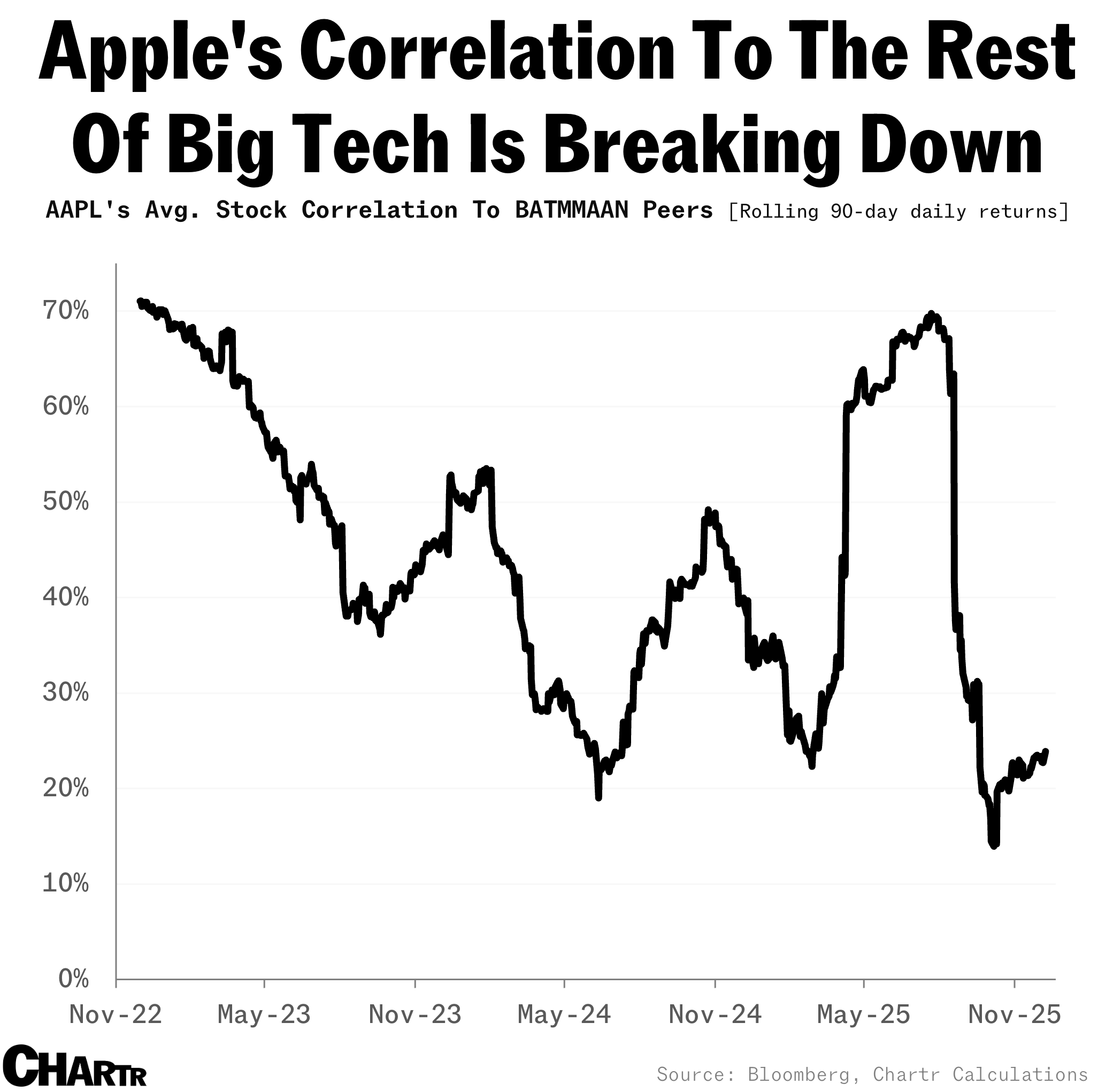
Apple stock correlation to rest of big tech (BATMMAAN)
Sherwood News

This is a pretty remarkable drop-off — and it’s been most pronounced in the stocks that are closest to the AI trade (notably Nvidia, Microsoft, and Broadcom). Apple and Microsoft used to trade nearly in tandem, with a correlation coefficient between the two north of 0.8. That has all but collapsed, with the last 90 trading sessions barely showing a positive correlation.

[The chart above is an average of the seven individual Apple-peer correlations below.]

Of course, this detachment isn’t necessarily a bad thing. On days when the AI trade sputters — such as November 13, when tech stocks got slammed, with Nvidia and Broadcom dropping ~4% and Tesla shedding 6.6% — Apple provided some refuge for tech investors, dropping just 0.2%.

Apple is weirder than Tesla

Perhaps what’s most remarkable from mining the correlation stats is that Apple’s average correlation with the rest of its peer group is now the lowest of any BATMMAAN stock. People used to say that Tesla was the odd one out of the Big Tech giants — but the trading data suggests, fairly strongly, it’s Apple right now.
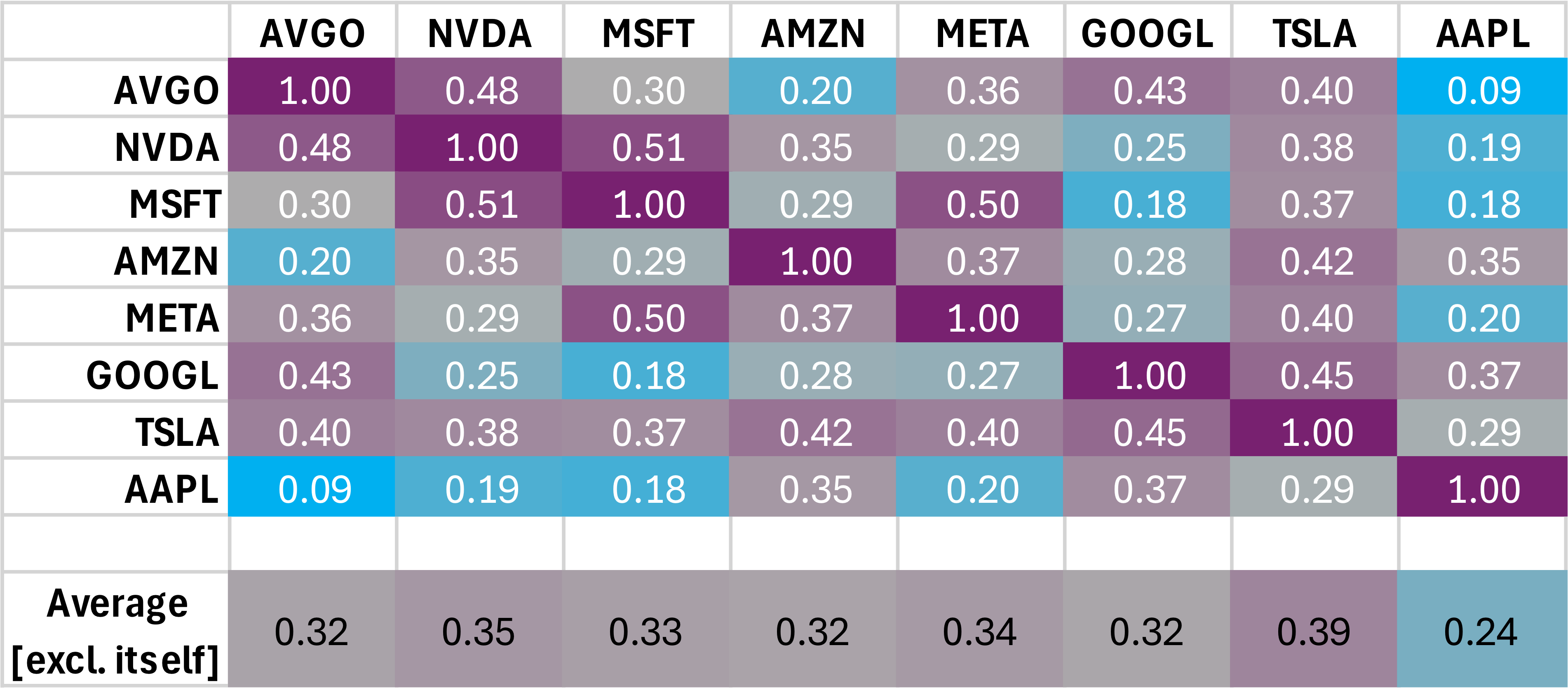
BATMMAAN Correlation Matrix
Sherwood News, 90-day correlation matrix

Last week, Apple retired its AI chief, potentially suggesting a renewed focus on the nascent technology under new leadership.

*Pearson correlations based on daily returns over 90-day rolling periods.

More Markets

See all Markets
markets

Enphase drops as guidance and results fail to impress investors

Enphase Energy fell in after-hours trading Tuesday as uninspiring Q2 guidance overshadowed better-than-expected numbers in its Q1 earnings report. The maker of solar power and battery equipment reported:

  • Sales of $282.9 million vs. the $282.3 million FactSet expectation.

  • Non-GAAP diluted earnings per share of $0.47 vs. the $0.43 consensus estimate.

  • Q2 guidance for revenue between $280 million and $310 million ($295 million at the midpoint) vs. the $294.9 million forecast.

Enphase was a sometimes popular retail trade of the Covid era, when federal tax credits and low interest rates led to a burst of activity for rooftop solar installation. Between the end of 2019 and 2022, the shares rose more than 1,000%.

But as interest rates rose — driven, in part, by both Fed hikes and worries the increases wouldn’t be enough to quell price growth — and Republicans stripped out key tax credits and subsidies for the solar sector from the federal budget, the shares tanked. They’ve lost nearly 90% of their value since peaking in December 2022, and have emerged as a favorite of short sellers. Roughly 20% of the company’s public float is now in the hands of bearish traders.

markets

Bloom Energy surges after reporting huge Q1 revenue beat, big guidance hike

Fuel cell maker and momentum trading favorite Bloom Energy surged late Tuesday after reporting Q1 earnings and revenue that trounced Wall Street expectations while ratcheting guidance higher. Here are the numbers:

  • Q1 adjusted earnings per share of $0.44 vs. the $0.12 expected by analysts, according to FactSet.

  • Revenue of $751.1 million vs. the $539.9 million consensus forecast.

  • Full-year EPS guidance of between $1.85 and $2.25 vs. previous guidance of between $1.33 and $1.48 and Wall Street expectations for $1.42.

Bloom Energy shares have been ripping in 2026. They’ve doubled this year, and were up sharply in April after the company announced that it was expanding a deal to supply its fuel cells to Oracle’s data centers. (Oracle also received warrants in April to buy Bloom stock as part of a previous deal.)

The rise of the stock — it’s up more than 1,200% over the last 12 months — has been driven by a simultaneous rise in market sentiment and expectations for business results. Analysts have lifted their full-year 2026 earnings expectations for Bloom by about 30% since the start of the year.

But even accounting for those improving fundamentals, the stock is still quite highly priced by conventional metrics, trading at a multiple of almost 120x earnings over the next 12 months and about 17x expected sales.

markets

Seagate soars on strong quarterly numbers, guidance far above expectations

Seagate Technology Holdings ripped late Tuesday after the maker of hard disk drives, relatively cheap data storage devices, reported better-than-expected quarterly numbers and guidance in its earnings report. Seagate reported:

  • Revenue of $3.11 billion vs. the $2.96 billion expectation from Wall Street analysts, per FactSet.

  • Adjusted earnings per share of $4.10 vs. the $3.51 anticipated on the Street.

  • EPS guidance of between $4.80 and $5.20 (midpoint $5.00) for the current quarter — which ends in June — vs. the $3.99 expectation.

  • Sales guidance of between $3.35 billion and $3.55 billion ($3.45 midpoint) for the current quarter vs. Wall Street’s expectation for $3.16 billion.

The sudden explosion of Seagate shares — and those of its disk-making rival, Western Digital — has been one of the more surprising outgrowths of the AI boom.

A little over a year ago, on April 8, 2025, Seagate shares had been essentially flat for over a decade. (They ended that day up 0.1% since the end of 2014.) Since then, they’re up roughly 800%, as the reality of seemingly endless AI-related demand for data storage has become plain.

Perhaps most impressive is that the pace of the gains is quickening. If the after-hours gains hold, Seagate is on track for April to be its the best month since October 2011.

Latest Stories

Sherwood Media, LLC produces fresh and unique perspectives on topical financial news and is a fully owned subsidiary of Robinhood Markets, Inc., and any views expressed here do not necessarily reflect the views of any other Robinhood affiliate, including Robinhood Markets, Inc., Robinhood Financial LLC, Robinhood Securities, LLC, Robinhood Crypto, LLC, Robinhood Derivatives, LLC, or Robinhood Money, LLC. Futures and event contracts are offered through Robinhood Derivatives, LLC.

