

Markets
BAM Circus Festival Takes Place In Milan
French acrobat Olivier Mathieu mimics recent price action in crypto (Emanuele Cremaschi/Getty Images)

Bitcoin’s plunge produces technical signal that implies 60% more downside to come

“Longer term dip buying right now appears less likely and bearish momentum is reinforced,” writes Tallbacken Capital Advisors CEO Michael Purves.

The rout in bitcoin is poised to produce a bearish technical signal that has meant “substantial more downside to come” in four of its prior five instances, according to Michael Purves, CEO of Tallbacken Capital Advisors.

He’s looking at the signal generated from the monthly moving average convergence/divergence indicator (or MACD). The technical gauge, in this case, takes the difference between the 26-month exponential moving average (EMA) of an asset with its 12-month EMA. The difference between those two is the MACD — and when that MACD crosses below its own nine-month EMA, what’s known as the signal line, that’s considered to be bearish (vice versa if crossing above).

November is slated to be the sixth time this monthly MACD sell signal has been generated in bitcoin’s history. 80% of the time, bitcoin has gone on to fall about 60% after this technical breakdown occurs.

“Longer term dip buying right now appears less likely and bearish momentum is reinforced,” Purves wrote.
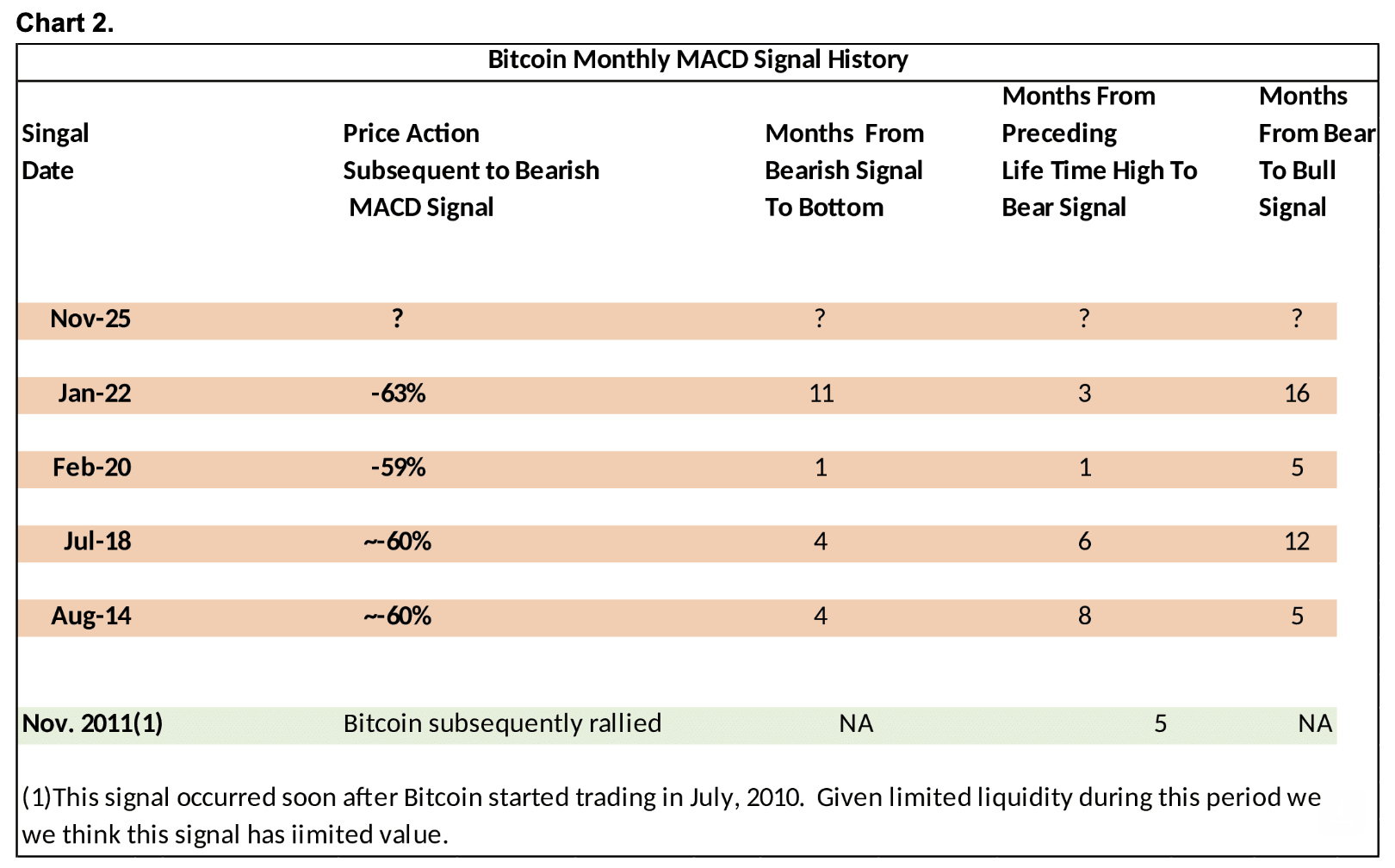
Bitcoin MACD Signal Tallbacken
Source: Tallbacken Capital Advisors

Separately, Purves also observed that bitcoin has had a much higher positive correlation with other asset classes compared to the first half of 2021, another period when there was immense appetite for tech stocks in general and speculative ones in particular. However, he expects some of this strong relationship to begin to wane in the near term.

“In the immediate term, we note that Bitcoin is very oversold (daily RSI) at 22 and has been bouncing off the 80k level, the point of the Liberation Day lows,” concluded Purves, who does not have a position recommended on the crypto asset as this time. “Some near term consolidation should be expected.”


More Markets

See all Markets
markets

Sandisk rides Wall Street price target hikes toward new record

Sandisk leapt Friday, riding a resurgent wave of AI-related market exuberance as well as two price target hikes from Wall Street analysts.

Goldman Sachs lifted its target for the stock to $320 from $280, while keeping a “buy” rating on the stock. Mizhuho lifted its target to a Street high of $410 from its previous target of $250, while maintaining an “outperform” rating on the shares.

Long considered a maker of commodity data storage products, Sandisk was spun off by Western Digital in an IPO in February.

When it dawned on the market sometime in the fall that the AI boom would mean an explosion in demand for data storage, Sandisk shares went parabolic.

Its more than 350% run-up between the ends of August and December led to Sandisk’s inclusion in the S&P 500. And its 560% gain for the year made it the index’s top performer.

markets
Luke Kawa

It looks like the stock market was expecting some tariff relief

The S&P 500 briefly dipped into negative territory and tariff-sensitive stocks swung from big gains to big losses after the Supreme Court declined to give a ruling on tariffs imposed by President Donald Trump under the IEEPA.

A basket of “Trump Tariff Losers” stocks compiled by UBS, which includes Under Armour, American Eagle, Yeti, Mattel, and Deckers Outdoor, was up as much as 1.5% in early trading before falling as much as 1.7% after news of the lack of news surfaced.

The good news is that for the market as a whole (and even this group in particular), the pain seems to have been short-lived, with both bouncing back to erase losses.

It’s a decent little snapshot or case study to show that, yes, as prediction markets imply, the stock market is pricing in tariff relief.

markets

Amazon pharmacy to begin offering home delivery for Novo Nordisk’s Wegovy pill

Amazon Pharmacy announced Friday that it will offer Novo Nordisk’s recently approved weight-loss pill Wegovy, the newest frontier in the drugmaker’s push toward direct-to-consumer options.

Amazon said it will offer delivery for the pill through insurance and cash-pay options. Novos cash-pay price for the pill is $149 a month — less than half of what its injectables cost through the same channel.

Novo has partnered with big-box stores like Costco and Walmart as well as several big telehealth companies, including Ro, Weight Watchers, and LifeMD, to distribute the pill. This comes as the Danish pharma giant is trying to regain ground after Eli Lilly surpassed it in market share, in large part because of its early emphasis on direct-to-consumer channels.

The Food and Drug Administration approved Novos weight-loss pill in December, making it the first approved weight-loss pill to go to market. It has the same active ingredient, semaglutide, as its injectable products, Ozempic and Wegovy. Lillys oral version, orforglipron, is expected to come to market later this year.

markets

Intel gains after a favorable post from Trump

Intel continued its strong 2026 start by rising early Friday, following a favorable online post from President Trump, whose administration partially nationalized the ailing American chip giant in August.

In a Truth Social post Thursday afternoon, he praised CEO Lip-Bu Tan, boasted about the amount of money the government’s 10% investment in the company has made, and said, “Our Country is determined to bring leading edge Chip Manufacturing back to America, and that is exactly what is happening!!!”

Even after adjusting for the Trumpian tendency toward hyperbole, that last comment will be intriguing to Intel watchers. The company’s search to make deals with external customers willing to use its next-generation contract chip manufacturing business, crucial to the future of Intel’s ailing foundry business, will likely be a key driver of the stock price this year.

It’s not nuts to think that having the US government as a shareholder and the president as an active cheerleader — especially one who’s not shy about putting pressure on private sector companies to get what he wants — could be helpful in corralling reticent foundry customers.

Intel is up roughly 16% year to date and has more than doubled over the last year.

Even after adjusting for the Trumpian tendency toward hyperbole, that last comment will be intriguing to Intel watchers. The company’s search to make deals with external customers willing to use its next-generation contract chip manufacturing business, crucial to the future of Intel’s ailing foundry business, will likely be a key driver of the stock price this year.

It’s not nuts to think that having the US government as a shareholder and the president as an active cheerleader — especially one who’s not shy about putting pressure on private sector companies to get what he wants — could be helpful in corralling reticent foundry customers.

Intel is up roughly 16% year to date and has more than doubled over the last year.

Latest Stories

Sherwood Media, LLC produces fresh and unique perspectives on topical financial news and is a fully owned subsidiary of Robinhood Markets, Inc., and any views expressed here do not necessarily reflect the views of any other Robinhood affiliate, including Robinhood Markets, Inc., Robinhood Financial LLC, Robinhood Securities, LLC, Robinhood Crypto, LLC, or Robinhood Money, LLC.