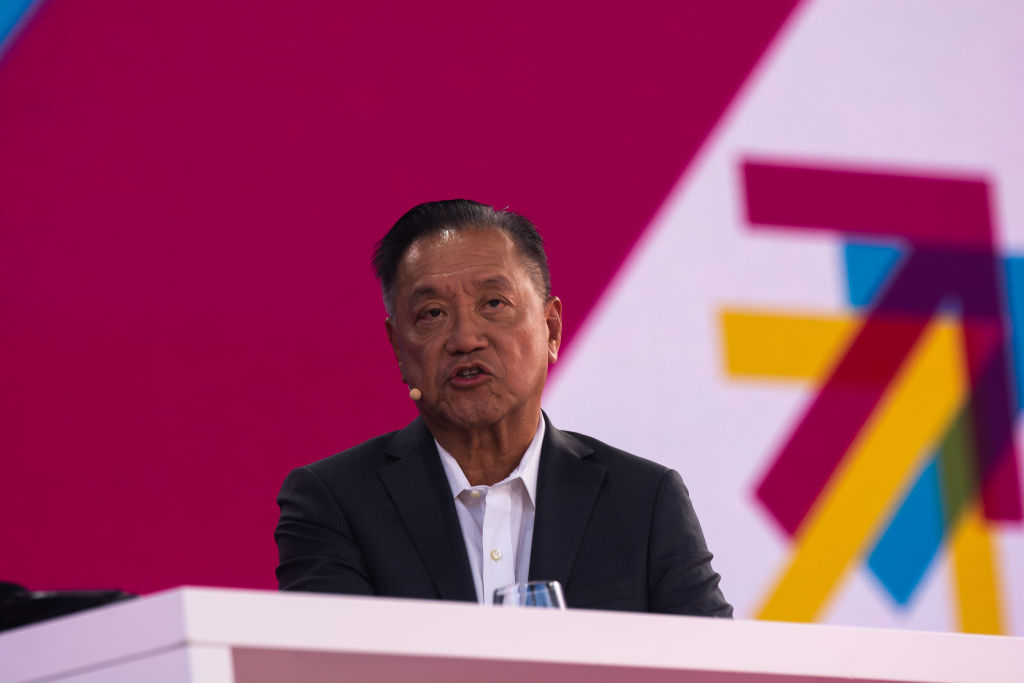
How Broadcom CEO Hock Tan won the market over during the earnings call
“Broadcom knocked down (at least) four outstanding investor concerns on the call,” wrote Bernstein analyst Stacy Rasgon, who upped his price target to $525 from $475.
Broadcom CEO Hock Tan served up an optimistic vision of a fast-growing, highly profitable, multi-faceted AI juggernaut whose custom chip business is its major clients’ top priority.
And the market ate it up.
Shares had been relatively lifeless after the custom chip specialist posted modestly better than expected Q1 results along with strong Q2 guidance. But the stock took off during the conference call as Tan spoke, advancing more than 5% during the call and adding to those gains in premarket trading on Thursday.
“Broadcom knocked down (at least) four outstanding investor concerns on the call,” wrote Bernstein analyst Stacy Rasgon, who upped his price target to $525 from $475. “It now appears that EPS approaching $20 a share could conceivably be in the realm of possibility for next year, putting valuation extremely inexpensive relative to likely earnings power, with accompanying margins and free cash flow entering rarefied territory.”
Here’s how Hock won the market over during the call:
High confidence on massive orders from his six custom chip buyers
From the CEO:
“For Anthropic, we are off to a very good start in 2026 for 1-gigawatt of TPU compute. And for '27, this demand is expected to surge in excess of 3-gigawatts of compute. Our XPU franchise, I should add, extends beyond TPUs. Now contrary to recent analyst reports, Meta's custom accelerator MTIA roadmap is alive and well. We're shipping now. And in fact, for the next-generation XPUs, we will scale to multiple gigawatts in '27 and beyond.”
How high is that confidence? Enough to have a $100 billion revenue forecast for the biggest part of its business, a substantial improvement over the $73 billion backlog the company had set as a “minimum” for AI sales over the next six quarters back in December.
“Our visibility in 2027 has dramatically improved. Today, in fact, we have line of sight to achieve AI revenue — from chips, just chips — in excess of $100 billion in 2027,” Tan added.
(He clarified that the $100 billion applied to XPUs, switch chips, DSPs, and more — “these are silicon content we’re talking about.”)
The consensus estimate for Broadcom’s fiscal 2027 AI sales was $85.8 billion heading into this release, and has already been revised up to $96.6 billion before the market opened on Thursday.
Do not worry about margins
“I hate to tell you that you must be a bit hallucinating,” said Tan in response to a question from an analyst about rack sales weighing on gross margin.
Broadcom’s profitability on that metric was stronger than expected in Q1, and management’s call for adjusted EBITDA to be 68% of sales in the current quarter bested analysts’ expectations for 67%.
“On the margin side, the team is not seeing any gross margin degradation as it ramps up XPU program for Anthropic in the 2H of the year— and that alleviates a major investor concern and overhang for the stock,” writes JPMorgan analyst Harlan Sur, who lifted his price target to $500 from $475.
Supply isn’t a challenge, either
Broadcom has secured supply to meet its big customers’ needs. Not just for this year or next year, but the year after that (2028) as well.
Per Tan:
“We provide multi-year supply agreements as our customers scale up deployment of their compute infrastructure. Our ability to ensure supply in these times of constrained capacity in leading edge wafers, in high-bandwidth memory, and substrates ensures the durability of our partnerships, and we have fully secured capacity of these components for '26 through '28.”
On this point, Broadcom’s semiconductor solutions group president Charlie Kawwas added that this resourcing was a function of how deeply integrated the company is with its custom chip clients.
“We build custom silicon for six customers. We have very deep strategic multi-year engagement with them,” he said. “They share with us, because of this custom capability, exactly what they anticipate at least over the next two to three years, sometimes four years.”
It’s not always what you say but...
...how your stock price looked like before you said it.
The conference call has been a huge swing factor for Broadcom in recent quarters.
In Q4, the stock swooned after the CEO failed to detail any new major wins for its custom chip business. Prior to that, Tan’s on-call announcement following Q3 results of a new $10 billion customer (first speculated to be OpenAI, later revealed as Anthropic) that would boost this year’s sales “significantly” sent shares skyward.
Unlike rivals Nvidia and Advanced Micro Devices, Broadcom hadn’t been doing well in the run-up to this report. This may help explain why traders were willing to be reassured and reward positive results and a solid outlook, which was not the case for those GPU sellers.