Markets
In this photo illustration a Reddit logo is seen on a mobile...
(Pavlo Gonchar/Getty Images)
Weird Money

How a Canadian carpenter became an options trader, made $300 million, and then went bust

The trader, who made and lost his fortune trading Tesla options, is suing RBC, claiming the bank’s at fault.

Jack Raines

Like many of us, Christopher DeVocht, a carpenter from Vancouver, developed a propensity for trading stocks during the pandemic. Unlike most of us, however, he was pretty good at trading stocks, turning C$88,000 into C$415 million ($306 million) between 2019 and 2022.

And then he lost it all.

On October 1, 2024, DeVocht filed a lawsuit against the Royal Bank of Canada (RBC) and accounting firm Grant Thornton, for, among other things, costing him C$415 million. I read through the court filing, and the details of this case are wild. 

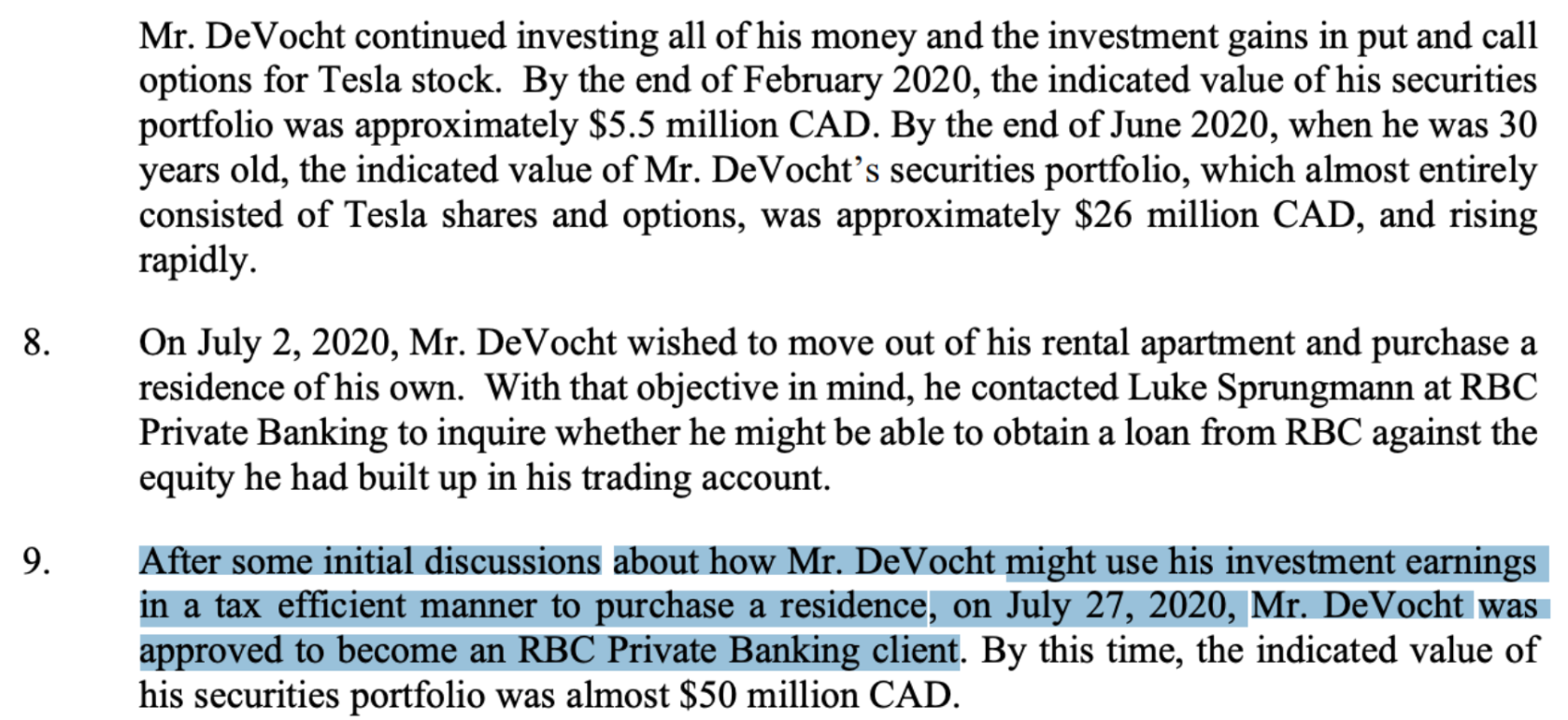
According to the civil claim filing, in his early 20s, DeVocht regularly lost money day-trading in a personal account that he had opened through RBC, but he kept dumping more money into his account, primarily to trade Tesla. In 2019, as Tesla’s stock price climbed, his portfolio grew to C$88,000, and DeVocht decided to double down on Tesla again, and again, and again, loading up on options contracts, and it worked. By February 2020, he had C$5.5 million, and in June, his portfolio was worth C$26 million and “rising rapidly.”

In July of that year, he wanted to move out of his rental unit and purchase his own home, and he contacted a representative from RBC’s Private Banking arm to see if he could borrow against his Tesla stock to get a loan to buy a house.

Yes, instead of selling the millions of dollars that he had made on Tesla call options, he wanted to use it as collateral for a home loan.
DeVocht
From DeVocht’s civil claim

After he was approved to become an RBC Private Banking client, DeVocht was given an RBC financial advisor, Chris Delorme. Per the civil claim, DeVocht and RBC signed an agreement stating the following:

“RBC would be paid various fees and commissions from the products and services provided to the plaintiffs as arranged by Mr. Delorme on behalf of RBC. In return, Mr. Delorme would provide Mr. DeVocht with financial planning advice, and in doing so would exercise the care, skill and diligence reasonably expected from a professional advisor in that capacity.”

Among other responsibilities, Delorme’s team would:

  • advise Mr. DeVocht carefully and skillfully in accordance with his risk tolerance and financial objectives;

  • explain to Mr. DeVocht the risks and consequences of any financial planning strategies;

  • recommend only investments and financial planning strategies to Mr. DeVocht that were suitable, having regard to his particular circumstances, investment knowledge, financial objectives, and risk tolerance;

  • advise about and recommend strategies to minimize risks and preserve wealth.

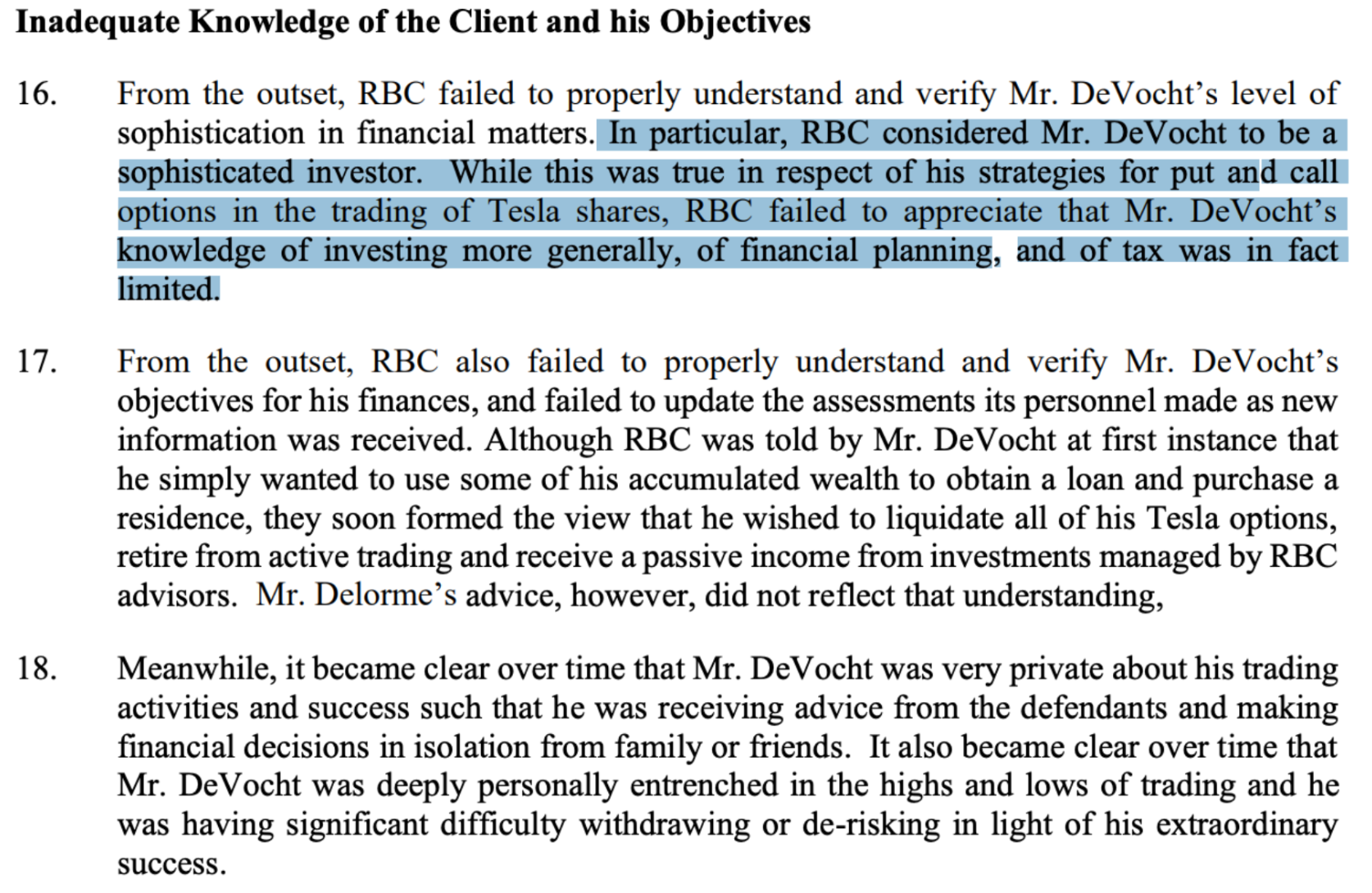
According to the claim, RBC “failed to properly understand and verify” Mr. DeVocht’s level of sophistication in financial matters, which were pretty narrow in scope: he knew how to sling Tesla options, but that was about it.
DeVocht
From DeVocht’s civil claim

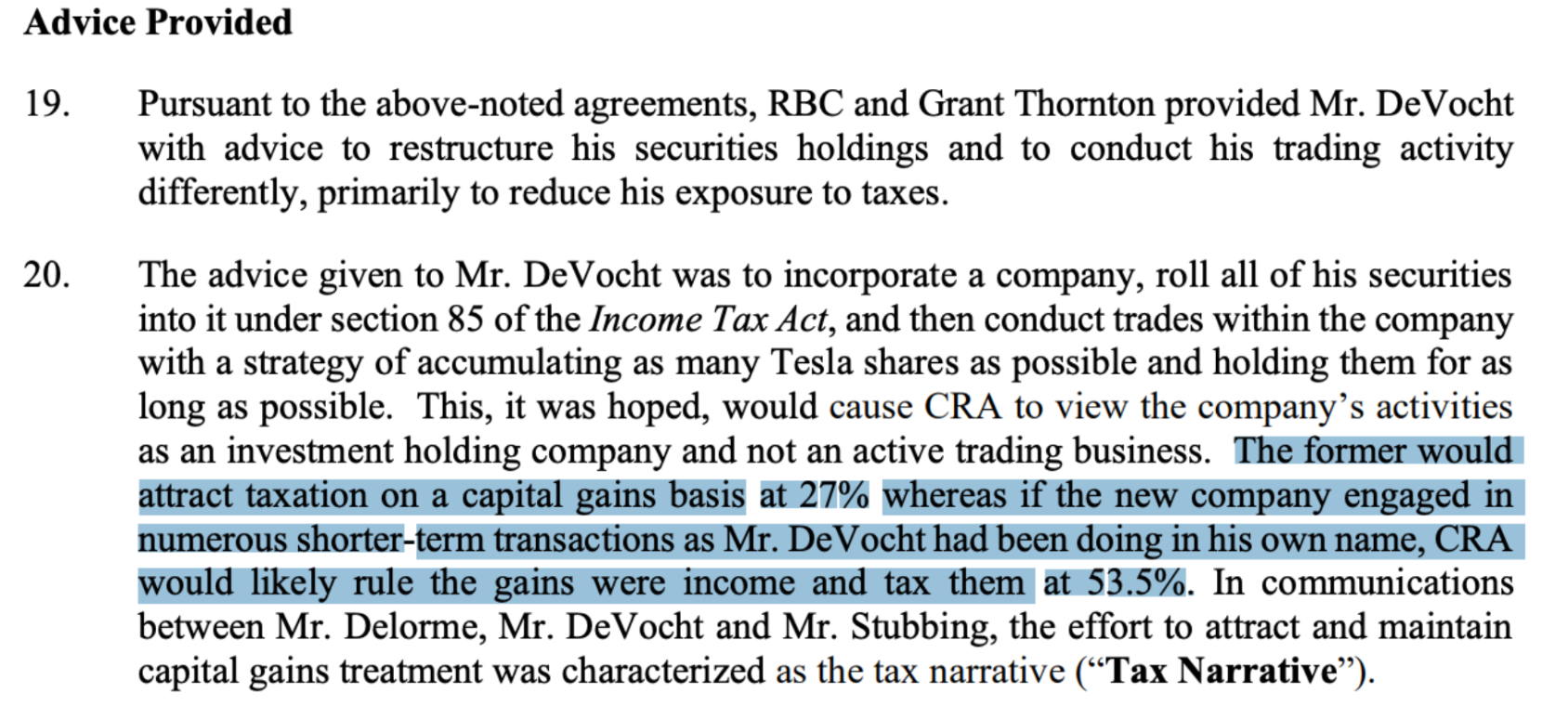
RBC also connected DeVocht to accounting firm Grant Thornton, which it appears provided him decent advice for minimizing his taxes: namely, trading through an LLC to cut his capital gains tax rate in half.
DeVocht
From DeVocht’s civil claim

Note in point 20 that according to DeVocht, besides creating an LLC, he was advised to “accumulate as many Tesla shares as possible” and hold them “as long as possible” to help lower his tax liability. So DeVocht did just that: he transferred his securities to DeVocht Corp in October 2020, and he began providing trading instructions to Delorme to execute the trades (for a fee, of course) in December of that year. DeVocht then claimed, in accordance with the tax minimization advice, he accrued “as much Tesla stock as possible through options trading and other transactions” and held it for “as long as possible.”

And for the next 11 months, it worked! By April 2021, his portfolio was worth C$186 million, and in November, it reached C$415 million. I would like to take a step back here so we can imagine what this looks like:

A 30-year-old carpenter from Vancouver approaches the Royal Bank of Canada and says, “I want to buy a house. Can I take a loan against my portfolio?” A representative from RBC’s Private Bank raises an eyebrow as he reviews a portfolio consisting of millions in Tesla call options, before shaking his hand, saying, “Of course!” and setting him up with a financial advisor. A few months later, this carpenter is calling his RBC-appointed financial advisor, instructing him to buy C$75 million in weekly Tesla call options. Of course the advisor complies: it’s the client’s money, after all! And those call options represent trading fees.

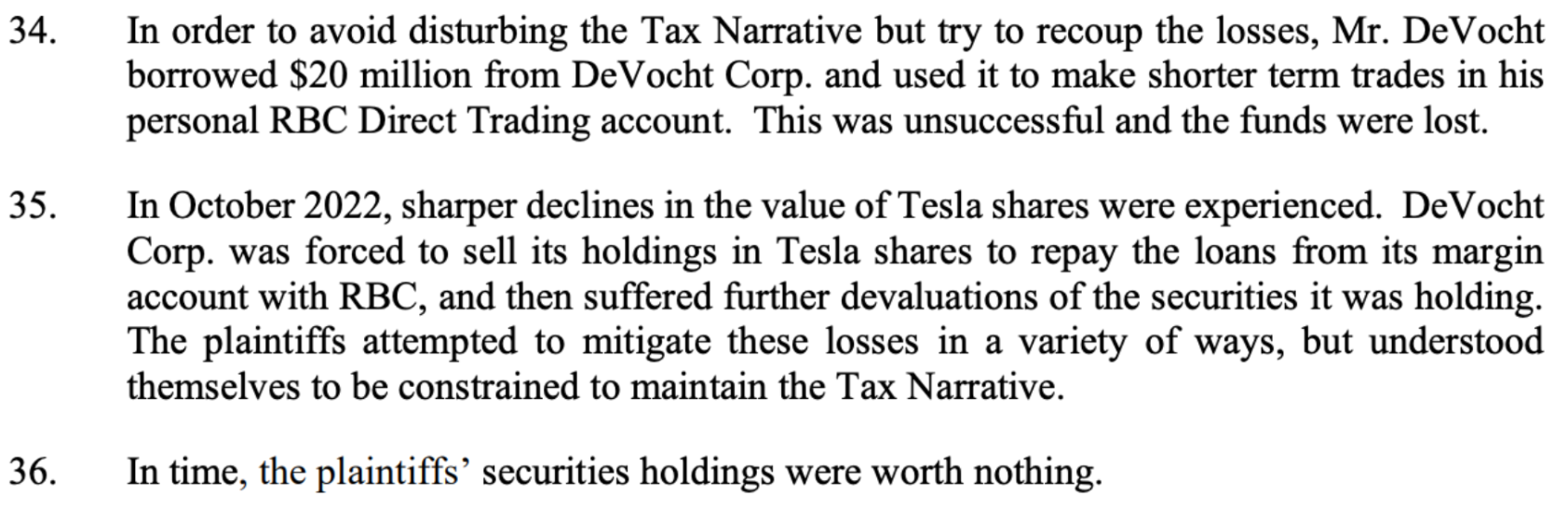
Then Tesla tanked, and DeVocht took a C$20 million personal loan from his own LLC to try to “recoup the losses” by trading his personal account, which went about as well as you’d expect:
DeVocht
From DeVocht’s civil claim

This is, without a doubt, my favorite trading story of all time. I remember, in the early days of the pandemic, turning $10,000 into $30,000 trading S&P put options, before quickly roundtripping back to $10,000, but $88,000 to $415 million to “nothing” is god-tier performance. Among the reasons listed in legal basis for his suit, Devocht notes that RBC “failed to recognize Mr. DeVocht’s personal entrenchment and potential addiction to the highs and lows of RBC’s Direct Investing platform, such that he was having significant difficulty withdrawing or de-risking in light of his extraordinary success.”

I would say addiction is an understatement. While he may have lost nine figures, there is a consolation prize: his story managed to garner 6,900 upvotes on Wall Street Bets.
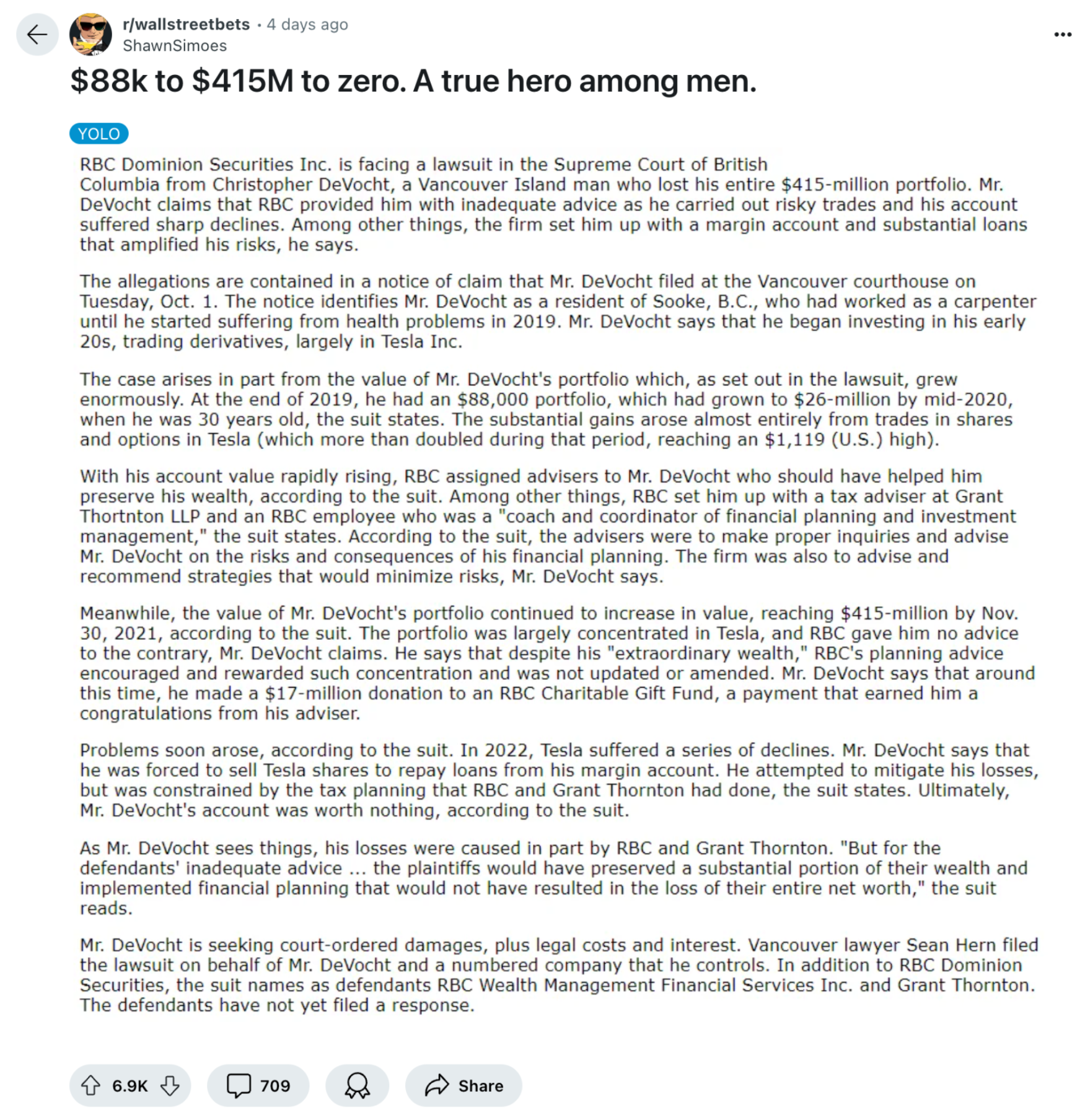
WSB DeVocht
Wall Street Bets post highlighting DeVocht

Capital gains are temporary; Reddit karma is forever.

More Markets

See all Markets
markets

JetBlue takes off on bullish options activity

Low-cost airline JetBlue is up more than 8% on Tuesday, on pace for its biggest daily gain since August. If the price momentum holds, Tuesday will mark JetBlue’s sixth-best trading day of the past 52 weeks.

The carrier is being propelled by bullish options activity, with more than 53,000 call options changing hands as of 12:14 p.m. ET, nearly 4x the 20-day average for a full session.

JetBlue closed up 4.6% on Monday, as traders appeared to price in medium-term oil supply relief due to the possibility of Venezuela’s reserves getting more developed amid tensions with the US.

markets

Moderna rallies after BofA raises its price target to $24 from $21

Moderna rose on Tuesday after Bank of America analysts raised their price target for the ailing biotech behind the COVID-19 vaccine, painting a rosy picture of the products in its pipeline.

BofA kept Moderna’s “underperform” rating but raised its price target to $24 from $21, which now accounts for “refreshed revenue builds for lead assets.” Analysts said the company’s cost-cutting measures, paired with potential new revenue from its investigatory oncology vaccines, could bring it back to profitability in the coming years.

Moderna is best known for being tapped by the US government to quickly develop a vaccine for COVID-19 in 2020, a product that remains its single source of revenue. The company has yet to bring new products to market and is now faced with a second Trump administration hostile to that product.

markets

Roblox drops following overnight outages and a lowered price target from TD Cowen

Gaming platform Roblox fell as much as 7% on Tuesday, following reports of widespread outages overnight and a lowered price target from TD Cowen.

Downdetector, a monitoring service that uses “signals from its own websites, social media platforms and other sources” to analyze outages, tracked roughly 22 outage reports per second at peak overnight Monday into Tuesday.

Meanwhile, TD Cowen issued a new research note on Roblox Tuesday, lowering its price target on the stock to $70 from $77. Analyst Doug Creutz wrote that user engagement with the platform’s biggest hits, including “Grow a Garden” and “Steal a Brainrot,” declined 52% between mid-September and mid-December. The firm lowered its fiscal year bookings estimate from $8.48 billion to $8.09 billion.

markets

Data storage stocks surge as Nvidia CEO calls the market “completely unserved”

Sandisk soared in early trading, leading the pack of data storage stocks that topped the market last year — including Western Digital, Micron, and Seagate Technology Holdings — sharply higher Tuesday.

Despite little news on Sandisk itself, its shares were trading at a furious rate. Shortly before 10 a.m. ET, roughly 4.1 million had changed hands, more than 3x as much as normal for that stage of the session.

Besides benefiting from a broad upswing in AI-related trades on Tuesday, memory chip and data storage makers have soared, alongside prices for their products, in an rally that started late last year.

Closely watched comments from Nvidia CEO Jensen Huang at the Consumer Electronics Show underscored the strong outlook for demand from the AI industry for data storage.

“This market will likely be the largest storage market in the world, basically holding the working memory of the world’s AIs,” he told analysts at the trade show Monday, who called storage “a completely unserved market today.”

That demand seems set to continue to push prices up in early 2026, according to Morgan Stanley analysts.

In a note published Tuesday, tech hardware analysts at the bank wrote that prices for DRAM memory, which Micron makes, are expected to increase 40% to 70% quarter over quarter in Q1.

Similarly prices for NAND flash memory — a crucial form of memory for long-term storage and the heart of Sandisk’s products — are expected to increase 30% to 35% in Q1 2026, Morgan Stanley analysts said, citing industry estimates.

markets

Nvidia’s partners really want you to know they’re involved with Vera Rubin, too

Everybody’s trying to get on the Vera Rubin rocket ship.

Nvidia CEO Jensen Huang’s confirmation that its new flagship AI chips are in “full production” sparked a flurry of announcements from partners reminding us that they’ll also be involved in this rollout, sending their stocks meaningfully higher on Tuesday, before most pared gains.

  • Nvidia-backed Nebius “will deploy the NVIDIA Rubin platform through Nebius AI Cloud and Nebius Token Factory, unlocking next-generation reasoning and agentic AI capabilities for customers starting H2 2026.”

  • Also Nvidia-backed CoreWeave said it expects “to be among the first cloud providers to deploy the NVIDIA Rubin platform in the second half of 2026, offering its customers greater flexibility and choice as AI systems scale.”

  • Server company Super Micro Computer announced “expansions in manufacturing capacity and liquid-cooling capabilities, in collaboration with NVIDIA, to enable first-to-market delivery of data center-scale solutions optimized for the NVIDIA Vera Rubin and Rubin platforms.”

Latest Stories

Sherwood Media, LLC produces fresh and unique perspectives on topical financial news and is a fully owned subsidiary of Robinhood Markets, Inc., and any views expressed here do not necessarily reflect the views of any other Robinhood affiliate, including Robinhood Markets, Inc., Robinhood Financial LLC, Robinhood Securities, LLC, Robinhood Crypto, LLC, or Robinhood Money, LLC.