


How a Canadian carpenter became an options trader, made $300 million, and then went bust
The trader, who made and lost his fortune trading Tesla options, is suing RBC, claiming the bank’s at fault.
Like many of us, Christopher DeVocht, a carpenter from Vancouver, developed a propensity for trading stocks during the pandemic. Unlike most of us, however, he was pretty good at trading stocks, turning C$88,000 into C$415 million ($306 million) between 2019 and 2022.
And then he lost it all.
On October 1, 2024, DeVocht filed a lawsuit against the Royal Bank of Canada (RBC) and accounting firm Grant Thornton, for, among other things, costing him C$415 million. I read through the court filing, and the details of this case are wild.
According to the civil claim filing, in his early 20s, DeVocht regularly lost money day-trading in a personal account that he had opened through RBC, but he kept dumping more money into his account, primarily to trade Tesla. In 2019, as Tesla’s stock price climbed, his portfolio grew to C$88,000, and DeVocht decided to double down on Tesla again, and again, and again, loading up on options contracts, and it worked. By February 2020, he had C$5.5 million, and in June, his portfolio was worth C$26 million and “rising rapidly.”
In July of that year, he wanted to move out of his rental unit and purchase his own home, and he contacted a representative from RBC’s Private Banking arm to see if he could borrow against his Tesla stock to get a loan to buy a house.
Yes, instead of selling the millions of dollars that he had made on Tesla call options, he wanted to use it as collateral for a home loan.
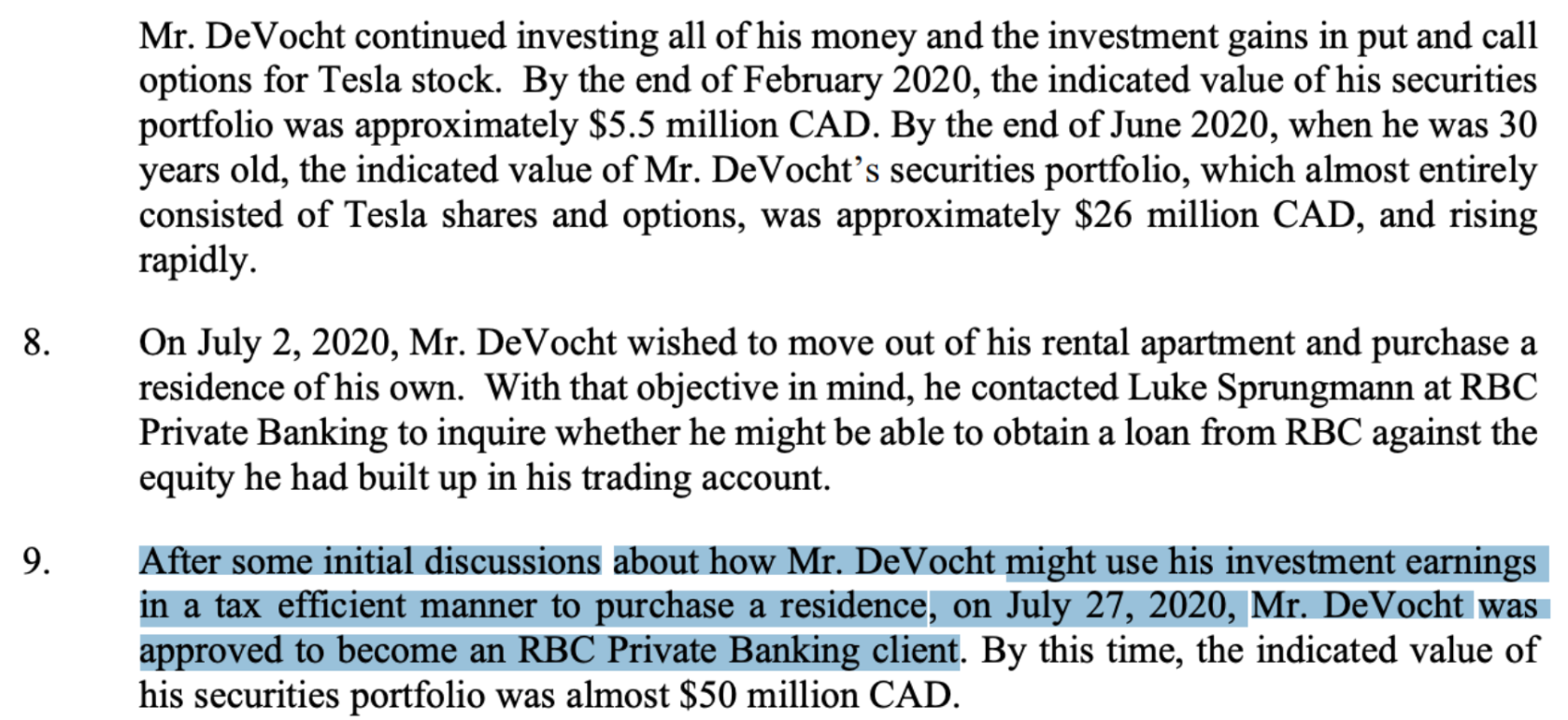
After he was approved to become an RBC Private Banking client, DeVocht was given an RBC financial advisor, Chris Delorme. Per the civil claim, DeVocht and RBC signed an agreement stating the following:
“RBC would be paid various fees and commissions from the products and services provided to the plaintiffs as arranged by Mr. Delorme on behalf of RBC. In return, Mr. Delorme would provide Mr. DeVocht with financial planning advice, and in doing so would exercise the care, skill and diligence reasonably expected from a professional advisor in that capacity.”
Among other responsibilities, Delorme’s team would:
advise Mr. DeVocht carefully and skillfully in accordance with his risk tolerance and financial objectives;
explain to Mr. DeVocht the risks and consequences of any financial planning strategies;
recommend only investments and financial planning strategies to Mr. DeVocht that were suitable, having regard to his particular circumstances, investment knowledge, financial objectives, and risk tolerance;
advise about and recommend strategies to minimize risks and preserve wealth.
According to the claim, RBC “failed to properly understand and verify” Mr. DeVocht’s level of sophistication in financial matters, which were pretty narrow in scope: he knew how to sling Tesla options, but that was about it.
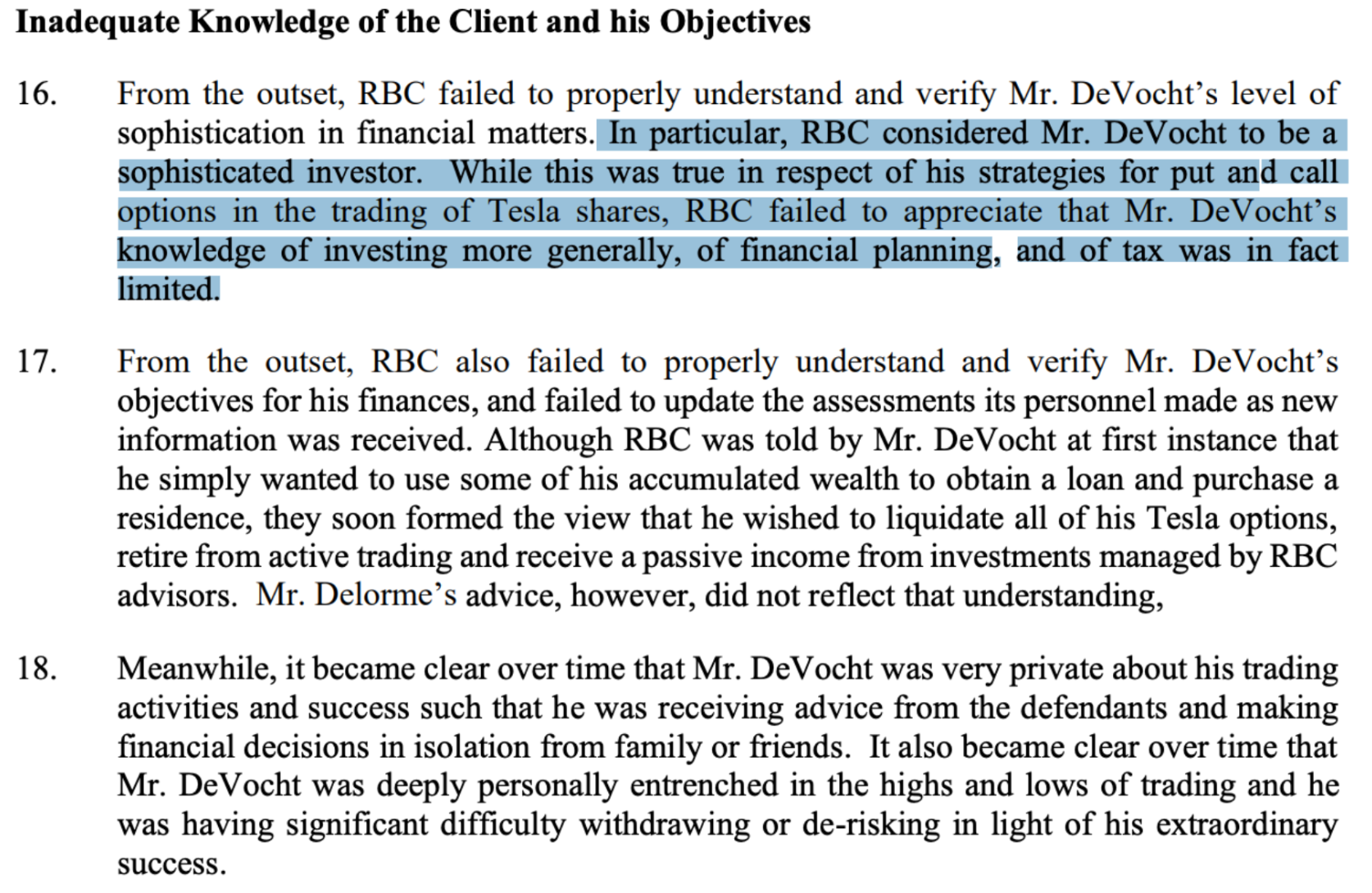
RBC also connected DeVocht to accounting firm Grant Thornton, which it appears provided him decent advice for minimizing his taxes: namely, trading through an LLC to cut his capital gains tax rate in half.
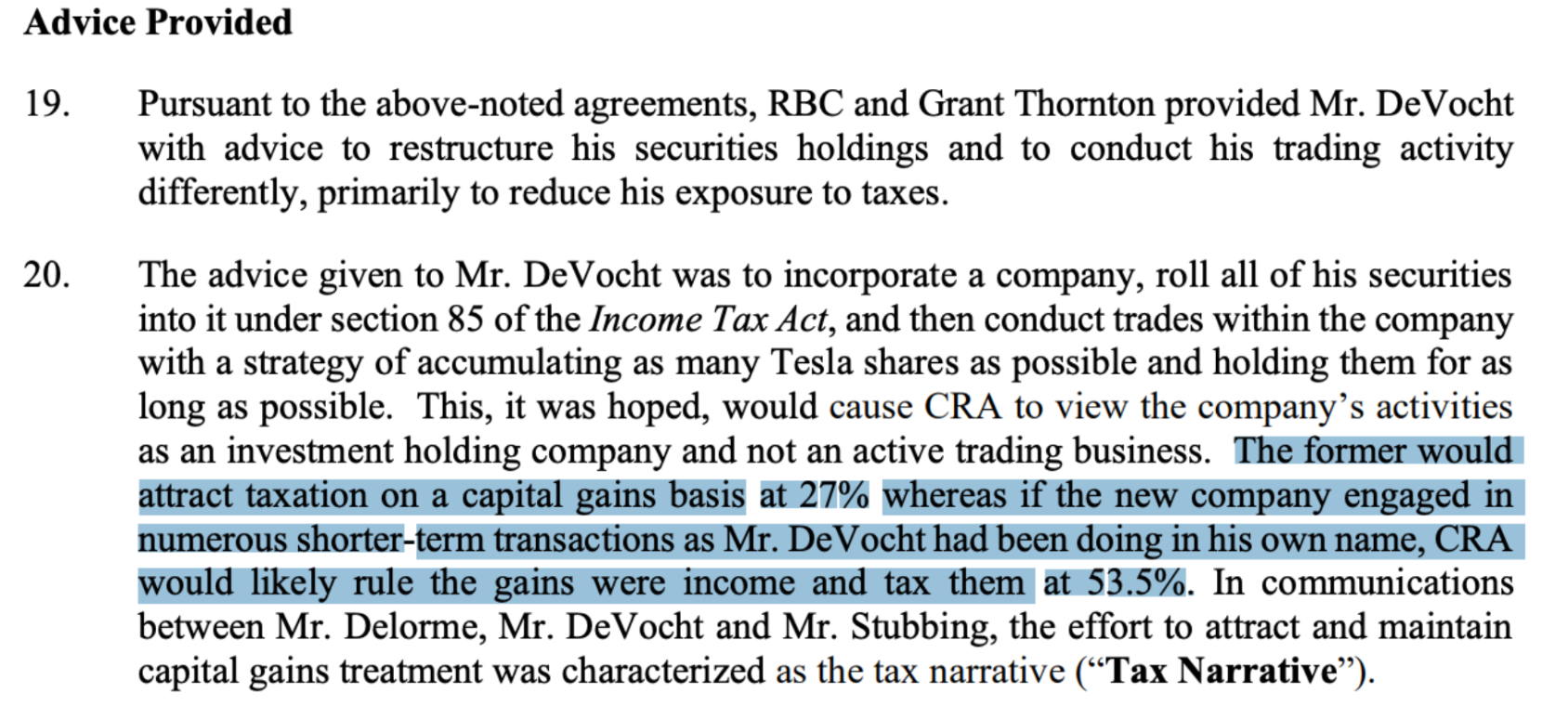
Note in point 20 that according to DeVocht, besides creating an LLC, he was advised to “accumulate as many Tesla shares as possible” and hold them “as long as possible” to help lower his tax liability. So DeVocht did just that: he transferred his securities to DeVocht Corp in October 2020, and he began providing trading instructions to Delorme to execute the trades (for a fee, of course) in December of that year. DeVocht then claimed, in accordance with the tax minimization advice, he accrued “as much Tesla stock as possible through options trading and other transactions” and held it for “as long as possible.”
And for the next 11 months, it worked! By April 2021, his portfolio was worth C$186 million, and in November, it reached C$415 million. I would like to take a step back here so we can imagine what this looks like:
A 30-year-old carpenter from Vancouver approaches the Royal Bank of Canada and says, “I want to buy a house. Can I take a loan against my portfolio?” A representative from RBC’s Private Bank raises an eyebrow as he reviews a portfolio consisting of millions in Tesla call options, before shaking his hand, saying, “Of course!” and setting him up with a financial advisor. A few months later, this carpenter is calling his RBC-appointed financial advisor, instructing him to buy C$75 million in weekly Tesla call options. Of course the advisor complies: it’s the client’s money, after all! And those call options represent trading fees.
Then Tesla tanked, and DeVocht took a C$20 million personal loan from his own LLC to try to “recoup the losses” by trading his personal account, which went about as well as you’d expect:
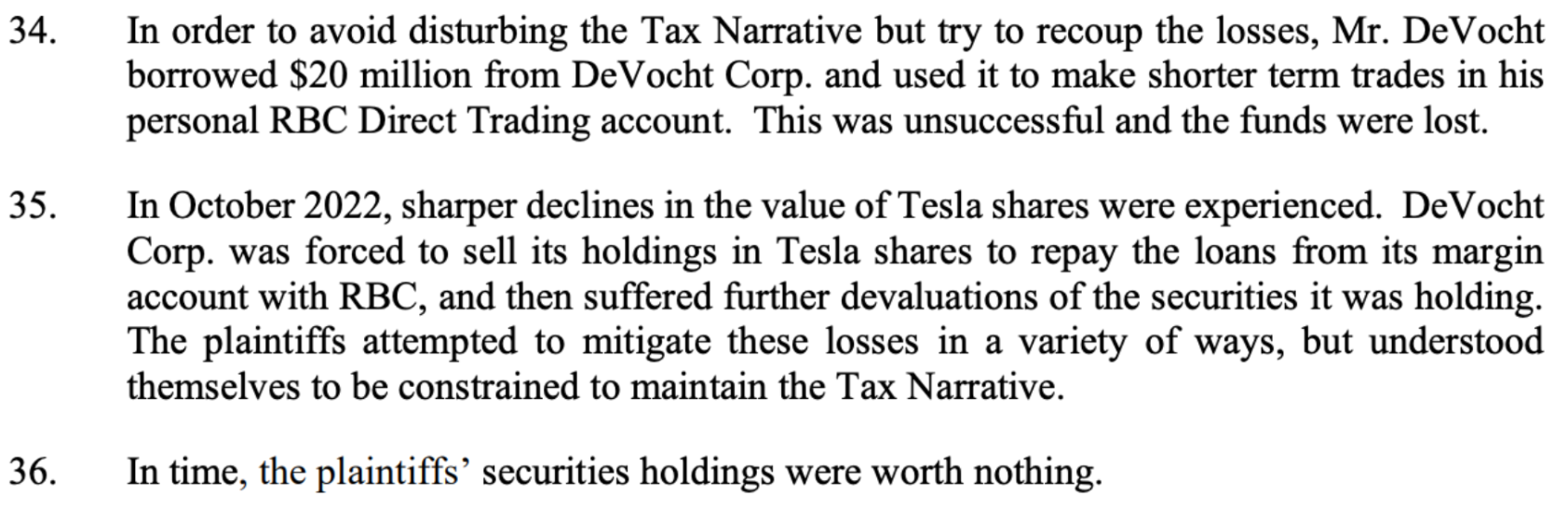
This is, without a doubt, my favorite trading story of all time. I remember, in the early days of the pandemic, turning $10,000 into $30,000 trading S&P put options, before quickly roundtripping back to $10,000, but $88,000 to $415 million to “nothing” is god-tier performance. Among the reasons listed in legal basis for his suit, Devocht notes that RBC “failed to recognize Mr. DeVocht’s personal entrenchment and potential addiction to the highs and lows of RBC’s Direct Investing platform, such that he was having significant difficulty withdrawing or de-risking in light of his extraordinary success.”
I would say addiction is an understatement. While he may have lost nine figures, there is a consolation prize: his story managed to garner 6,900 upvotes on Wall Street Bets.
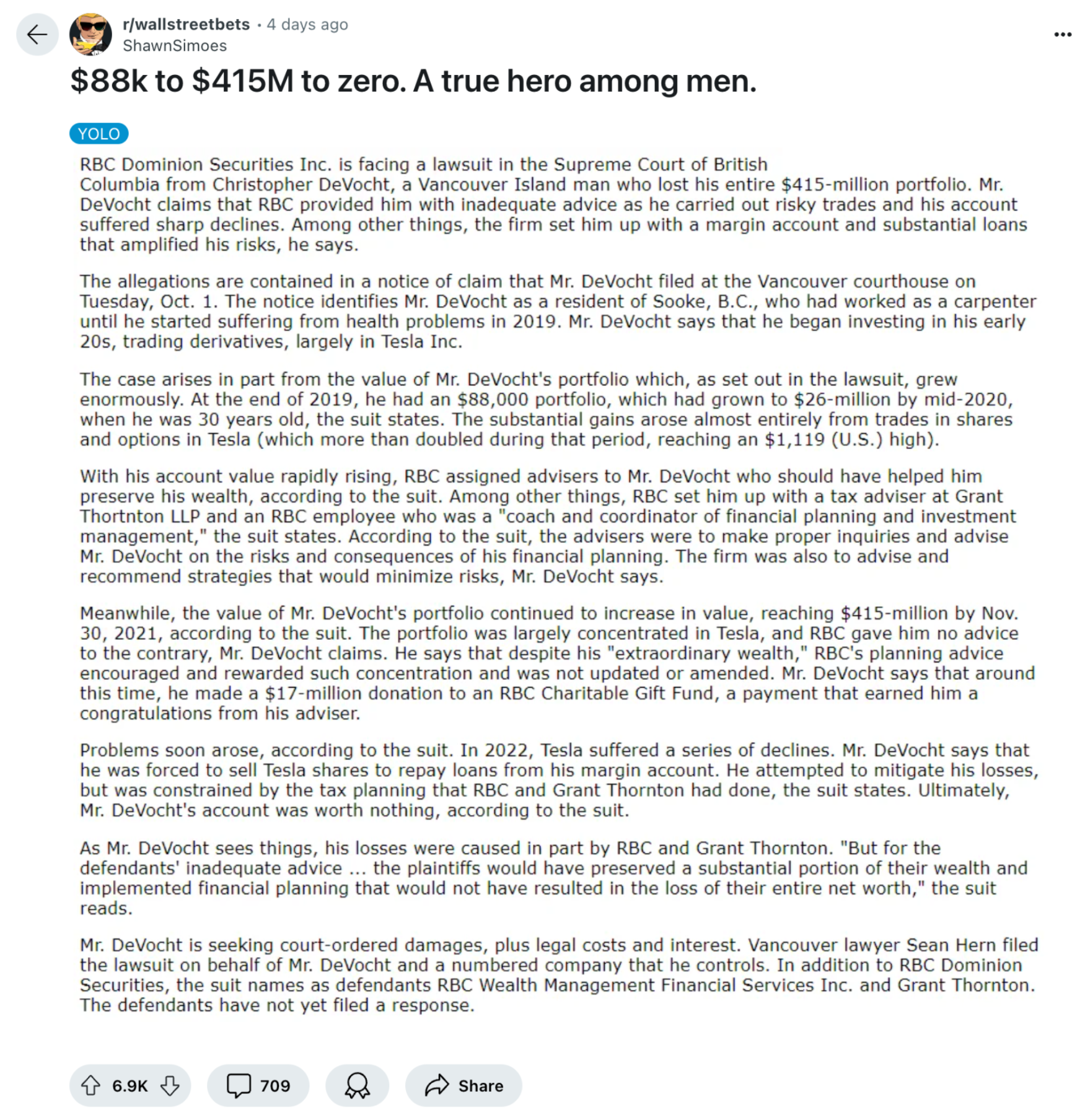
Capital gains are temporary; Reddit karma is forever.




