

Markets
markets

CoreWeave guidance disappoints as delays weigh on data center ramp despite blowout top and bottom line beats

CoreWeave reported a strong sales beat in Q3, with bottom-line results to match.

  • Revenue: $1.36 billion (compared to analyst estimates of $1.23 billion and guidance for $1.26 billion to $1.30 billion)

  • Adjusted operating income: $217.15 million (estimate: $177.2 million, guidance: $160 million to $190 million)

Those figures exceeded every estimate among analysts polled by Bloomberg.

More strong sales seem to be in the pipeline: CoreWeave’s revenue backlog swelled to $55.6 billion at the end of the quarter, nearly double the $30.1 billion at the end of Q2.

But they’re not imminent: in fact, despite this revenue beat, CoreWeave reduced its 2025 annual sales forecast to a range of $5.05 billion to $5.15 billion from its prior outlook for $5.15 billion to $5.35 billion.

That cut to its guidance has shares deep in the red on Tuesday morning during premarket trading.

CoreWeave seems to be having a little trouble getting as much compute up and running as Wall Street had hoped for, with active power of 590 megawatts at the end of the quarter, where analysts had anticipated nearly 625 megawatts.

On the earnings call, the company’s executives discussed a delay to one of their data centers in more detail, a problem which is weighing on its Q4 and FY25 guidance. To be clear, CoreWeave isn’t flagging access to power in particular as a critical bottleneck right now (unlike Microsoft’s and Nvidia’s leaders). Rather, it’s the other physical infrastructure supporting the data center that’s the issue.

Michael Intrator, CoreWeave’s CEO, said:

So you're going to be hearing this theme repeated again and again as you talk to not just CoreWeave, but across the space. And it is a real challenge at the powered shell level. It's not a challenge for power, right? There's plenty of power right now, and we believe that there will be ample power for the next couple of years. But really where the challenge is, is the powered shell.

Accordingly, CoreWeave’s guidance for over 850 megawatts of active power at year end would entail the company falls well short of the current consensus estimates for nearly 900 megawatts.

It’s going to take a lot of supply chain unfurling to realize its revenue backlog on schedule.
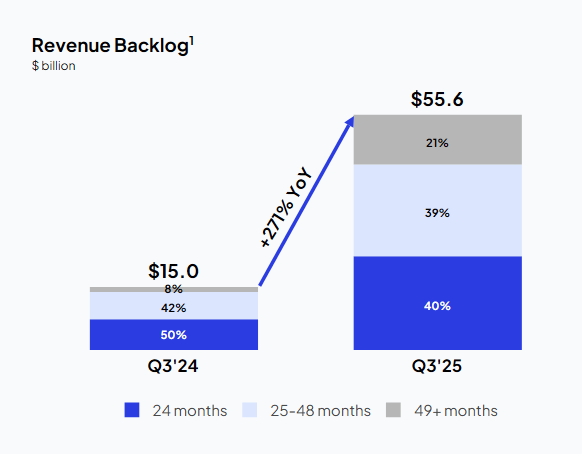
CoreWeave revenue backlog
Source: CoreWeave Q3 earnings presentation

The neocloud company had a busy quarter, reaching a $14 billion pact with Meta for AI compute, expanding its agreement with OpenAI, and signing a $6.3 billion deal with Nvidia for any unused cloud computing capacity, among others. CoreWeave’s recent attempt at vertical integration failed, as Core Scientific shareholders voted overwhelmingly against its proposed acquisition on October 30.

However, there’s a little less drama around this quarter’s results than there was for the last one. That’s because its lock-up period expired shortly after CoreWeave’s impressive Q2 results, catalyzing a wave of profit taking in the AI darling.

More Markets

See all Markets
markets

Power Solutions International mysteriously craters ahead of earnings, then tumbles more after earnings too

Shares of Power Solutions International are extending losses in postmarket trading after the engine- and power-system provider released its Q1 results.

Revenues of $128.6 million came in shy of the consensus call for $161 million, and operating income of $11.4 million was less than half of the anticipated $23.7 million.

(Granted, there were only two estimates available here.)

But the curious thing is... traders didn’t wait until these underwhelming results were released to dump the stock.

Up until about 12:10 p.m. ET, volumes were tracking above their 5-day average, but nothing too abnormal. In the 20-minute span after that — with no reported news on any wires — shares tumbled on 40 times their average volume for that time of day.

The stock finished down 17.7% in regular trading, and extended that loss to down 50% as of 5:05 p.m. ET.

Suffice it to say, this isn’t normal.

Companies operating in a similar segment of the market, like Cummins or Generac Holdings, didn’t suffer a similar intraday swoon.

While other power providers are visibly cashing in on the AI boom and offering robust outlooks tied to data center demand, Power Solutions’ management was reluctant to pencil in anything forward-looking on that front.

“The Company continues to see strong demand for data center power solutions, and expects sales to increase in the second half of 2026,” per the press release. “However, the timing and ultimate volume of related shipments remain subject to customer scheduling, manufacturing throughput, supply-chain factors, and other variables, and the Company is not predicting any specific level of data center revenue in any future period.”

markets

AST Spacemobile drops after 1Q top and bottom lines miss estimates

After soaring during Monday's session, AST SpaceMobile shares are coming back to earth.

The retail-trading favorite is down double digits in postmarket trading Monday after the company fell short of Wall Street’s expectations with its Q1 earnings report. 

Here are the details:

  • Revenue of $14.7 million (compared to analyst estimates of $39 million). 

  • Net income of -$191 million (estimate: -$76.3 million)

Shares, which rose 10% during the regular session on Monday, fell 11% after the report.

The company — which is building the first space-based cellular broadband network, connecting standard cell phones to satellites — has experienced high stock volatility over the past year. Despite the dips, however, it had still landed up nearly 200% since last May. 

Despite missing Street estimates, the company's revenue is a significant increase over the Q1 2025's $7.18 million, when the company focused primarily on government contract work. The company has a devoted retail following, who call themselves the SpaceMob, who’ve cheered on the SpaceX rival’s rapid growth. 

Today, AST Spacemobile has agreements with Verizon, AT&T, and others to provide space-based internet directly to phones. Earlier this year, it also won a key contract with the US Department of Defense for the “Golden Dome.” 

So far the company has successfully launched seven functioning satellites and on Monday recommitted to plans to have 45 total satellites by 2026. The company currently trails behind Elon Musk’s SpaceX, who says they now have 10,000 Starlink satellites in orbit and launched. AST Spacemobile also is one short on their goal after their BlueBird 7 satellite had to be taken out of orbit in April.

markets

CleanSpark drops after Q2 results trail estimates, with much deeper-than-expected quarterly loss

Shares of CleanSpark are down in postmarket trading after the bitcoin miner and data center developer reported its second-quarter earnings on Monday, missing Wall Street estimates on the top and bottom lines.

CleanSpark reported:

  • $136.4 million in revenue (compared to analysts consensus estimate of $139.4 million). 

  • An adjusted loss per share of $1.52 (estimate: a $0.66 loss).

Those numbers show revenue down 24.9% year over year.

Like TeraWulf, which reported earnings on Friday, and many, many others, CleanSpark is transitioning from a solely bitcoin mining company to a broader AI infrastructure provider. The company is up 53% over the past year. 

In its press release Monday, the company said it roughly doubled its megawatts under contract year over year. Per Matt Schultz, CEO and chairman of CleanSpark:

Our objectives are clear: commercialize our AI/HPC-applicable assets, grow the portfolio, and continue mining efficiently to power CleanSpark’s transformation.

According to exchange data, CleanSpark is among the Russell 3000 companies that traders love to hate, with roughly 35% of its float sold short as of mid-April. That’s one reason, besides the bitcoin/AI crossover, that the name is on the dashboard of many retail traders.

markets

MARA dips after missing earnings expectations

Bitcoin miner and data center operator MARA Holdings released its Q1 earnings report Monday afternoon, missing analysts expectations on revenue and earnings per share. Shares dropped in after-hours trading, giving back gains built on Mondays session.

The company reported:

  • Revenue of $174.6 million, below the FactSet analyst consensus estimate of $181.9 million and an 18% decline from $213.9 million in the same period last year.

  • A net loss of $1.3 billion, or a $3.31 loss per diluted share, compared to the $1.55 loss per share in Q1 2025.

The jump in the companys net loss was primarily driven by a $520.4 million increase in operating loss, largely due to unfavorable bitcoin mark-to-market adjustments of ($1.0 billion) and restructuring costs of $45.9 million during the quarter, MARA CFO Salman Khan said in the firms Q1 2026 shareholder letter.

MARA Holdings has the fourth-largest bitcoin treasury and, similar to other mining companies, has made a push to develop infrastructure to capitalize on the artificial intelligence boom. Last month, the company announced acquiring Long Ridge Energy & Power LLC for $1.5 billion to add over 1 gigawatt of total potential power capacity.

We expect Long Ridge will continue to supply power to the grid and generate cash flow and positive EBITDA upon closing, MARA Chairman and CEO Fred Thiel said in a statement. Our intention is to develop incremental capacity at the site and build a higher value digital infrastructure asset.”

Latest Stories

Sherwood Media, LLC produces fresh and unique perspectives on topical financial news and is a fully owned subsidiary of Robinhood Markets, Inc., and any views expressed here do not necessarily reflect the views of any other Robinhood affiliate, including Robinhood Markets, Inc., Robinhood Financial LLC, Robinhood Securities, LLC, Robinhood Crypto, LLC, Robinhood Derivatives, LLC, or Robinhood Money, LLC. Futures and event contracts are offered through Robinhood Derivatives, LLC.
