
Markets
Demonstration Against President Daniel Noboa
It’s a tire fire (Felipe Stanley/Getty Images)

CoreWeave’s attempt to buy Core Scientific is going down in flames

The last time CoreWeave tried to buy Core Scientific, management didn’t approve. This time, it looks like shareholders don’t.

Luke Kawa

CoreWeave’s last attempt to buy Core Scientific in 2024 failed because management thought the bid was too low.

Its July offer of an all-stock transaction then valued at about $9 billion was good enough to convince Core Scientific’s top brass, but doesn’t look to be enough to convince the true owners of the company: its shareholders.

Shares of Core Scientific are trading for much more than the terms of the agreement say they’re worth heading into Thursday’s shareholder vote on the transaction, strongly suggesting traders are pricing in either a rejection of this proposal or a last-minute boost to the offer.

Major shareholders and proxy advisory firms are publicly opposing the union. Two brokerages upgraded the stock to buy from hold this week, with both analysts citing the unlikelihood of this transaction going through as a cause for their rosier view.

An initial concern with this deal was the lack of a so-called collar: since the transaction would be completely in CoreWeave stock, with each Core Scientific holder poised to receive 0.1235 shares of CoreWeave, what they’d ultimately receive was down to the whims of what the market felt about CoreWeave at the time this closed (or not!). As we discussed, Core Scientific became a slave to CoreWeave’s low float, which was going up, but with no easy way for its owners to protect the value of their position because of the high cost of shorting CoreWeave, which would have been necessary for any arbitrage play.

Shares of the neocloud company are down 14% since initial reports of its renewed plan to buy Core Scientific surfaced and off 17% since the agreement was announced.

The deal premium vanished decisively as CoreWeave’s post-IPO lockup expired, which unleashed a wave of pent-up profit taking and made more shares available to be shorted, and turned starkly negative as key investors and advisory firms voiced their disapproval.

On August 7, Two Seas Capital issued a statement opposing the deal, and followed that up with a presentation earlier this month detailing its concerns. The investment fund, which is one of Core Scientific’s biggest shareholders, argued that rather than being a hot-air balloon for shares of Core Scientific, CoreWeave’s offer has actually been an anchor, causing its returns to severely lag other bitcoin miners turned data center companies that offer high-performance computing services. In the days that followed, Gullane Capital — another major Core Scientific holder — also said it would be voting no.
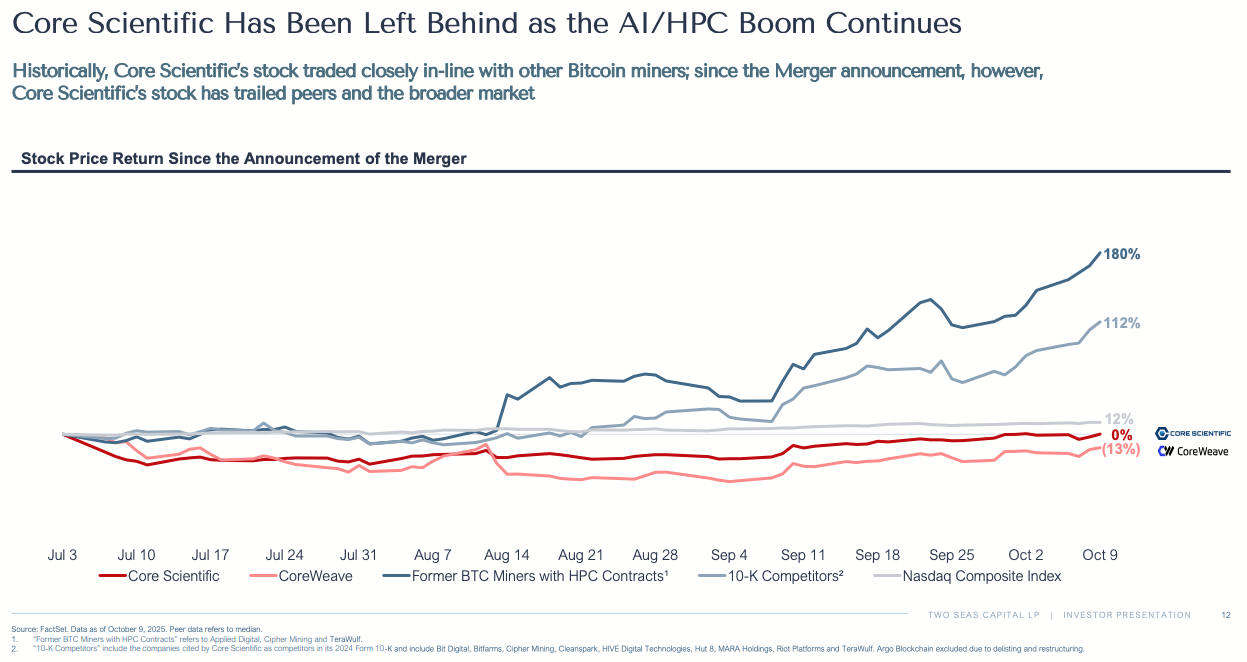
Two Seas CORZ
Source: Two Seas

On October 21, two independent proxy advisory firms, Institutional Shareholder Services Inc. and Glass Lewis & Co., also came out against the proposal.

CoreWeave and Core Scientific management teams, for their part, remain strongly in favor of a tie-up. Core Scientific recommended voting in favor of the transaction, noting that it had been “unanimously determined” by its board of directors as providing “meaningful upfront premium and upside opportunity.”

CoreWeave CEO Michael Intrator has been resolute that there will be no bump to his offer, telling Bloomberg earlier this month, “Really under no circumstances will we readdress the bid that we put out,” with the company reiterating that stance in a press release last week.


More Markets

See all Markets
markets

Novo Nordisk’s slide continues after CEO warns of “unprecedented pricing pressure” as outlook overshadows Q4 results

Novo Nordisk’s shares are tumbling further in premarket trading on Wednesday after CEO Mike Doustdar warned that the Danish pharma giant will face “unprecedented” price pressures in 2026, addressing the company’s annual sales forecast, which showed a decline in revenue.

“Our 2026 guidance reflects a year of unprecedented pricing pressure,” Doustdar said on a call with journalists, adding in an interview with CNBC that people should expect that US pricing “goes down before it comes back up,” as headwinds from lower US Wegovy pricing remain.

On Tuesday, NVO shares fell double digits after it forecast that sales and operating profit for 2026 will both decline by between 5% and 13% — analysts were expecting very modest growth in each.

In its 2025 annual report, released on Wednesday morning, the company detailed the disappointing guidance, citing “lower realised prices, including the MFN (Most Favoured Nations) agreement in the US and the loss of exclusivity for the semaglutide molecule in certain markets in International Operations.” Novo also added that “positive impacts related to US gross-to-net sales adjustments during 2025 are not anticipated to reoccur.”

Across its actual Q4 results, things were a little rosier: sales and diluted EPS figures for Q4 2025 came in at $12.3 billion and $0.94, respectively, slightly beating analyst consensus estimates in both cases by 0.9% and 1.4% (forecasts compiled by Bloomberg).

Meanwhile, Eli Lilly reported quarterly earnings results and posted 2026 guidance on Wednesday that crushed Wall Street estimates. Indeed, though Novo was first to the GLP-1 market, Lilly is proving fierce competition, having surpassed the Danish giant’s sales by Q2 of last year. The Mounjaro maker’s earnings on Wednesday showed that the gap is only getting wider.

Just as Novo launched a new oral GLP-1 for weight loss in January — and early signs show uptake is strong — Lilly also has a weight-loss pill expected to come to market later this year. Novo is facing patent expiry for semaglutide, the active ingredient in Ozempic and Wegovy, starting this year in major markets like Canada, India, and China.

markets

Lumentum jumps on earnings beat and strong guidance

Lumentum rose about 9% in premarket trading on Wednesday after the optical and photonics company reported better-than-expected quarterly earnings and guidance.

For the quarter ended December, revenue rose 65% year on year to a record $665.5 million, topping Wall Streets estimate of $652.5 million, per Bloomberg. Adjusted earnings per share came in at $1.67, also crushing the $1.42 expected. Looking ahead, Lumentum projected March quarter revenue of $780 million to $830 million, well above analyst estimates for $745 million.

Lumentum sells optical and photonics components that power telecom networks and cloud data centers, with its customers ranging from equipment makers like Cisco and Ciena to hyperscalers such as Microsoft and Google, which are ramping up AI-heavy data center builds. The company also supplies lasers used in consumer electronics manufacturing, including for Apple.

On the earnings call, management said the order backlog for Optical Circuit Switches — a high-margin product used by hyperscalers to build AI clusters — has now surged past $400 million.

Latest Stories

Sherwood Media, LLC produces fresh and unique perspectives on topical financial news and is a fully owned subsidiary of Robinhood Markets, Inc., and any views expressed here do not necessarily reflect the views of any other Robinhood affiliate, including Robinhood Markets, Inc., Robinhood Financial LLC, Robinhood Securities, LLC, Robinhood Crypto, LLC, or Robinhood Money, LLC.