Markets
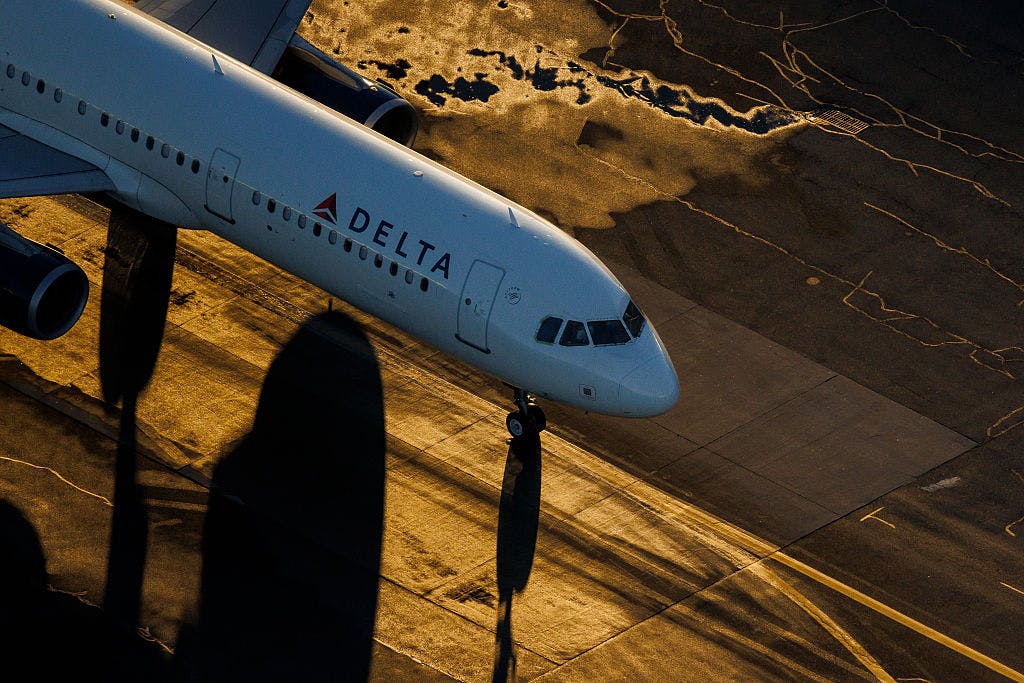
Delta: Aerial Views Of Aircraft At Boston Logan International Airport
(Austin DeSisto/Getty Images)

Delta tumbles after 2026 earnings guidance disappoints

The country’s largest airline forecast adjusted earnings of between $6.50 to $7.50 per share in 2026, while analysts were looking for $7.28.

Delta Air Lines reported its fourth-quarter and full-year earnings on Tuesday morning, but it’s what management sees on the radar for the year ahead that has traders downbeat this morning.

The country’s largest airline said it expects adjusted earnings per share to come in between $6.50 to $7.50 in 2026, while Wall Street analysts polled by FactSet were looking for $7.28, sending shares sharply lower in premarket trading.

In 2025, Delta earned $5.82 per share, below the $6-per-share forecast it gave in October. That’s significantly under the company’s initial full-year forecast of more than $7.35 per share — guidance that was issued before tariffs became reality, when Delta believed 2025 had the potential to be its best fiscal year ever. The midpoint for 2026 guidance implies 20% growth for its bottom line.

This underwhelming guidance is also weighing on its peers, with United Airlines, American Airlines, Southwest Airlines, and Alaska Airlines selling off in tandem.

For the first quarter of 2026, Delta projects total revenue growth of between 5% and 7%, and an adjusted EPS range of between $0.50 and $0.90.

Delta posted adjusted earnings per share of $1.55 in its fourth quarter, ended in December, beating the $1.53 per share expected by analysts polled by FactSet. Still, the figure fell below the bottom of Delta’s own projection range of between $1.60 and $1.90 per share.

Premium ticket offerings continued to outperform main cabin tickets, with sales rising 7% from last year compared to the 5% drop in main cabin sales, as premium becomes a bigger driver of Delta’s overall business.

Delta’s American Express card proved yet again to be worth more than its weight in plastic, pulling in $8.4 billion on the year, up 11% from 2024. Industry experts pin airline credit card profit margins at about 50%.

Along with its earnings, the carrier announced it reached an agreement to buy 30 Boeing 787s, with the option for 30 more, scheduled to begin deliveries by 2031.


More Markets

See all Markets
markets

Microsoft unveils “community-first AI infrastructure plan” after Trump calls out data centers for high electricity bills

Microsoft is committing to paying up for its data center electricity needs so American households won’t have to face higher costs.

This announcement comes after President Donald Trump posted on Monday evening that his administration was working with leading tech companies to ensure that US households don’t “pick up the tab” for their data center-driven energy demands, which have helped propel electricity bills higher.

Microsoft, he said, would be the first to unveil steps in this direction.

Here’s its plan, from a post attributed to Microsoft Vice Chair and President Brad Smith:

Microsoft community first AI infrastructure plan
Source: Microsoft

From a markets and economics standpoint, the first part is the most interesting. Smith said that Microsoft will ask utilities and public commissions to charge Microsoft enough to cover both data center installation and usage, as well as support two-tier pricing systems (like what’s being proposed in Wisconsin) that will see “Very Large Customers” like data centers face higher costs.

The hyperscalers are walking a fine line of trying to aggressively pursue a build-out of a technology that they believe will be transformative and offer profits for years to come while avoiding public and political backlash due to how resource-intensive these capital outlays and operations are.

“Especially when tech companies are so profitable, we believe that it’s both unfair and politically unrealistic for our industry to ask the public to shoulder added electricity costs for AI,” Smith said. “Instead, we believe the long-term success of AI infrastructure requires that tech companies pay their own way for the electricity costs they create.”

Microsoft’s 12-month forward expected profit margin is above 38%, per analysts polled by Bloomberg, its highest projection on record.

Microsoft, he said, would be the first to unveil steps in this direction.

Here’s its plan, from a post attributed to Microsoft Vice Chair and President Brad Smith:

Microsoft community first AI infrastructure plan
Source: Microsoft

From a markets and economics standpoint, the first part is the most interesting. Smith said that Microsoft will ask utilities and public commissions to charge Microsoft enough to cover both data center installation and usage, as well as support two-tier pricing systems (like what’s being proposed in Wisconsin) that will see “Very Large Customers” like data centers face higher costs.

The hyperscalers are walking a fine line of trying to aggressively pursue a build-out of a technology that they believe will be transformative and offer profits for years to come while avoiding public and political backlash due to how resource-intensive these capital outlays and operations are.

“Especially when tech companies are so profitable, we believe that it’s both unfair and politically unrealistic for our industry to ask the public to shoulder added electricity costs for AI,” Smith said. “Instead, we believe the long-term success of AI infrastructure requires that tech companies pay their own way for the electricity costs they create.”

Microsoft’s 12-month forward expected profit margin is above 38%, per analysts polled by Bloomberg, its highest projection on record.

markets

Stocks rise after core inflation rises by less than feared in December

SPDR S&P 500 ETF erased premarket losses to jump higher after core CPI inflation rose 0.2% month on month in December, slightly less than analysts had forecast.

Economists anticipated that headline and core CPI inflation (the latter of which strips out food and energy prices) would be up 0.3% month on month. Headline CPI did indeed rise 0.3% for the month.

The pricing of event contracts for December CPI implied that traders expected headline inflation to be up 0.3% month on month, with higher odds of a reading coming in above than below.

(Event contracts are offered through Robinhood Derivatives, LLC — probabilities referenced or sourced from KalshiEx LLC or ForecastEx LLC.)

The November CPI report showed that core inflation had cooled by much more than expected, with the annual rate decelerating to a 4.5-year low. However, that reading was flattered by the Bureau of Labor Statistics’ decision to assume housing-centric components were flat in October.

Annual core CPI inflation held steady at 2.6% in December, having been projected to tick up to 2.7%.

markets

Nvidia rebuts claim that it’s requiring full up-front payment from Chinese buyers of its H200 AI chips

An Nvidia spokesperson offered a rebuttal to Reuters on Tuesday, saying the chip designer does not require full payment for H200 chips up front, as the outlet had written in a January 8 report.

President Trump had said on December 8 that Nvidia could ship H200s, its best chip from the Hopper generation, to China. Chinese regulators, however, would need to allow their companies to import these chips, at a time when the nation’s leadership is keenly interested in bolstering domestic alternatives.

Concerns over whether Chinese regulators would permit imports fueled Nvidia’s alleged payment strategy, per Reuters. But Nvidia has now told the outlet that it “would never require customers to pay for products they do not receive.”

Notably, the chip designer isn’t going on the record to contradict any of Reuters’ other recent reporting surrounding its H200 chips, which includes:

  • Demand for H200s is extremely hot, with Chinese companies having already placed orders for 2 million in 2026.

  • Nvidia is planning on selling these chips at around $27,000 apiece.

    • Put those two together and that’s a $54 billion revenue opportunity.

  • Nvidia plans to begin sending its H200 GPUs (which it holds in inventory) to China by mid-February.

  • The world’s most valuable company has asked TSMC to boost production of these chips.

Last week, Bloomberg reported that China plans to allow purchases of H200s “as soon as this quarter.”

Latest Stories

Sherwood Media, LLC produces fresh and unique perspectives on topical financial news and is a fully owned subsidiary of Robinhood Markets, Inc., and any views expressed here do not necessarily reflect the views of any other Robinhood affiliate, including Robinhood Markets, Inc., Robinhood Financial LLC, Robinhood Securities, LLC, Robinhood Crypto, LLC, or Robinhood Money, LLC.