
Markets
2024-04-19-norway-fund-site

Norway now has a wealth fund worth $290k+ for every citizen of the country

Norway’s nest egg

The value of Norway's sovereign wealth fund rose 6.3% last quarter, adding a whopping $110 billion to the country’s stockpile despite technically falling just shy of its target benchmark return.

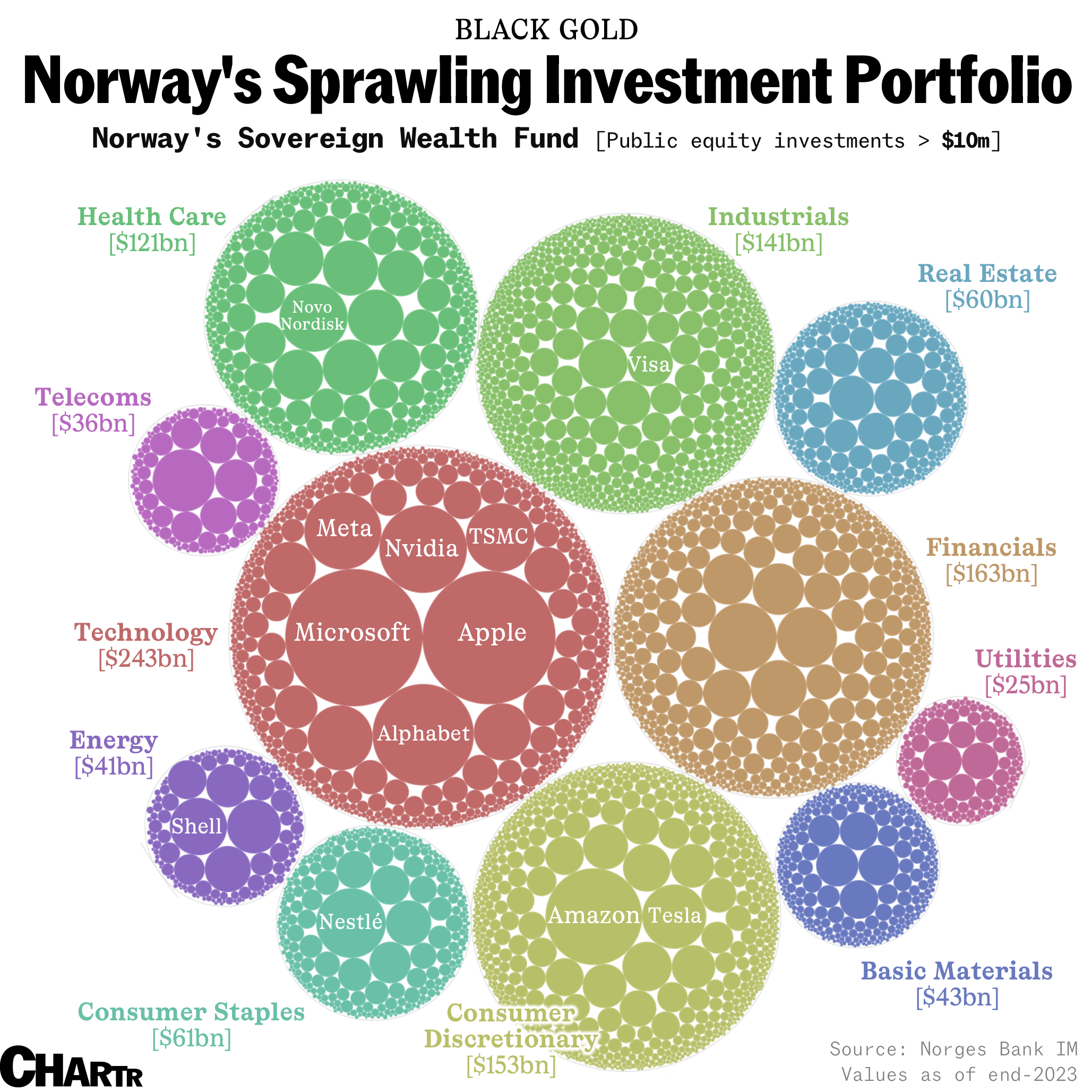
What started as the Norwegian government’s rainy day fund — somewhere to put its excess oil revenues in the 1990s — has become the largest investor on the planet. Today, 71% of its investment portfolio is in equities: a total of $1.1 trillion spread across more than 8,800 companies in 65 countries. Mirroring a diversified market index due to its sheer size, the fund has slices of every major sector. Visualized above are ~4,900 of the fund's equity investments: the smallest dots in the chart, the ones that you can barely see, represent $10 million stakes in individual companies.

Keeping it public

But, while its equities portfolio returned a respectable 9% in Q1, its fixed income and unlisted real estate investments saw losses, pulling down the overall return. Indeed, in the past 2 decades, the fund's equity investments have grown some 21x in value — and its success in public stocks is one reason why the Norwegian government last week confirmed it wants nothing to do with private equity, even as other institutional investors increase their exposure to the asset class.

In case managing this behemoth portfolio wasn't enough, you can catch the fund's chief hosting his podcast, where he interviews the likes of Elon Musk and Satya Nadella — two CEOs of companies that the fund owns a large slice of.

Slippery slope: When you're managing a pot of $1.6 trillion, even a tiny Excel error can result in a $92 million miscalculation.

More Markets

See all Markets
markets

SpaceX gets a wave of bullish ratings from Wall Street analysts

SpaceX received more than a dozen positive analyst calls on Tuesday — including from major Wall Street banks — as they initiate coverage on Elon Musk’s space and AI company.

SpaceX went public on June 12 at a $2.2 trillion valuation, the largest debut in history. While the company hasn’t yet posted a profit, it seems to have convinced Wall Street that it will get there and grow its valuation on the way.

Of the at least 17 analysts that gave a rating on Tuesday, all but one gave it a “buy” or “outperform” rating. MoffettNathanson was "neutral."

The ratings come as SpaceX joined the Nasdaq 100 index, a benchmark tech-heavy basket of companies that underpins millions of portfolios. The inclusion adds built-in demand for the stock from index funds and ETFs.

Still, SpaceX fell more than 5% on Tuesday amid a broader sell-off, and is currently effectively flat from its opening price of $150 a share.

markets

Nike sinks to lowest level since 2014 after warning of “challenged” sales environment in Q4 report

Did Nike do it?

Investors had a mixed reaction after the global sports apparel company reported its fourth quarter earnings on Tuesday after the bell. Shares initially rose 5% as Nike beat out Wall Street expectations amid a hefty tariff refund bonus. However, the stock then sank to its lowest level since August 2014 in postmarket trading.

Here are the Q4 numbers:

  • Revenue of $11.0 billion (estimate: $10.8 billion).

  • Adjusted earnings per share of $0.20 (estimate: $0.12).

Ahead of this report, Nike warned that results would be flattered by a one-time tariff refund (now estimated at roughly $0.52 per share for the bottom line). That gave the company an extra cushion in snapping its streak of seven quarters of year-over-year profit declines.

Over the past year, the company had been punished by tariffs on imported goods, stagnant consumer spending, and increasing competition from other footwear brands like New Balance, Adidas, and Hoka.

Outgoing CFO Matthew Friend deemed it an “increasingly challenging operating environment, where sell-through remains challenged.”

Latest Stories

Sherwood Media, LLC and Chartr Limited produce fresh and unique perspectives on topical financial news and are fully owned subsidiaries of Robinhood Markets, Inc., and any views expressed here do not necessarily reflect the views of any other Robinhood affiliate, including Robinhood Markets, Inc., Robinhood Financial LLC, Robinhood Securities, LLC, Robinhood Crypto, LLC, Robinhood Money, LLC, Robinhood U.K. Ltd, Robinhood Derivatives, LLC, Robinhood Gold, LLC, Robinhood Asset Management, LLC, Robinhood Credit, Inc., Robinhood Ventures DE, LLC and, where applicable, its managed investment vehicles.

