Markets
Federal Reserve Chair Powell Holds A News Conference Following The Federal Open Market Committee Meeting
Federal Reserve Chairman Jerome Powell (Andrew Harnik/Getty Images)

There’s one game in town for investors betting on a soft landing

Fed cuts. Lots of ‘em.

Luke Kawa

Investors are betting big on a soft landing and there’s one reason why.

Bank of America’s closely-followed monthly fund manager survey shows that the recent bout of market volatility didn’t cause investors to radically re-evaluate the likely path for economic activity in the coming year.

In fact, consensus is coalescing on a soft landing, with over three-quarters of respondents calling that the most likely outcome for the global economy in the next 12 months.

A “soft landing” is an environment in which growth has moderated but is still positive and inflation has cooled back to near the central bank’s target.

The share of investors expecting that benign outcome is up from 68% in July, though it should be noted that this increase comes fully from a 10 percentage-point drop in those who expect “no landing” (that is, solid growth and stubbornly high inflation) and was accompanied by a modest uptick in those expecting a “hard landing” (shorthand for a recession).

“‘Soft landing’ economic conviction [is] driven by expectations for lower rates,” write strategists led by Michael Hartnett. “93% of fund manager survey investors expect short-term rates to be lower in 12 months’ time, highest in the past 24 years.”
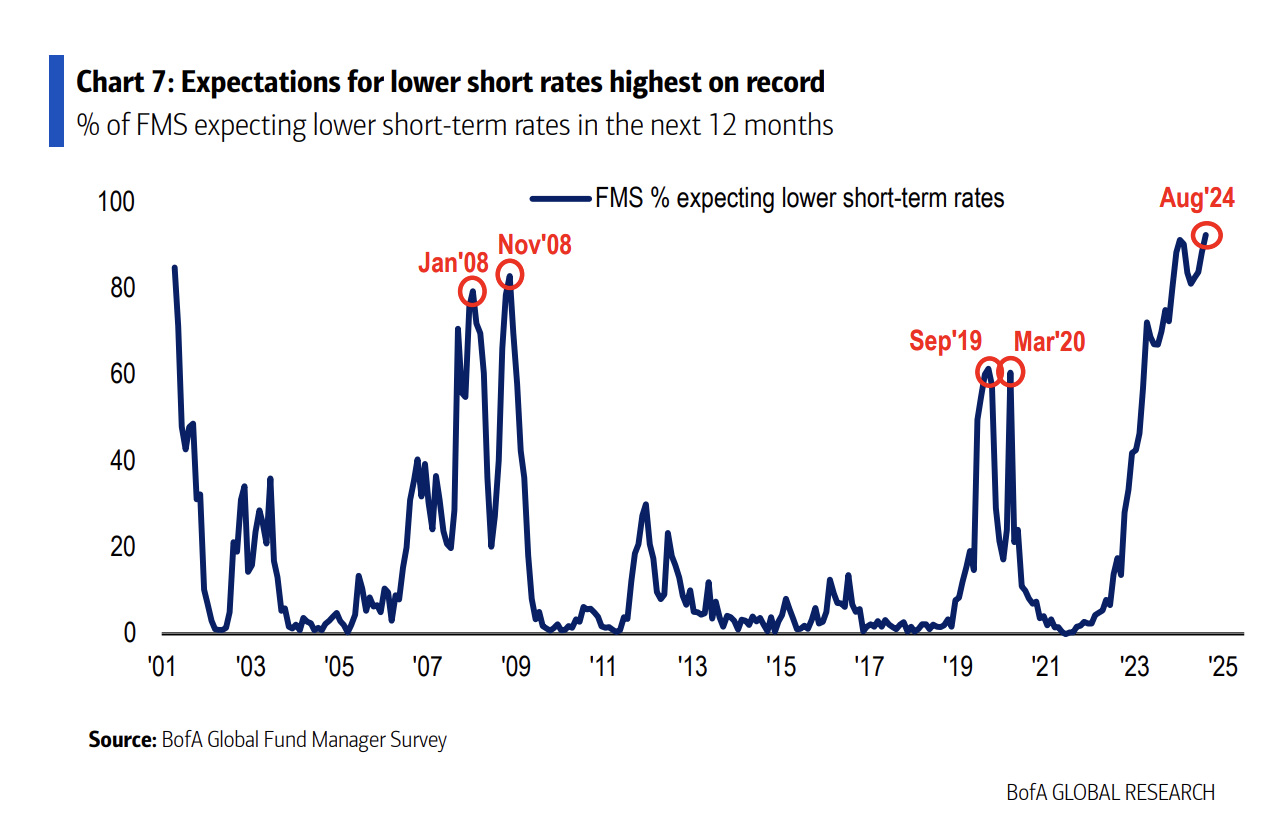
Bank of America Short Rates
Bank of America

Fund managers with over half a trillion in assets under management were surveyed by Bank of America from August 2nd to 8th. That period started with a soft July non-farm payrolls report, included sharp retreats across global markets and a spike in volatility, and ended with the best day for the S&P 500 since November 2022.

Investors seem to be buying into what Peter Williams, economist at 22V Research, told us before the last Federal Reserve meeting in late July: “There's nothing wrong with this economy that lower rates for a while, if they're really needed, can't fix."

What’s changed is that investors are more confident that this easing will be delivered, and that the Fed will simply have to do more to protect the expansion.
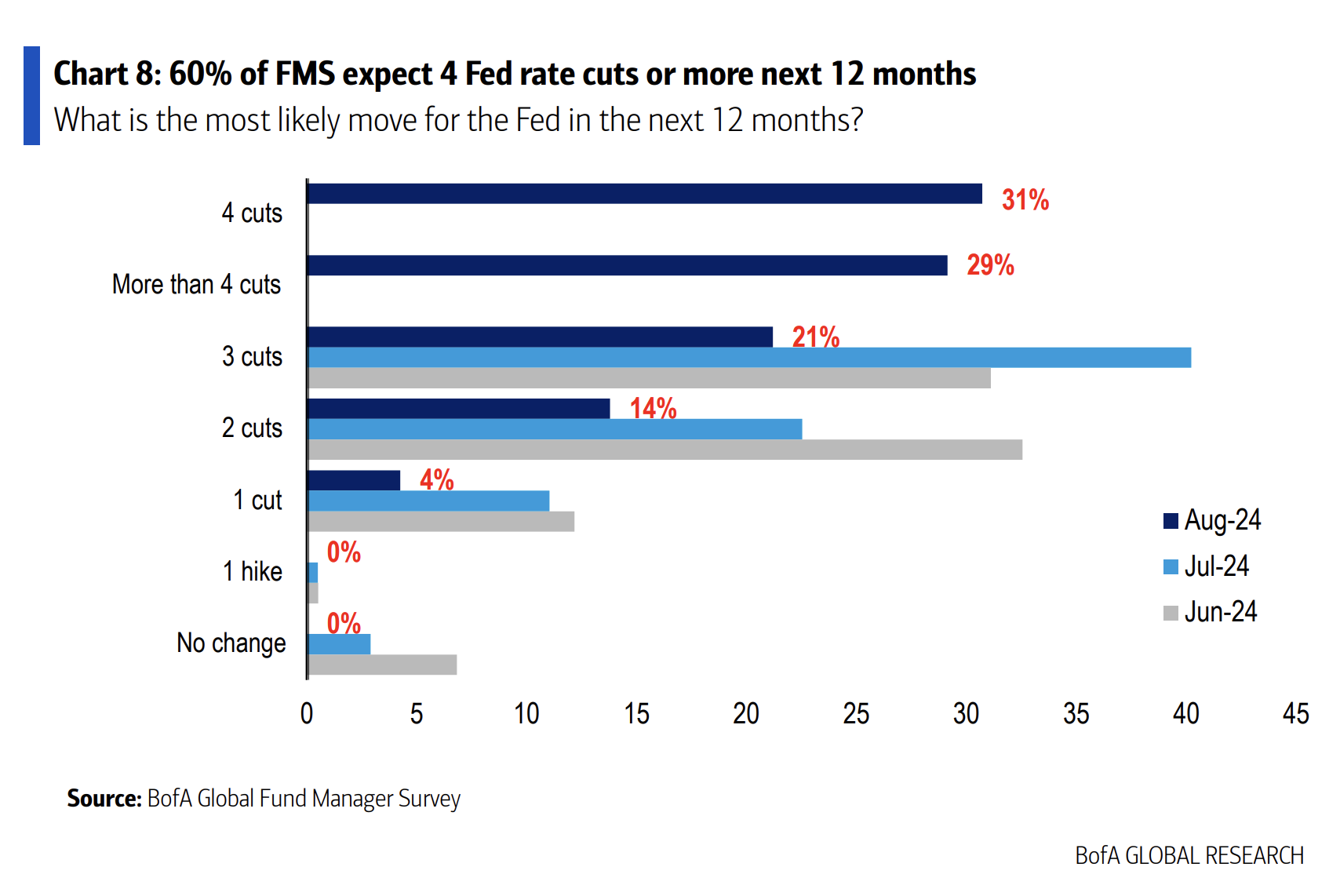
More Fed Cuts BofA
Bank of America

“Core optimism of a ‘soft landing’ [is] unchanged, but investors now expect a greater degree of Fed policy easing in the next 12 months will be required to achieve this outcome,” added Hartnett.

More Markets

See all Markets
markets

Novo Nordisk rallies after FDA weight loss pill approval

Novo Nordisk’s US-listed shares are up 7% in pre-market trading on Tuesday after the US Food and Drug Administration approved its Wegovy weight loss pill on Monday evening.

Now the first pill of its kind to receive approval from the regulator, Novo’s Wegovy pill is expected to launch in the US in early January 2026, and awaits the European Medicines Agency and other regulatory authorities’ approval after submitting for review in the second half of 2025, per the company’s press release. The 1.5 milligram starting dose of the pill will be sold at an introductory price of $149 a month.

“The pill is here. With today's approval of the Wegovy® pill, patients will have a convenient, once-daily pill that can help them lose as much weight as the original Wegovy® injection,” said Mike Doustdar, president and CEO of Novo Nordisk.

The approval was based on Novo’s Oasis 4 trial, which found participants who took 25 milligram doses of Wegovy pills daily lost 16.6% of their body weight over a 64 week period.

The approval will give Novo — which lost more than 50% of its market cap this year after Eli Lilly took the crown in weekly US prescriptions for injectable weight-loss drugs with its product Zepbound — a first-mover advantage in the expanding market. Lilly, which is down some 1% in pre-market trading today, has said its own oral drug orforglipron could be approved by March 2026.

markets

‘Golden age of profit margins’ seen in 2026

Wall Street tends to be a pretty optimistic place. But on one measure, market watchers are the most optimistic on record.

FactSet data shows the consensus estimate for S&P 500 net profit margins in calendar year 2026 calls for the gauge to climb to 13.9% in 2026.

But if borne out by events next year “it will mark the highest (annual) net profit margin reported by the index since FactSet began tracking this metric in 2008,” wrote John Butters, senior earnings analyst at the financial data company.

A recent story from Barron’s also commented on the expectations for especially fat profit margins embedded into forecasts for next year.

“We are in the golden age of margins,” RBC’s Capital Markets’ head of US equity strategy, Lori Calvasina, told the magazine.

That’s good news for investors looking forward to next year. But the follow up question, of course, is where the growth in profitability is expected to come from. The answer, as you might have guessed, is tech. Though the precise mechanisms by which those profits land in the coffers of the giant tech firms remains something of a mystery. Barron’s doesn’t get into the details, saying “call it benefits from AI, pricing power, or whatever.”

That doesn’t exactly sound like money in the bank. But even die-hard haters of AI have to acknowledge that betting against the ability of giant tech companies to generate massive profit growth has been a bad trade for the last couple decades.

But if borne out by events next year “it will mark the highest (annual) net profit margin reported by the index since FactSet began tracking this metric in 2008,” wrote John Butters, senior earnings analyst at the financial data company.

A recent story from Barron’s also commented on the expectations for especially fat profit margins embedded into forecasts for next year.

“We are in the golden age of margins,” RBC’s Capital Markets’ head of US equity strategy, Lori Calvasina, told the magazine.

That’s good news for investors looking forward to next year. But the follow up question, of course, is where the growth in profitability is expected to come from. The answer, as you might have guessed, is tech. Though the precise mechanisms by which those profits land in the coffers of the giant tech firms remains something of a mystery. Barron’s doesn’t get into the details, saying “call it benefits from AI, pricing power, or whatever.”

That doesn’t exactly sound like money in the bank. But even die-hard haters of AI have to acknowledge that betting against the ability of giant tech companies to generate massive profit growth has been a bad trade for the last couple decades.

markets

Opendoor rises after CEO Kaz Nejatian touts an explosion in its home-buying footprint

Opendoor Technologies gained in early trading after CEO Kaz Nejatian touted an explosion in the company’s home-buying footprint.

In a message on X, the former Shopify COO posted two maps: one of which depicts a fairly limited area in which the online real estate company would buy or sell homes, and the second of which suggests that has now expanded to include the entire lower 48:

In a follow-up tweet, Nejatian attributed the gains to AI, writing, “First pic took 10 *years* of work without AI. Second pic took 10 *weeks* of work with AI.”

On his first earnings call as CEO, Nejatian said the company had adopted a “default to AI approach.”

One of his first pledges was to launch Opendoor everywhere in the lower 48.

markets

Hertz surges on bullish options activity

As millions begrudgingly make their way to the rental car counter amid the winter holidays, investors are pouring into calls and sending Hertz stock soaring.

As of 10:51 a.m. eastern, Hertz had seen 17,861 calls traded. That’s already significantly ahead of the 20-day average volume of 12,956. Hertz shares are up more than 12%.

Seemingly juicing the rally was a post on X that read “car rental companies could end up being the picks and shovels of autonomy” that was reposted by billionaire Bill Ackman, whose hedge fund is one of Hertz’s largest shareholders.

If Hertz’s price action holds, the move will mark its ninth-best trading day of 2025.

Latest Stories

Sherwood Media, LLC produces fresh and unique perspectives on topical financial news and is a fully owned subsidiary of Robinhood Markets, Inc., and any views expressed here do not necessarily reflect the views of any other Robinhood affiliate, including Robinhood Markets, Inc., Robinhood Financial LLC, Robinhood Securities, LLC, Robinhood Crypto, LLC, or Robinhood Money, LLC.