
Markets
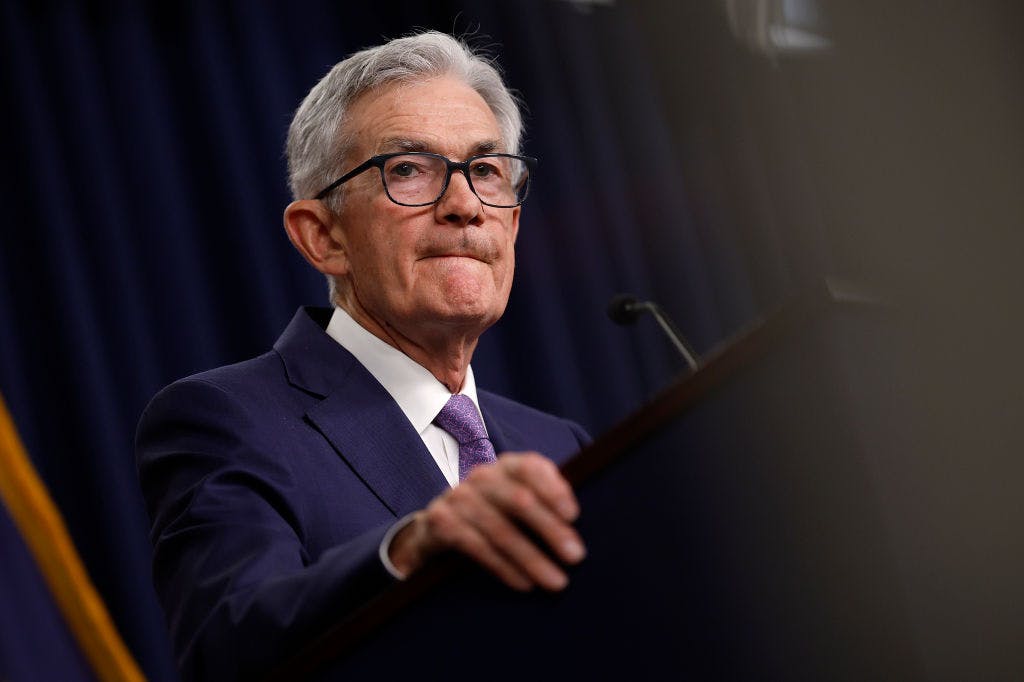
Fed Chair Jerome Powell Holds An News Conference On Interest Rates
Federal Reserve Chair Jerome Powell (Kevin Dietsch/Getty Images)

Federal Reserve leaves rates unchanged; dot plot still signals lower rates in the cards for 2026

A relatively dovish reaction function from the US central bank.

The Federal Reserve held its policy rate unchanged at a range of 3.5% to 3.75%, as was universally expected.

The Summary of Economic Projections accompanying this release showed that the median monetary policymaker still expects the policy rate to be 25 basis points lower by the end of 2026 if the economy unfolds in-line with their expectations.

The US central bank was very wrong-footed by the persistence of the inflation shock coming out of the pandemic, which was then turbo-charged by the spike in oil and natural gas prices stemming from Russia’s invasion of Ukraine and subsequent restrictions on purchasing its energy.

Fed officials upped their forecast for growth in this year and the next relative to December and raised their forecasts for inflation (particularly headline inflation, which includes energy prices) in 2026. Stronger growth and inflation would generally indicate a reduced need for rate cuts, but the median rate path through 2028 was unchanged from December.

The message from the central bank seems to be, “We’re not fighting the last war, and we’re praying for a short war.”

The SPDR S&P 500 ETF was little changed in the aftermath of the statement and updated forecasts, but extended losses to as much as 1.1% during Fed Chair Jay Powell’s press conference.

Fed Governor Stephen Miran was the lone official to dissent, favoring lower rates.

Prediction markets thought the most likely outcome was that two US monetary policymakers would dissent at this meeting, with roughly 30% odds of just one dissent and about a 5% probability of of three dissents.

(Event contracts are offered through Robinhood Derivatives, LLC — probabilities referenced or sourced from KalshiEx LLC or ForecastEx LLC.)

The war in Iran and resulting disruption to global energy markets, with US gas prices registering their sharpest increase in more than two decades, has caused traders to tear up the playbook for any easing from the US central bank this year.

Before the strikes, a full interest rate cut was priced into fed funds futures by the July meeting. Heading into this decision, a full cut is not priced in for all of 2026.

In the run-up to this release, prediction markets ascribed roughly 5% odds to a cut at the Fed’s meeting next month, and about one-in-three to the prospect of a reduction in June.

This is the US central bank’s first meeting since President Donald Trump said that former Fed Governor Kevin Warsh would be his pick to succeed Jay Powell as chair of the Federal Reserve.


More Markets

See all Markets
markets

Constellation, Talen, and NRG surge as BNP analysts see “golden (AI)ge” ahead for them

Power producers Talen Energy, Constellation Energy, and NRG jumped Wednesday, benefiting in part from a rosy write-up by analysts at BNP Paribas, who launched coverage of all three at “outperform” and argued that the AI energy trade — a big AI-related winner in recent years that has lagged a bit recently — is due for a second wind.

That view was in a broad note on the independent power producer segment of utilities industry that the analysts published Wednesday, titled “The Golden (AI)ge of IPPs.”

Here’s the gist of it:

US independent power producers (IPPs) have lagged the AI basket for 6+ months, after garnering much attention in 2023-1H25. Investors are caught up in the minutia of perceived headwinds: underwhelming pace of power purchase agreement deals, distributed behind-the-meter solutions stealing the ‘time-to-power’ edge, pressure for data centers to bring generation and not tighten the grid, etc.

And yet, as we demonstrate, despite all this noise, the wave of rising load is at the cusp of an acceleration that will nonetheless overwhelm new supply—well into the 2030s, in our view. Hop on or risk missing the resurgent AI trade this decade.

BNP’s price targets for the stocks — Constellation ($407), NRG ($232) and Talen ($549) — implied gains of 32%, 50%, and 68% respectively. (Though today’s gains would reduce those potential upside targets somewhat for new buyers.)

US independent power producers (IPPs) have lagged the AI basket for 6+ months, after garnering much attention in 2023-1H25. Investors are caught up in the minutia of perceived headwinds: underwhelming pace of power purchase agreement deals, distributed behind-the-meter solutions stealing the ‘time-to-power’ edge, pressure for data centers to bring generation and not tighten the grid, etc.

And yet, as we demonstrate, despite all this noise, the wave of rising load is at the cusp of an acceleration that will nonetheless overwhelm new supply—well into the 2030s, in our view. Hop on or risk missing the resurgent AI trade this decade.

BNP’s price targets for the stocks — Constellation ($407), NRG ($232) and Talen ($549) — implied gains of 32%, 50%, and 68% respectively. (Though today’s gains would reduce those potential upside targets somewhat for new buyers.)

markets

Chinese tech giants rally after hiking AI prices

ADRs of Alibaba and Baidu are gaining in early trading after the Chinese tech giants announced AI price hikes.

Alibaba said that it’s hiking the price of its AI chips by up to 34% and raising the cost of cloud storage by 30%, with Baidu planning on increasing AI cloud product prices by up to 30%.

Tech companies in China and the US are aiming to show that AI is not just a technological breakthrough but also a core tool for moneymaking. And, well, raising the price of what you sell is one of the most basic ways to make more money!

“Baidus decision to raise AI cloud product prices by as much as 30%, according to Bloomberg News, is a positive development that signals a shift toward monetization rather than price competition,” wrote Bloomberg Intelligence analysts Robert Lea and Jasmine Lyu. “Baidus move mirrors similar steps by Tencent, Alibaba, and Zhipu, catalyzed by surging demand for agentic AI following the launch of OpenClaw.”

markets

The Iran war is producing the sharpest spike in US gas prices since Hurricane Katrina

The average US national gas price jumped a little more than $0.05 to $3.84 on Wednesday, per the American Automobile Association, its highest level since September 2023.

While front-month West Texas Intermediate futures have come off the boil, down roughly 20% from their March 8 peak, front-month gasoline futures are trading about 2% shy of their 2026 peak as of 8:20 a.m. ET.

Prediction markets currently imply that gas prices will end the month near (but below) $4.30 per gallon.

(Event contracts are offered through Robinhood Derivatives, LLC — probabilities referenced or sourced from KalshiEx LLC or ForecastEx LLC.)

Prices are up nearly 29% over the past 20 days, per AAA, making this the sharpest such rise in fuel costs in more than two decades.

Hurricane Katrina, which made landfall in the US in late August 2005, was one of the deadliest and costliest natural disasters in American history. The damage wreaked havoc on energy infrastructure in the region, prompting gas prices to jump above $3 per gallon by early September from less than $2.30 in early August.

Latest Stories

Sherwood Media, LLC produces fresh and unique perspectives on topical financial news and is a fully owned subsidiary of Robinhood Markets, Inc., and any views expressed here do not necessarily reflect the views of any other Robinhood affiliate, including Robinhood Markets, Inc., Robinhood Financial LLC, Robinhood Securities, LLC, Robinhood Crypto, LLC, Robinhood Derivatives, LLC, or Robinhood Money, LLC. Futures and event contracts are offered through Robinhood Derivatives, LLC.