
Markets
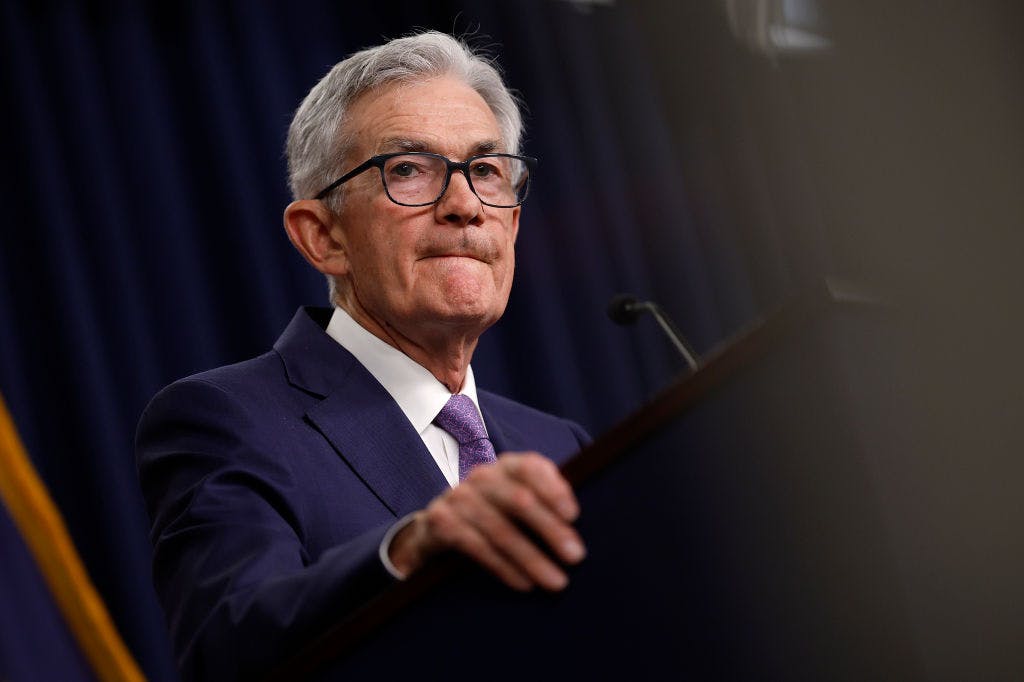
Fed Chair Jerome Powell Holds An News Conference On Interest Rates
Federal Reserve Chair Jerome Powell (Kevin Dietsch/Getty Images)

Federal Reserve leaves rates unchanged; dot plot still signals lower rates in the cards for 2026

A relatively dovish reaction function from the US central bank.

Luke Kawa

The Federal Reserve held its policy rate unchanged at a range of 3.5% to 3.75%, as was universally expected.

The Summary of Economic Projections accompanying this release showed that the median monetary policymaker still expects the policy rate to be 25 basis points lower by the end of 2026 if the economy unfolds in line with their expectations.

The US central bank was very wrong-footed by the persistence of the inflation shock coming out of the pandemic, which was then turbocharged by the spike in oil and natural gas prices stemming from Russia’s invasion of Ukraine and subsequent restrictions on purchasing its energy.

Fed officials upped their forecast for growth this year and the next relative to December and raised their forecasts for inflation in 2026 — particularly headline inflation, which includes energy prices. Stronger growth and inflation would generally indicate a reduced need for rate cuts, but the median rate path through 2028 was unchanged from December.

The message from the central bank seems to be, “We’re not fighting the last war, and we’re praying for a short war.”

The SPDR S&P 500 ETF was little changed in the aftermath of the statement and updated forecasts, but extended losses to as much as 1.1% during Fed Chair Jerome Powell’s press conference.

Fed Governor Stephen Miran was the lone official to dissent, favoring lower rates.

Prediction markets thought the most likely outcome was that two US monetary policymakers would dissent at this meeting, with roughly 30% odds of just one dissent and about a 5% probability of three dissents.

(Event contracts are offered through Robinhood Derivatives, LLC — probabilities referenced or sourced from KalshiEx LLC or ForecastEx LLC.)

The war in Iran and resulting disruption to global energy markets, with US gas prices registering their sharpest increase in more than two decades, has caused traders to tear up the playbook for any easing from the US central bank this year.

Before the strikes, a full interest rate cut was priced into federal funds futures by the July meeting. Heading into this decision, a full cut is not priced in for all of 2026.

In the run-up to this release, prediction markets ascribed roughly 5% odds to a cut at the Fed’s meeting next month, and about one in three odds to the prospect of a reduction in June.

This is the US central bank’s first meeting since President Donald Trump said that former Fed Governor Kevin Warsh would be his pick to succeed Powell as chair of the Federal Reserve.

More Markets

See all Markets
markets

Intel surges after Trump announces US chip deal with Apple

Intel is soaring in early trading after President Donald Trump posted on Truth Social that Apple has agreed to work with the semiconductor giant to design and manufacture its chips domestically.

President Trump positioned the agreement as the latest victory for his administration’s industrial policy after the federal government acquired a 9.9% equity stake in Intel last year.

"Stupid Presidents took our Economy for granted, and let Taiwan and others steal our Semiconductor Factories," Trump wrote in the post. "We design everything, but we need to BUILD it here, NOW! So I decided to help Intel because we need to design and build our Chips right here in America... and, finally, Apple has agreed to work with Intel to design and build its Chips in America."

Intel reportedly reached a preliminary agreement back in May to manufacture chips for the Apple, which has been facing supply constraints for its iPhone as well other products. The deal could help Apple reduce its reliance on longtime partner TSMC by bringing more of its chip manufacturing stateside.

"This partnership helps Apple with chip development and manufacturing on US soil with greater focus on reducing dependence on Asian manufacturing facilities." Wedbush's Dan Ives commented in a company report. He has a $400 price target for Apple this year.

The timing aligns with Intel's technical roadmap. Earlier this week, Intel confirmed that its advanced, performance-boosted 18A-P process node officially entered its risk production phase. This move serves as a blueprint for both Intel chips and processors the company plans to build for foundry customers.

“The current capacity crunch is probably emboldening customers to give Intel a harder look at this stage than perhaps they might ordinarily be inclined to do as the prospect of more advanced capacity will take on higher value in a constrained environment,” wrote Bernstein analyst Stacy Rasgon. “We are sure that Trump’s encouragement is at least not going to hurt though.”

Momentum was built around Intel Foundry services as surging global AI demand continuously outpaced capacity. Earlier this month, Google reportedly placed an order with Intel to manufacture more than 3 million of its increasingly popular tensor processing unit chips in 2028. According to the report, Nvidia is also testing to see if Intel could manufacture its next-gen Feynman chips.

markets

Stocks rise after US, Iran sign peace plan

Stocks rose Thursday morning after President Trump and Iranian President Masoud Pezeshkian signed a memorandum of understanding aimed at ending the war, in another sign that a months-long war that caused energy prices to spike could be coming to an end.

Trump signed the MOU before a dinner in Versailles, France on Wednesday evening. The president previously announced that a deal had been reached on Sunday evening, saying that traffic through the Strait of Hormuz would resume and that the US naval blockade would be lifted.

The deal comes after both sides exchanged attacks last week, escalating tensions to some of the highest levels since the US and Israel struck Iran in late February.

The price of Brent Crude ticked even lower after dropping on Sunday, sitting at about $76 a barrel. Oil giants like Shell, Chevron and Exxon fell on the news, as average gas prices in the US dropped below $4 for the first time in months.

Futures for the S&P 500 and Nasdaq Composite rose 0.9% and 1.5%, respectively. Last week, inflation readings for May showed both wholesale inflation and consumer prices rose in large part because of higher energy costs.

Signs of the peace deal have also lead to buying of momentum stocks this week. iShares MSCI USA Momentum Factor ETFrose another 1.46% in premarket trading.

Latest Stories

Sherwood Media, LLC and Chartr Limited produce fresh and unique perspectives on topical financial news and are fully owned subsidiaries of Robinhood Markets, Inc., and any views expressed here do not necessarily reflect the views of any other Robinhood affiliate, including Robinhood Markets, Inc., Robinhood Financial LLC, Robinhood Securities, LLC, Robinhood Crypto, LLC, Robinhood Money, LLC, Robinhood U.K. Ltd, Robinhood Derivatives, LLC, Robinhood Gold, LLC, Robinhood Asset Management, LLC, Robinhood Credit, Inc., Robinhood Ventures DE, LLC and, where applicable, its managed investment vehicles.

