
Markets
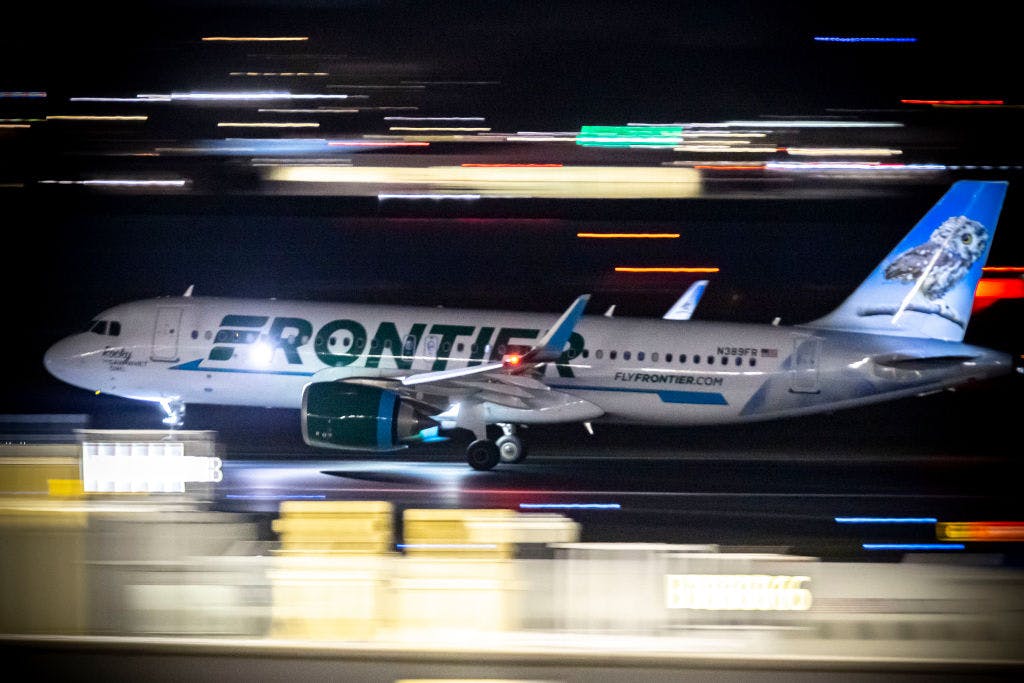
Frontier Airlines Airbus A320neo
(Nicolas Economou/Getty Images)

Frontier takes off in the wake of Spirit’s second bankruptcy filing

Deutsche Bank said Frontier is the big winner of Spirit’s collapse, sending its shares up and those of its rivals downward.

The skies are looking a bit more blue today for Frontier Airlines.

The low-cost carrier stands to benefit the most from Friday’s fresh bankruptcy filing by its budget rival Spirit Airlines, according to a recent note from Deutsche Bank. Deutsche Bank upgraded Frontier’s rating to “buy” from “hold” following the news, with analyst Michael Linenberg noting that more than a third of Frontier’s network overlaps with Spirit’s in the current quarter.

Frontier shares were up as much as 20% in Tuesday morning trading. Shares of budget flying rival JetBlue were up 2% in recent trading.

The whole ordeal is a cheaper way for Frontier to achieve its long-standing mission of eliminating competition from Spirit. Frontier has unsuccessfully tried to acquire the carrier twice since 2022 — a failed merger that would have created the US’s fifth-largest airline. Now, Frontier will have even more opportunity to eat Spirit’s market share, without the need to get approval from antitrust regulators.

Last week, Frontier said it would launch 20 new routes this winter. Many of those will be in Spirit’s major markets.


More Markets

See all Markets
markets

Symbiotic tanks as company and Softbank, its largest shareholder, announce offering of 10 million shares

Symbiotic was among the robotics companies that popped on Wednesday, gaining nearly 10% on the news that the Trump administration was on the precipice of a major push to support the industry.

And so naturally, management thinks it is a good time to sell shares — and its largest shareholder, SoftBank, agrees.

After the close on Wednesday, management announced a 10 million share offering, with 6.5 million of that as a primary offering from the company to raise money for general corporate purposes, and 3.5 million from a secondary sale by Softbank, which owns over one third of its shares.

The stock cratered on the announcement, giving back all of its one-day gains and then some.

Symbiotic went public in 2022 through a SPAC merger with a Softbank-backed affiliate.

In October, Softbank sold its entire $5.8 billion stake in Nvidia to meet an upcoming payment to OpenAI to finance its equity position in the company. Since Softbank is slated to pay the ChatGPT maker more than $20 billion this month, it would appear that this is another step toward raising the needed cash for that position.

We’ll see if this divestment makes Softbank founder Masayoshi Son cry.

markets

Snowflake sinks as weak margin forecast overshadows Q3 beat

Snowflake is down 9% in premarket trading on Thursday after the cloud company gave an operating margin outlook that fell short of analyst expectations, reflecting investors’ worries about the profitability of new AI-based products.

The company now expects its adjusted operating income margin for the three months ending in January to come in around 7%, lower than 8.5% projected by analyst data compiled by Bloomberg. Snowflake also sees product revenue of around $1.2 billion for the coming quarter.

Despite the softer outlook, Snowflake’s most recent quarter was a pretty solid one, with Q3 revenue jumping 29% year-over-year to $1.21 billion (2% ahead of consensus estimates), driven by higher product revenue, on which CEO Sridhar Ramaswamy commented in a press release that “Snowflake Intelligence, our enterprise AI agent, saw the fastest adoption ramp in Snowflake history.” Earnings also beat, with adjusted EPS coming in at at $0.35, 13% ahead of estimates.

The stock’s drop shows how “the bar was high” for Snowflake going into earnings, according to BNP Paribas analyst Stefan Slowinski, as investors had high hopes for the company that rose nearly 70% this year even when rival stocks slumped in fears of AI disruption.

On Wednesday, the company also announced a $200 million multi-year deal with Anthropic that would make the AI startup’s Claude model available within the Snowflake data environment to more than “12,600 global customers across Amazon Bedrock, Google Cloud Vertex AI, and Microsoft Azure.”

markets

Seagate, Western Digital stumble amid reports of customer resistance to AI

Hard disk drive makers Seagate Technology Holdings and Western Digital slumped Wednesday following a report from The Information that Microsoft is facing pushback from software clients who don’t want to pay more for AI-optimized products.

Microsoft contested the report, issuing a statement saying it hadn’t lowered sales quotas or targets. But the story hit squarely on the core issue facing the market right now: whether AI will ever produce enough revenue to pay for the massive investments hyperscalers are making.

As the tumble for hard disk makers shows, this is a market-wide issue. Share prices of hard disk makers have boomed amid expectations that the soaring demand for data storage related to AI investment will juice sales of these cheap storage devices for the foreseeable future.

Seagate and Western Digital are still the second- and third-best-performing stocks in the S&P 500 this year, with gains of roughly 200% and 250%, respectively.

markets

Micron announces exit from consumer business to focus on AI demand

With a lot of AI mouths to feed amid a supply crunch for memory chips, Micron has made the decision to exit its consumer chip business (which goes by the brand name “Crucial”).

“The AI-driven growth in the data center has led to a surge in demand for memory and storage. Micron has made the difficult decision to exit the Crucial consumer business in order to improve supply and support for our larger, strategic customers in faster-growing segments,” said Sumit Sadana, EVP and chief business officer.

Memory chip prices have been surging thanks to demand from the AI boom, with South Korean memory giant SK Hynix saying that it’s already sold out all of next year’s production.

Per the press release, Micron will cease shipments of Crucial-branded items at the end of February 2026.

The product line has been a bit of a misnomer for the memory chip specialist as of late. Sales of Crucial-branded products fall under its mobile and client business unit, and the brand enjoyed a 25% jump in revenues year on year as of its most recent quarter. While impressive growth, that pales in comparison to the more than 200% surge in revenues for its cloud memory business unit, which focuses on high-bandwidth memory chip sales to hyperscalers.

Operating margins in the mobile and client business unit were 29% in its most recent quarter, compared to 48% for the cloud-centric division.

Latest Stories

Sherwood Media, LLC produces fresh and unique perspectives on topical financial news and is a fully owned subsidiary of Robinhood Markets, Inc., and any views expressed here do not necessarily reflect the views of any other Robinhood affiliate, including Robinhood Markets, Inc., Robinhood Financial LLC, Robinhood Securities, LLC, Robinhood Crypto, LLC, or Robinhood Money, LLC.