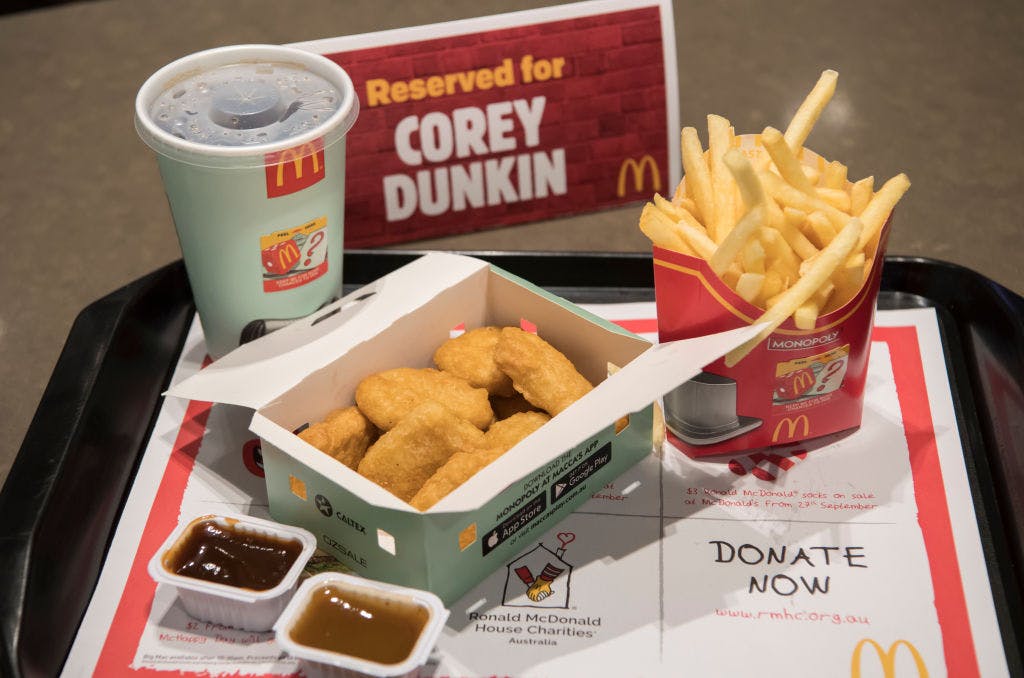
We have the futures market — and Ray Dalio — to thank for the Chicken McNugget
Bridgewater founder Ray Dalio reimagined the chicken as an entity that consumes corn and soybeans on its way to being consumed by you.
Welcome to Sherwood’s deep dive into futures markets, presented in partnership with 
Long before you could use a “buy now, pay later” option to DoorDash some McDonald’s, financial innovation played a key role in delivering the Chicken McNugget.
And what is a Chicken McNugget, anyway?
If you ask McDonald’s, it will tell you it’s a scrumptious morsel of chicken, water, vegetable oil, enriched flour, and a host of other ingredients available quickly for relatively cheap.
But if you ask Ray Dalio to zoom in on the main ingredient, he’d have a different answer.
In the same way that a Michelin chef might deconstruct a cheesecake into its constituent parts, reimagining the dish for an eager gourmet, Dalio viewed the chicken as an entity that consumes corn and soybeans on its way to being consumed by you.
This reconceptualization — and the futures market — is what allowed for bite-sized fried poultry to become a fast-food favorite.
Early in his career, the Bridgewater founder was hired as a consultant to work with McDonald’s on pricing this new menu item. McDonald’s wanted price security to be able to generate a solid return without frequently changing prices. So-called “menu costs” — the time and resources it takes to update pricing — are the deadweight costs of inflation, and can also turn off consumers.
There have been many attempts to introduce chicken (and egg) futures over time — oh, and by the way, the egg futures came first. But these were plagued by perishability and standardization concerns, and later, the magnitude of vertical integration among major poultry producers. Even now, you have to turn to China’s Dalian Commodity Exchange to access these futures.
So Dalio couldn’t simply tell McDonald’s to use chicken futures to lock in supply at various points in time. That’s where his financial ingenuity came to the rescue, as he also happened to have Lane Processing, a leading chicken producer that would go on to be acquired by Tyson, as a client.
As Bridgewater recounts in its founding story (emphasis ours):
“The corn and soymeal prices were the volatile costs the chicken producer needed to worry about. Ray suggested combining the two into a synthetic future that would effectively hedge the producer’s exposure to price fluctuations, allowing them to quote a fixed price to McDonald’s. The poultry producer closed the deal and McDonald’s introduced the McNugget in 1983.”
Dalio, for his part, has said that it would be “overreaching” to call himself the creator of the Chicken McNugget.
But without this display of financial engineering, the McNugget might have never gotten off the ground. Solving the financial equation was a prerequisite to overcoming the additional challenges of storage, distribution, deep-frying, and marketing.
It’s a throwback to the original conceit of futures in greasing the wheels of production and consumption, a practice that continues to this day for major sellers and buyers of everything from chocolate to jet fuel.
Since the early 1980s, the list of tradable agricultural commodity futures has swelled to include a variety of dairy products, pork cutout (the processed meat, rather than the live hog), and fertilizer, to name a few.