
Markets
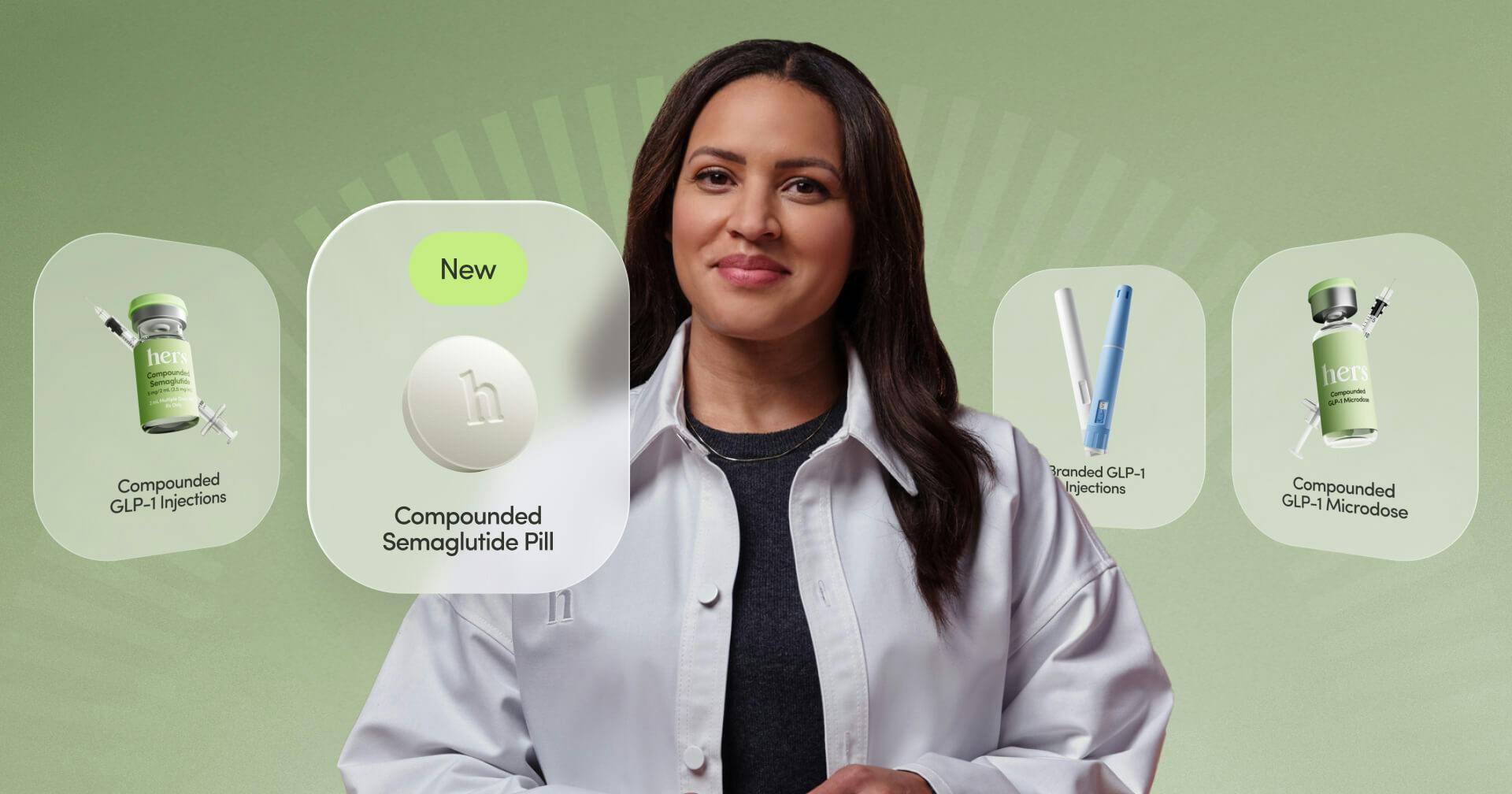
(Hims & Hers compounded semaglutdie)
(Hims & Hers)

Hims to offer copies of Wegovy pill at $49 a month for starting dose, Novo threatens legal action

Novo said in a statement that it “will take legal and regulatory action to protect patients, our intellectual property and the integrity of the US gold-standard drug approval framework.”

Hims & Hers will offer copies of Novo Nordisk’s Wegovy pill at $49 for a starting dose, the company announced Thursday, a sign that the telehealth giant is doubling down on copycat versions of blockbuster weight-loss drugs over forging partnerships with Big Pharma like its peers.

Hims’ product is $100 less than the initial price consumers would pay if buying directly from Novo. For a five-month subscription, patients pay $49 for the first month’s starting dose, then $99 per month, versus the $199 Novo charges. The drugmaker said it “will take legal and regulatory action.

The news was first reported by Reuters. Hims rose more than 10% in early trading after falling for several days in a row, but gave back those gains and then some by midday. Novo, which has already fallen about 20% since giving a gloomy sales guidance on Tuesday, fell further.

Eli Lilly, Novo’s top competitor, which said yesterday that it expects sales to boom in 2026, also fell in Thursday trading, a sign investors are concerned about Hims’ new offering gaining market share at Lilly’s expense, or that Lilly itself might not be immune to copycat versions of its drugs.

Billion-dollar question

Hims’ announcement came right before Novo was scheduled to have a call with analysts. “You’re wasting $49, in my opinion,” Novo CEO Mike Doustdar said in that call.

Novo has a patent on its delivery method for its Wegovy pill, which protects the active ingredient in the pill during digestion. A Hims spokesperson told Sherwood News that its pill uses “liposomal technology that is intended to support absorption.”

The Wegovy pill has has to be taken on an empty stomach followed by a 30-minute fast for it to be absorbed. It is unclear if this is also the case for the version Hims is selling. Hims’ pharmacy partner, Strive, did not immediately respond to a request for comment. Unlike branded medications, compounded products don’t undergo clinical trials and are not evaluated for safety and efficacy by the FDA.

In a statement, Novo accused Hims of “illegal mass compounding that poses a significant risk to patient safety” and said it “will take legal and regulatory action to protect patients, our intellectual property and the integrity of the US gold-standard drug approval framework.”

“This is another example of Hims & Hers’ historic behaviour of duping the American public with knock-off GLP-1 products, and the FDA has previously warned them about their deceptive advertising of GLP-1 knock-offs,” a spokesperson said.

Hims characterized Novo’s response as another attempt to demonize more affordable options. This narrative is as predictable as it is outdated and false, the company wrote in a post on X.

Michael Botta, president and cofounder of Sesame, a telehealth platform that partners with Novo, noted it’s much harder to personalize pills — which are pressed in large batches — than injectables, which can be taken in various doses from the same vials. He also said it’s hard to imagine how this can be anywhere near as effective with the tolerability of Wegovy pill.

On the delivery method — that’s the billion-dollar question, Botta said, referring to how the active ingredient is protected during the digestive process. Novo has spent billions on getting it right, and it’s not easy.

Novo and Hims have sparred before

The announcement comes after the two companies had an epic falling-out last year. 

Hims and other telehealth companies began selling copies of Novo’s injectable weight-loss drug in 2024 while it was in a shortage. Even after the shortage ended, Hims continued to sell copies it says are “personalized” for patients. Novo has expressed frustration that regulators have not cracked down on this legal loophole, and it has sued smaller players doing this, though not Hims.

In June, Novo abruptly ended its short-lived deal to offer its weight-loss shot on Hims and accused the company of “illegal mass compounding and deceptive marketing.” The drugmaker reportedly expected Hims to stop selling copycat versions if it were to carry the FDA-approved, brand-name product. 

We’ve seen this cycle play out repeatedly: branded manufacturers raise concerns, regulators move slowly, and compounders move quickly to meet demand in the gray areas of the market, said Michael Schnell, consumer health expert at West Monroe. Until there is clearer enforcement or new rules, that dynamic is unlikely to change.

Hims CEO Andrew Dudum told analysts on its most recent earnings call in November that it was again in talks with Novo to potentially reforge a deal. That looks increasingly unlikely after today’s announcement. 

Novo’s Wegovy pill is the first oral GLP-1 for weight loss to come to market. The drugmaker has been pushing its Wegovy pill through Hims’ competitors, and early signs show uptake is strong and predominantly coming from people who have never taken a GLP-1 before versus those switching from injections. 

Despite this, the company said on Tuesday that it expects sales to take a hit from growing competition from other drugmakers. Its top rival, Eli Lilly, is expected to release its own GLP-1 pill in April.

More Markets

See all Markets
markets

Nvidia to invest up to $2.1 billion in IREN in partnership that deploys as much as 5 gigawatts of its AI infrastructure

Another day, another massive Nvidia warrants deal in the AI ecosystem.

Shares of data center company IREN spiked 20% in postmarket trading after it reached a pact with the chip designer to deploy up to 5 gigawatts of its AI offerings across data centers.

This means that IREN will effectively be building out data centers designed by Nvidia to optimize for its hardware. And some of that hardware deployed will seemingly then be utilized by Nvidia: IREN also announced a $3.4 billion AI cloud contract with the giant on Thursday.

As part of the arrangement, IREN issued Nvidia warrants that expire in five years that enable the company to buy up to 30 million shares at $70 apiece. If fully exercised, that would amount to a $2.1 billion investment into IREN.

This announcement took the sting out of IREN’s Q3 results, which saw the firm report sales of $144.8 million (compared to analyst estimates of $216.6 million) and adjusted EBITDA of $59.5 million (estimate: $125 million).

On Wednesday, Nvidia announced an investment of $500 million in fiber-optics firm Corning to accelerate its manufacturing capacity.

markets

Applied Optoelectronics sinks after Q1 sales miss, underwhelming Q2 revenue guidance

Applied Optoelectronics tumbled after-hours after the connectivity company reported lower-than-expected Q1 sales and underwhelming revenue guidance.

Here are the numbers:

  • Revenue of $151.1 million (compared to analyst estimates of $157.5 million).

  • An adjusted loss per share of $0.07 (estimate: a $0.05 loss).

  • An adjusted gross margin of 29.1% (estimate: 30.37%).

The company helps servers in large-scale data centers relay information, partnering with companies like Microsoft and Amazon. Last month, the stock surged after news broke that a key hyperscale customer, following an initial order, had significantly increased its demand for AAOIs offerings.

For second quarter of 2026, the company expects:

  • Revenue in the range of $180 million to $198 million (estimate: $196.83 million).

  • Adjusted gross margin in the range of 29% to 30% (estimate: 31.42%).

In the press release, AAOI Chief Financial and Strategy Officer Dr. Stefan Murry said:

Our focus remains on ramping our capacity thoughtfully to meet the unprecedented demand and are confident in our ability to execute on our ambitious growth plans, while ensuring reliability, quality, and a dedication to excellence.”

Demand for photonics does not seem to be in question, but judging by Lumentum’s post-earnings call on Tuesday and Applied Optoelectronics’ commentary, the challenge lies in securing supply.

AAOI was up nearly 300% since the beginning of the year before this print.

markets

Airbnb beats on Q1 revenue, increases guidance for current quarter

Shares of Airbnb whipsawed in after-hours trading Thursday after the company beat Wall Street estimates on revenue and raised guidance for the year, but missed on earnings per share, citing macroeconomic and geopolitical uncertainty.

Airbnb reported: 

  • Q1 revenue of $2.7 billion (compared to analyst estimates of $2.6 billion).

  • Adjusted EBITDA of $519 million (estimate: $483.2 million).

  • Adjusted diluted EPS of $0.26 (estimate: $0.29).

  • Q2 revenue sales guidance of $3.54 billion to $3.60 billion, representing year-over-year growth of 14% to 16% (estimate: $3.4 billion).

Investors were watching for initial impacts of the Iran war, gas prices, jet fuel costs, and cost-of-living increases on the companys finances and projections.

Despite the difficult terrain, the company said that its confident going forward. For 2026, Airbnb raised its guidance, stating that it expects year-over-year revenue growth to accelerate to low to mid-teens and an adjusted EBITDA margin of at least 35%.

The upward revision to our revenue outlook reflects meaningful progress across our growth initiatives and improvements to monetization through a simplified fee structure and our insurance programs, which are expected to lift our full-year take rate. We remain optimistic about our continued momentum, even as we face tougher comparisons in the back half of this year against the rollout of Reserve Now, Pay Later in 2025 and current headwinds from the Middle East conflict.

Perhaps Wall Street is less certain about customers’ willingness to splurge on vacations given the state of things. According to the company, in Q1, roughly 20% of global booking value came from Reserve Now, Pay Later bookings.

markets

DraftKings rises after reporting better-than-expected Q1 numbers

Sports betting company DraftKings rose in aftermarket trading Thursday after it reported better-than-expected Q1 sales and earnings. Here’s a rough outline of the results:

  • Q1 revenue of $1.65 billion vs. Wall Street’s $1.63 billion expectation, according to FactSet.

  • Q1 earnings per share of $0.03 vs. the consensus estimate of $0.01.

  • Q1 adjusted EBITDA of $167.9 million vs. the $152.6 million expectation.

  • Maintained previous full-year adjusted EBITDA guidance of $700 million to $900 million, compared with estimates of $791.4 million.

  • Maintained previous full-year sales guidance of between $6.5 billion and $6.9 billion (midpoint $6.70 billion), compared with analysts’ estimates of $6.82 billion, according to FactSet.

Shares of traditional online sports gambling platforms like DraftKings have struggled as prediction markets have emerged as a center of industry excitement.

The shift to such markets has been tricky for both DraftKings and rival FanDuel, the US leader in online sports betting, which have to manage preexisting relationships with state gaming commissions that stand to be disrupted by prediction markets, which are regulated on the federal level by the CFTC.

DraftKings is down roughly 25% in 2026, while FanDuel parent Flutter Entertainment, which reported earnings yesterday, is down more than 50%.

markets

CoreWeave sinks after offering weak Q2 sales guidance

CoreWeave tumbled in postmarket trading after management unveiled soft Q2 guidance that failed to justify the stock’s 86% rally since late March.

In Q1, the neocloud firm reported:

  • Revenue of $2.1 billion (compared to analyst estimates of $2 billion).

  • Adjusted EBITDA of $1.2 billion (estimate: $1.1 billion).

While its revenue beat was only a little north of 5%, the figure surpassed all of the 32 analyst estimates compiled by Bloomberg.

During the conference call, management offered Q2 sales guidance of $2.45 billion to 2.6 billion, below the expected $2.7 billion. The outlook for adjusted operating income of $30 million to $90 million was also short of the consensus call for $153.9 million.

As of March 31, CoreWeave’s revenue backlog was a whopping $99.4 billion, up from $66.8 billion in the prior quarter.

“We surpassed 1 GW of active power and believe we are well on our way to more than 8 GW by 2030, having positioned our capital structure to scale with the opportunity ahead,” said CEO, cofounder, and Chairman Michael Intrator in a press release. “AI natives and enterprise customers are choosing CoreWeave because we sit between the models and the silicon, delivering the infrastructure, software, and expertise required to build and run AI at scale.”

At the end of the quarter, the company managed to close a unique debt deal backed by GPUs and what Meta is slated to pay for AI compute.

Since then, CoreWeave and its peers have been buoyed by a scramble for compute catalyzed by a seeming shortage for Anthropic, as the Claude developer aims to beef up its footprint amid complaints around usage limits.

CoreWeave reached a multiyear deal with Anthropic to help power Claude, and also expanded its AI compute sales pact with Meta by $21 billion.

Latest Stories

Sherwood Media, LLC produces fresh and unique perspectives on topical financial news and is a fully owned subsidiary of Robinhood Markets, Inc., and any views expressed here do not necessarily reflect the views of any other Robinhood affiliate, including Robinhood Markets, Inc., Robinhood Financial LLC, Robinhood Securities, LLC, Robinhood Crypto, LLC, Robinhood Derivatives, LLC, or Robinhood Money, LLC. Futures and event contracts are offered through Robinhood Derivatives, LLC.

