

Markets
markets
Luke Kawa

Global investors are fleeing US stocks at a record pace

The “sell America” trade is going viral.

That’s the top takeaway from the April edition of Bank of America’s closely watched monthly fund manager survey, which shows that more than half of portfolio managers want to hold an underweight position in US stocks — a record. The exodus is underway in earnest, with the biggest two-month drop in portfolio managers who say they are overweight US stocks in survey history.

And 73% of respondents say the theme of “US exceptionalism” in financial markets has peaked.
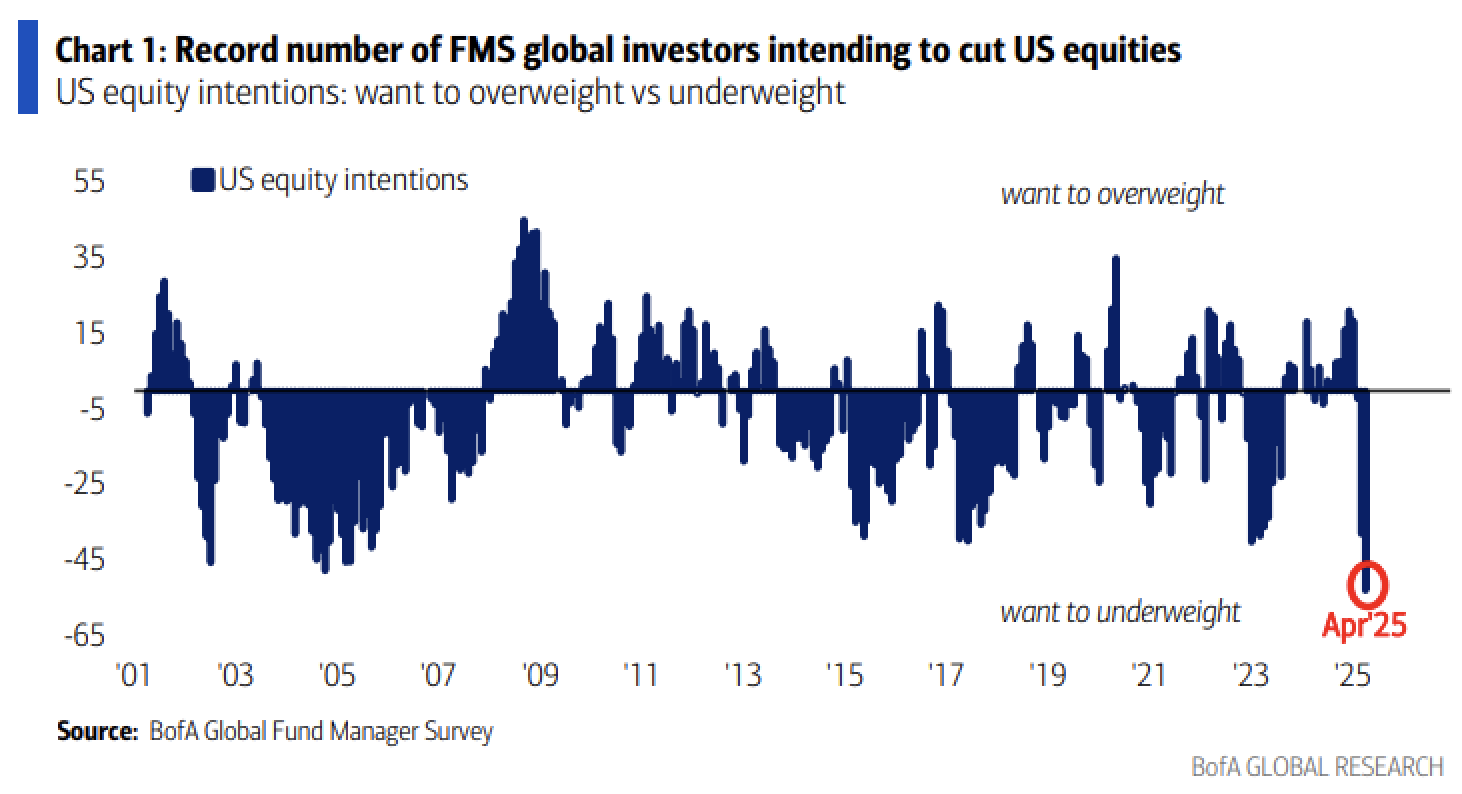
BofAAprilFMS

A plain reading of the results suggests that portfolio managers are battening down the hatches, with tariffs poised to push inflation higher and growth lower.

Michael Hartnett, chief investment strategist at BofA Global Research, wrote that this was the fifth-most-bearish fund manager survey in the past 25 years, with the fourth-highest recession expectations (surpassed by March 2009, April 2020, and November 2022).

More signs of the changing times:

  • A record increase in bond allocations, with exposure to cash and defensive stock market sectors like utilities, healthcare, and staples also rising.

  • A net 28% say the US profit outlook is unfavorable, the lowest reading since November 2007.

  • Relative trust in policymakers has been exported from America to China. Investors are more confident in Chinese policymakers providing stimulus that boosts growth in the second half of the year than they are in US politicians passing tax cuts that juice growth.

  • The Magnificent 7 are no longer deemed the “most crowded trade” for the first time in over two years; that title has instead been ceded to gold, a shiny rock with no yield that tends to do better than other assets when pessimism is the only thing in a bull market. Though it’s deemed to be crowded, that’s for good reason according to portfolio managers: it was the top answer for the best-performing asset class of this year.

The survey period was April 4 to April 10. If we assume a somewhat equal distribution, this implies that more responses came when US stocks were in free fall than during this nascent bounce.


BofAAprilFMS

A plain reading of the results suggests that portfolio managers are battening down the hatches, with tariffs poised to push inflation higher and growth lower.

Michael Hartnett, chief investment strategist at BofA Global Research, wrote that this was the fifth-most-bearish fund manager survey in the past 25 years, with the fourth-highest recession expectations (surpassed by March 2009, April 2020, and November 2022).

More signs of the changing times:

  • A record increase in bond allocations, with exposure to cash and defensive stock market sectors like utilities, healthcare, and staples also rising.

  • A net 28% say the US profit outlook is unfavorable, the lowest reading since November 2007.

  • Relative trust in policymakers has been exported from America to China. Investors are more confident in Chinese policymakers providing stimulus that boosts growth in the second half of the year than they are in US politicians passing tax cuts that juice growth.

  • The Magnificent 7 are no longer deemed the “most crowded trade” for the first time in over two years; that title has instead been ceded to gold, a shiny rock with no yield that tends to do better than other assets when pessimism is the only thing in a bull market. Though it’s deemed to be crowded, that’s for good reason according to portfolio managers: it was the top answer for the best-performing asset class of this year.

The survey period was April 4 to April 10. If we assume a somewhat equal distribution, this implies that more responses came when US stocks were in free fall than during this nascent bounce.

More Markets

See all Markets
markets

Duolingo tumbles despite better-than-expected Q1 results

Traders are crying foul over the green owl.

Duolingo posted better-than-expected first-quarter results, calling it an “outstanding start to the year.”

But the market seems to disagree, with shares down more than 10% in after-hours trading.

Here are the Q1 details:

  • Revenue of $292 million (compared to analyst estimates of $288.5 million).

  • Adjusted EBITDA of $83.4 million (estimate: $73.5 million).

  • Daily active users of 56.5 million (estimate: 55.7 million). 

  • Paid subscribers of 12.5 million (estimate: 12.7 million).

The company also boosted its full-year adjusted EBITDA guidance to $310 million, up from a prior range of $299 million to $305 million, and solidified its revenue outlook to $1.21 billion, the midpoint of its previous range.

The first quarter’s top- and bottom-line beats are larger than the changes to its full-year guidance. This may be Duolingo’s way of keeping expectations low, but on the surface it could be viewed as a sign that the good news for 2026 is already in the rearview mirror.

The language-learning app hit all-time highs more than a year ago and has been in free fall ever since, losing over 75% of its value as investors grapple with the effects of artificial intelligence on the foreign language business.

Duolingo’s user growth has slowed meaningfully in recent quarters, and has been decelerating for years. The company blamed some of this on choosing to forgo some of its unhinged social media posting, trading off user growth for a more positive experience. Whatever the reason, the slowing in user growth continued in Q1, with the app showing a 21.2% increase in daily active users compared to 2025. The deceleration was softer than feared, however, outperforming its guidance and the Street’s call.

Going forward, CEO and cofounder Luis von Ahn sees room to expand in some areas that might seem a little far afield for a language-learning app, until you remember how gamified nearly every app experience is these days.

“We are moving quickly to prioritize the product and free user experience, while also investing in our next engines of growth, like chess, math, and music. We have conviction this is ultimately what will make us a larger and more durable company,” he wrote.

markets

Palantir beats on earnings and revenue, raises guidance

Palantir reported Q1 sales and earnings per share that topped Wall Street’s consensus expectations and boosted its revenue and profit guidance. The defense, intelligence, and AI software company reported:

  • Adjusted Q1 earnings per share of $0.33 vs. Wall Street expectations for $0.28, according to FactSet.

  • Q1 sales of $1.63 billion vs. an expected $1.54 billion, per FactSet.

  • Q1 sales growth of 85% year over year vs. a 74.5% Wall Street expectation.

  • Q1 US commercial sales of $595 million vs. the $605 million consensus of seven analyst estimates collected by FactSet.

Looking forward, Palantir forecast:

  • Q2 2026 revenue in the range of $1.797 billion to $1.801 billion, vs. Wall Street expectations for $1.68 billion.

  • Q2 2026 adjusted operating income between $1.063 billion and $1.067 billion, vs. an expectation for $873.6 million.

  • Full-year 2026 revenue in the range of $7.65 billion to $7.662 billion, vs. its previous estimate of between $7.182 billion and $7.198 billion and Wall Street expectations for $7.24 billion.

  • Full-year 2026 adjusted operating income between $4.440 billion and $4.452 billion, vs. its previous estimate of between $4.136 billion and $4.142 billion and analyst expectations for $4.19 billion, according to FactSet.  

Shares were roughly flat shortly after the report.

A retail favorite since at least 2024, Palantir’s shares have struggled early in 2026, falling about 18% through Monday’s close. The problem isn’t with the fundamentals, as Palantir’s results have repeatedly trounced expectations for profitability and growth. (Though it did slightly undershoot expectations for Q1 US commercial sales, if one is being a stickler.)

It’s just that the market has given Palantir lots of credit over the last three years, during which time its shares soared roughly 1,900%. In the market’s view, perhaps Palantir’s sterling performance merely represents the company keeping its end of the bargain.

markets

Pinterest spikes after delivering impressive Q1 results, with fastest sales growth since Q2 2024

Pinterests nascent comeback gained traction on Monday as the company reported better-than-expected Q1 results.

After sinking double digits following each of its past three earnings reports, the social media company looks poised to snap that inauspicious streak, with shares jumping 20% in postmarket trading.

Here are the Q1 numbers: 

  • Revenue of $1.01 billion (versus a consensus estimate of $965.7 million and guidance for $958 million to $978 million).

  • Adjusted EBITDA of $206.5 million (estimate: $176.7 million, guidance for $163 million to $183 million).

  • Monthly active users of 631 million (estimate: 630.5 million).

Guidance for Q2 was modestly ahead of estimates:

  • Revenue in a range of $1.13 billion to $1.15 billion (estimate: $1.12 billion).

  • Adjusted EBITDA in a range of $256 million to $276 million (estimate: $264.8 million).

The stock had lost 40% of its value over the past six months as investors scrutinized the headwinds from tariffs and chatbots — worries that are seemingly being assuaged by these results.

Considering the vibe curation companys recent track record, the bar had been slightly lowered for Q1: in its guidance for the first quarter of the year, the company said it expected Pinterest to grow between 11% and 14% year over year, already a few ticks downward from the 16% growth the company saw in 2025. 

In the first part of the year, Pinterest actually enjoyed revenue growth of nearly 18%, its strongest pace since Q2 2024.

“As we continue building an AI-powered ads platform that delivers performance for advertisers, we remain focused on ensuring monetization more fully reflects the strength of our engagement,” said CEO Bill Ready.

The company’s attempted open-source AI pivot may be starting to show signs of paying off for investors. 

markets

Paramount beats Q1 earnings estimates, maintains full-year revenue guidance

Paramount delivered its first-quarter results after the bell on Monday. Shares of the entertainment company rose about 5% in after-hours trading.

For Q1, Paramount reported:

  • Adjusted earnings of $0.23 per share, compared to Wall Street estimates of $0.15 per share from analysts polled by FactSet.

  • Revenue of $7.35 billion, compared to a $7.28 billion estimate.

  • 79.6 million Paramount+ subscribers, compared to the 79.9 million consensus.

Looking ahead, the company said it expects Q2 revenue of between $6.75 billion and $7.95 billion, compared with the $7.07 billion Wall Street consensus forecast. The company maintained its full-year revenue guidance of $30 billion.

Q1 marks the company’s first earnings report since winning the bidding war for Warner Bros. Discovery in late February. As of Monday afternoon Eastern time, prediction markets speculating on which company will ultimately come out on top of the bidding war have Paramount at a 77% chance, compared to 17% for “none.”

(Event contracts are offered through Robinhood Derivatives, LLC — probabilities referenced or sourced from KalshiEx LLC or ForecastEx LLC.)

The megadeal still faces some hurdles, including significant opposition from notable entertainment workers and potential antitrust challenges on the federal or state level. Last week, a group of subscribers sued to block the deal on antitrust grounds.

Latest Stories

Sherwood Media, LLC produces fresh and unique perspectives on topical financial news and is a fully owned subsidiary of Robinhood Markets, Inc., and any views expressed here do not necessarily reflect the views of any other Robinhood affiliate, including Robinhood Markets, Inc., Robinhood Financial LLC, Robinhood Securities, LLC, Robinhood Crypto, LLC, Robinhood Derivatives, LLC, or Robinhood Money, LLC. Futures and event contracts are offered through Robinhood Derivatives, LLC.
