
Markets
US stock market sharpe ratio risk reward Goldman Sachs
(Manan Vatyayana/Getty Images)

Goldman’s list of stocks with great risk-reward ratios

On the age-old trade-off between risk and reward.

Sure, everybody likes a big fat gain on their stock portfolios.

But among Wall Street pros, the game is slightly different, with the highest praise reserved for investors who can generate the strongest returns while taking the least risk. In other words...
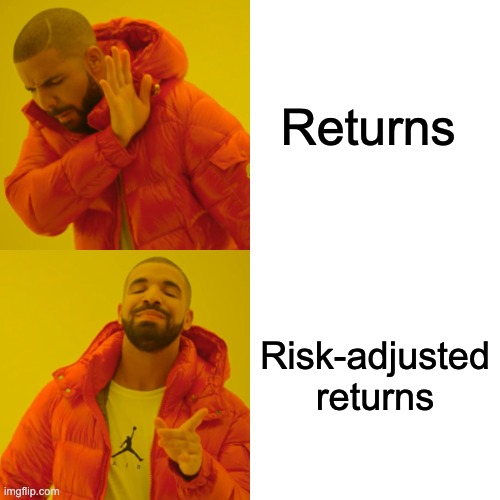
9y073b

There are lots of ways to asses the risks that are factored into “risk-adjusted” returns.

A widely used shortcut is to look at how much an investment gains (or loses) compared to a super safe benchmark — usually US government debt. Then compare that excess gain to the volatility of the investment. (That is, how much its price swings up and down.)

A Stanford economist by the name of William Sharpe came up with a handy formula that spits out a number — known as the Sharpe Ratio — that does just that.

Long story short, the higher the Sharpe Ratio, the better the risk-adjusted returns.

That seems like a good number to have. But for investors hoping to garner low-anxiety gains in the future, there’s a problem: those gains and price swings accounted for in the Sharpe Ratio have already happened. And there’s no guarantee the investment will perform that way in the future.

But maybe there’s a way to find such investments. The big brains down at Goldman Sachs have come up with a measure they call “prospective Sharpe ratios” to, well, prospect for such stocks.

It’s constructed out of expected price gains — a consensus price target published by Wall Street analysts — and a measure of expected price volatility, known as implied volatility, which is a statistical byproduct of the options market.

Analysts used this ratio to scour the S&P 500 for such stocks, which created one of Goldman’s themed baskets of stocks. They just updated the list.

So here, by Goldman’s reckoning, are the S&P 500 stocks that the market sees as the best bets for “risk-adjusted” returns over the next year.

By design, this isn’t the most glamorous list of stocks. LKQ Corp. tops it. (The company owns auto scrapyards, disassembles vehicles and sells them for parts.)

And many others on the list have had especially ugly rides in the market so far this year, like Omnicom, a giant in an industry — advertising — that’s been upended by AI. Viatris has been in the market’s penalty box since the FDA blocked imports from one its key plants in India after finding violations during an inspection. Vaccine maker Moderna has been badly battered by market sentiment as a result of big changes to US health policy under Health & Human Services Secretary Robert F. Kennedy Jr., a longtime leader of the US anti-vaccine movement.

So as you can see, even these companies are not free of risks. In the markets, nothing really is. But smart investors tried to get paid as much as possible for taking them.

More Markets

See all Markets
markets

Nike sinks to lowest level since 2014 after warning of “challenged” sales environment in Q4 report

Did Nike do it?

Investors had a mixed reaction after the global sports apparel company reported its fourth quarter earnings on Tuesday after the bell. Shares initially rose 5% as Nike beat out Wall Street expectations amid a hefty tariff refund bonus. However, the stock then sank to its lowest level since August 2014 in postmarket trading.

Here are the Q4 numbers:

  • Revenue of $11.0 billion (estimate: $10.8 billion).

  • Adjusted earnings per share of $0.20 (estimate: $0.12).

Ahead of this report, Nike warned that results would be flattered by a one-time tariff refund (now estimated at roughly $0.52 per share for the bottom line). That gave the company an extra cushion in snapping its streak of seven quarters of year-over-year profit declines.

Over the past year, the company had been punished by tariffs on imported goods, stagnant consumer spending, and increasing competition from other footwear brands like New Balance, Adidas, and Hoka.

Outgoing CFO Matthew Friend deemed it an “increasingly challenging operating environment, where sell-through remains challenged.”

markets

Rocket Lab deal lifts space stocks

Shares of Rocket Lab are surging after announcing an $8 billion acquisition of satellite communications operator Iridium Communications, helping lift a broader basket of space-related stocks as investors piled back into the sector.

Planet Labs, AST SpaceMobile and Redwire all traded higher alongside Rocket Lab, extending gains in an industry that has drawn enhanced investor attention in recent months in light of the strategic importance that governments place on space and satellite communications infrastructure.

In a presentation, Rocket Lab’s management called the purchase “a shortcut” for its satellite communications business.

Under the terms of the agreement, Iridium shareholders will receive $27 in cash and Rocket Lab stock, valuing Iridium at $54 per share. Backed by a $3.6 billion bridge loan committed by Deutsche Bank and Wells Fargo, Rocket Lab absorbs Iridium’s globally licensed spectrum and an active base of 2.5 million subscribers.

Rocket Lab has also remained one of the most active launch providers in the sector. The company completed its 12th launch of the year last week, maintaining one of the highest launch cadences among commercial space companies.

Today's rally helps offset a brutal stretch for the group. Rocket Lab shares had fallen over 35% over the prior month, while Planet Labs stock was down more than 40% and AST SpaceMobile stock was down around 30% over the same window.

markets
Jake Lahut

Comcast shares rise on news of NBCUniversal spinoff deal

Comcast rose on the news that the telecom behemoth is spinning off NBCUniversal and Sky from its cable portfolio. 

Comcast initially jumped up to 17% in early trading, with the deal leaving management to focus on its core verticals of cable, wireless, and business services. 

NBCUniversal and Sky will form a new publicly traded company, similar to Versant Media, the holding company of CNBC and MS NOW that Comcast officially spun off in January. Bravo, one of the most lucrative properties that remained at Comcast, will remain part of NBCUniversal in the deal. The Universal theme parks and studios will also come with the new spinoff entity, along with Telemundo and Peacock.

Mike Cavanagh, the co-CEO of Comcast, will become the CEO for NBCUniversal, according to CNBC. 

The spinoff will be completed in about a year, according to a Comcast company statement. Its shareholders will also own shares in NBCUniversal, according to the same statement.

Latest Stories

Sherwood Media, LLC and Chartr Limited produce fresh and unique perspectives on topical financial news and are fully owned subsidiaries of Robinhood Markets, Inc., and any views expressed here do not necessarily reflect the views of any other Robinhood affiliate, including Robinhood Markets, Inc., Robinhood Financial LLC, Robinhood Securities, LLC, Robinhood Crypto, LLC, Robinhood Money, LLC, Robinhood U.K. Ltd, Robinhood Derivatives, LLC, Robinhood Gold, LLC, Robinhood Asset Management, LLC, Robinhood Credit, Inc., Robinhood Ventures DE, LLC and, where applicable, its managed investment vehicles.

