
Markets
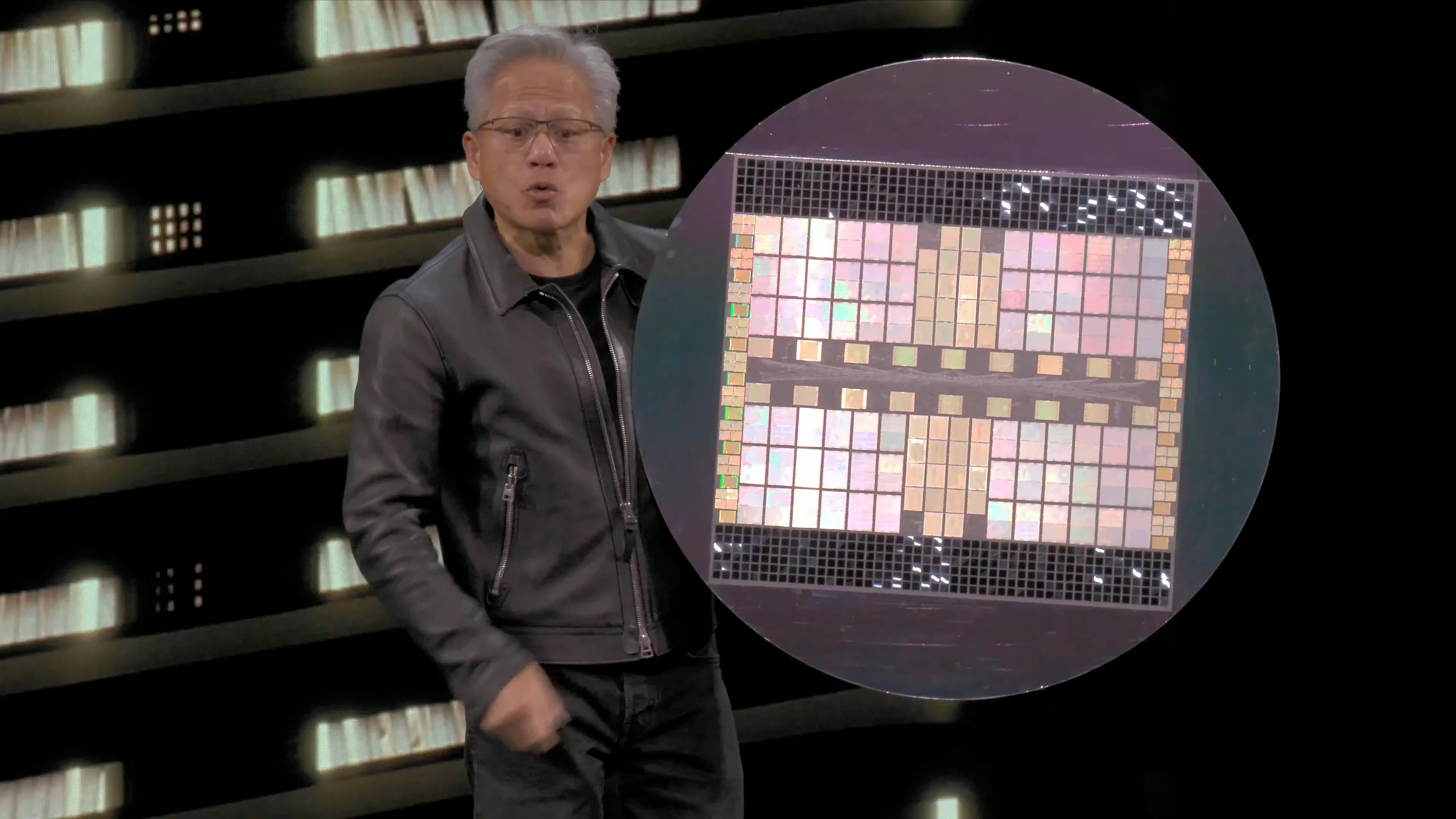
Jensen Huang with Grace Blackwell chips
(Screenshot: Nvidia)

Nvidia delivers another sales and earnings beat in Q1, with strong Q2 revenue guidance

Shareholder returns are going up too!

Luke Kawa

Nvidia is whipsawing in postmarket trading after reporting better-than-expected Q1 results along with strong sales guidance for Q2.

Fiscal Q1 2027 marked the chip designer’s 15th consecutive top-line beat and 14th straight quarter in which the company posted adjusted earnings per share above what Wall Street had penciled in.

Management also boosted its buyback authorization by $80 billion and raised the quarterly dividend to $0.25 from $0.01.

During the conference call, analysts will be looking for potential upside to CEO Jensen Huang’s March announcement that sales of Blackwell and Rubin chips (as well as associated networking equipment) would top $1 trillion through 2027.

In particular, the outlook for its Vera CPUs as well as for products developed with Groq’s capabilities will be in focus as fresh avenues for even more growth. Both address parts of the supply chain that are seemingly facing more constraints than GPUs — CPUs thanks to the particular compute requirements of AI agents, and memory as widening context windows reduce the speed of models and increase token usage.

With this quarterly report, Nvidia is unveiling a new framework for how it reports sales: a data center segment, and edge computing. The latter segment includes “data processing devices for agentic and physical AI” — perhaps a hint that Huang’s expected evolution of demand going from agentic AI to physical AI will be reflected more meaningfully in Nvidia’s financials going forward.

For the past few quarters, Nvidia has enjoyed an initial pop following earnings only to see that fizzle out thereafter — sometimes because of what Huang has said, and other times for seemingly no reason whatsoever.

Nvidia, the First Big Thing in the AI boom, was the second-best performer in the Magnificent 7 in 2026 heading into this report, up about 20%. However, it’s more of a laggard (and a dullard) relative to its semiconductor peers, as traders have been more aggressively bidding up companies tied to memory, networking, and CPUs that are benefiting from AI-induced shortages.

More Markets

See all Markets
markets

Nike sinks to lowest level since 2014 after warning of “challenged” sales environment in Q4 report

Did Nike do it?

Investors had a mixed reaction after the global sports apparel company reported its fourth quarter earnings on Tuesday after the bell. Shares initially rose 5% as Nike beat out Wall Street expectations amid a hefty tariff refund bonus. However, the stock then sank to its lowest level since August 2014 in postmarket trading.

Here are the Q4 numbers:

  • Revenue of $11.0 billion (estimate: $10.8 billion).

  • Adjusted earnings per share of $0.20 (estimate: $0.12).

Ahead of this report, Nike warned that results would be flattered by a one-time tariff refund (now estimated at roughly $0.52 per share for the bottom line). That gave the company an extra cushion in snapping its streak of seven quarters of year-over-year profit declines.

Over the past year, the company had been punished by tariffs on imported goods, stagnant consumer spending, and increasing competition from other footwear brands like New Balance, Adidas, and Hoka.

Outgoing CFO Matthew Friend deemed it an “increasingly challenging operating environment, where sell-through remains challenged.”

markets

Rocket Lab deal lifts space stocks

Shares of Rocket Lab are surging after announcing an $8 billion acquisition of satellite communications operator Iridium Communications, helping lift a broader basket of space-related stocks as investors piled back into the sector.

Planet Labs, AST SpaceMobile and Redwire all traded higher alongside Rocket Lab, extending gains in an industry that has drawn enhanced investor attention in recent months in light of the strategic importance that governments place on space and satellite communications infrastructure.

In a presentation, Rocket Lab’s management called the purchase “a shortcut” for its satellite communications business.

Under the terms of the agreement, Iridium shareholders will receive $27 in cash and Rocket Lab stock, valuing Iridium at $54 per share. Backed by a $3.6 billion bridge loan committed by Deutsche Bank and Wells Fargo, Rocket Lab absorbs Iridium’s globally licensed spectrum and an active base of 2.5 million subscribers.

Rocket Lab has also remained one of the most active launch providers in the sector. The company completed its 12th launch of the year last week, maintaining one of the highest launch cadences among commercial space companies.

Today's rally helps offset a brutal stretch for the group. Rocket Lab shares had fallen over 35% over the prior month, while Planet Labs stock was down more than 40% and AST SpaceMobile stock was down around 30% over the same window.

markets
Jake Lahut

Comcast shares rise on news of NBCUniversal spinoff deal

Comcast rose on the news that the telecom behemoth is spinning off NBCUniversal and Sky from its cable portfolio. 

Comcast initially jumped up to 17% in early trading, with the deal leaving management to focus on its core verticals of cable, wireless, and business services. 

NBCUniversal and Sky will form a new publicly traded company, similar to Versant Media, the holding company of CNBC and MS NOW that Comcast officially spun off in January. Bravo, one of the most lucrative properties that remained at Comcast, will remain part of NBCUniversal in the deal. The Universal theme parks and studios will also come with the new spinoff entity, along with Telemundo and Peacock.

Mike Cavanagh, the co-CEO of Comcast, will become the CEO for NBCUniversal, according to CNBC. 

The spinoff will be completed in about a year, according to a Comcast company statement. Its shareholders will also own shares in NBCUniversal, according to the same statement.

Latest Stories

Sherwood Media, LLC and Chartr Limited produce fresh and unique perspectives on topical financial news and are fully owned subsidiaries of Robinhood Markets, Inc., and any views expressed here do not necessarily reflect the views of any other Robinhood affiliate, including Robinhood Markets, Inc., Robinhood Financial LLC, Robinhood Securities, LLC, Robinhood Crypto, LLC, Robinhood Money, LLC, Robinhood U.K. Ltd, Robinhood Derivatives, LLC, Robinhood Gold, LLC, Robinhood Asset Management, LLC, Robinhood Credit, Inc., Robinhood Ventures DE, LLC and, where applicable, its managed investment vehicles.

