
Markets
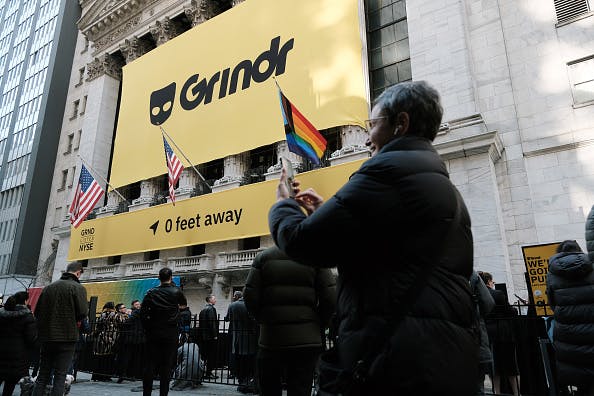
LGBTQ Dating App Grindr Goes Public On The NYSE
(Spencer Platt/Getty Images)

Grindr discloses buyout proposal at $18 per share

While two huge shareholders are hoping to buy out Grindr stock at a premium, it was above $20 as recently as July.

J. Edward Moreno

Grindr soared on Friday after it disclosed a take-private proposal that would value the company at $18 per share.

James Lu and Raymond Zage, who together already own more than 60% of the gay dating app, proposed to buy the remaining shares of the company and delist it from the New York Stock Exchange. The premium would be more than 50% from where the stock was trading before rumblings of the proposal were first reported.

Lu and Zage are requesting a response from the board by October 31.

The investors first informed Grindr’s board that they were exploring taking the company private on October 13. The next day, Semafor reported that a take-private deal was in the works, sending the stock climbing higher.

According to Semafor, Zage and Lu had pledged nearly all of their Grindr stock for personal loans. The loans became undercollateralized following the stock’s recent slide, which led their lender to seize and sell some of their shares in Grindr.

While they are buying out Grindr shares at a premium, the stock was above $20 as recently as July. The company has generally performed better than its peers, though its most recent revenue numbers disappointed Wall Street.

In a recent interview with Sherwood News, Grindr CEO George Arison described the company’s push toward AI and its goal to build a suite of products that cater to the audience on its flagship app. It hasn’t always been easy to communicate that to Wall Street, he said.

“Most investors don’t use our product at all,” he said. “We are very big in a certain set of users, but everybody else does not know our product at all.”

In the proposal, Lu and Zage said they “are firmly aligned with management and have no intentions of making any changes to the leadership” if the deal were to close.

Lu and Zage acquired Grindr in 2020 from the Chinese firm Kunlun. The move came after the Committee on Foreign Investment in the United States determined it was a national security risk for a company with sensitive data to be Chinese-owned. The investors also led Grindrs initial public offering in 2022.

Grindr declined to comment on the buyout proposal. In a statement, Lu and Zage said they have “received considerable initial interest from both debt and equity investors in participating in this opportunity.”

More Markets

See all Markets
markets

Eos Energy surges on commercial launch of second battery production line

Eos Energy Enterprises is surging in early trading after announcing the official start of commercial production at its second automated battery manufacturing line.

In a statement, the company said this milestone positions it to scale production of its proprietary zinc-based long-duration energy storage systems to meet rising commercial demand.

Management touted the enhanced efficiency of this facility, with design upgrades slashing raw material travel by 86% and shortening the physical production line length by 40% compared to Line 1.

“Battery Line 2 demonstrates our ability to continuously improve as we scale,” said John Mahaz, Chief Operating Officer of Eos. “It validates that our manufacturing system can be replicated and scaled with discipline.”

The battery energy storage company confirmed that while subassemblies will continue coming online through the early third quarter, full production capacity is targeted for the fourth quarter of 2026. The ultimate goal is to hit an aggregate 4 gigawatt-hours of annual manufacturing capacity by the end of 2026. Management also highlighted that Battery Line 1 already surpassed its full-year 2025 output within the first 164 days of 2026.

Today’s announcement builds on recent operational momentum for Eos, which posted better-than-expected Q1 sales and announced a joint venture with Cerberus Capital Management in May. However, shares are still down 37% year to date.

For the full year, Eos still expects to achieve revenues between $300 million and $400 million, in line with its previously provided guidance.

markets

Qualcomm reportedly in talks to acquire AI chip design company Tenstorrent

Qualcomm is in talks to acquire AI chip design firm Tenstorrent for $8 billion to $10 billion, according to The Information.

This transaction, if completed, would be another concrete signal of the San Diego-based chip company’s attempt to carve out a niche in the upstream AI space (data centers), rather than focusing on end-user devices.

Qualcomm’s key business of handset chips has fallen on hard times, particularly in China, due to the memory chip shortage.

Less than eight weeks ago, the chip company was the lowlight in the Philadelphia Semiconductor Index, down about 20% year to date.

Shares proceeded to surge over 60%, buoyed by optimism that the rising AI tide will lift all boats. With the release of Q2 earnings, CEO Cristiano Amon said that initial shipments of AI chips to a “leading hyperscaler” were on track for later this year, and to expect more on the company’s AI growth plans at its investor day on June 24 (next week). Last month, Bloomberg reported that Qualcomm is poised to sell “millions” of AI chips to TikTok parent ByteDance.

Established AI chip giants and hyperscalers alike have reached agreements with or gobbled up burgeoning AI chip companies as the boom rolls on. In December, Nvidia announced a major licensing deal with AI inference specialist Groq, while Meta bought AI chip startup Rivos in September.

markets

It’s still the “you gotta spend money to make money” stock market

A major theme of this year is that American companies are once again becoming major sellers of stocks.

For years, companies did the exact opposite: buying back trillions of dollars worth of shares, a practice that juiced earnings and was seen as a safe option for management teams that had run out of good-enough projects to allocate their capital to. Just look at Google, which is wiping out more than two years’ worth of buybacks with an $85 billion offering, while Meta reportedly mulls an equity raise of its own.

Now, the mantra is that investment opportunities in AI — particularly as suppliers to the arms race — are a source of future returns that are also key to sustaining higher growth. In short, capex is king, and buybacks are admitting that you don’t have enough investment opportunities that allow you to benefit from the AI boom. Raise debt, raise equity, raise anything — just make sure youre spending, and the market will reward you. A Goldman Sachs basket of companies with elevated capex relative to peers is besting stocks with the strongest buyback yields by some 30% — the most ever.

This is leading to some major divergences in accrual-based profit measures, like net income and free cash flow (which takes capex into account), for companies like Oracle.

Of course, the rest of the AI complex doesnt care whether the cash spent on the next data center was raised via debt or equity. More funding for the AI build-out is more funding for the AI build-out. Indeed, if we took capex to a bazillion dollars, that spending would still be accretive for aggregate earnings in the first year (assuming all the recipients of the capex binge were public stocks). Yes, eventually the depreciation on those assets starts to be felt and we’d normalize lower, but in the short term, it’s a boon to the stock markets bottom line.

This is why Oracle’s chart is actually just a more extreme version of the wider market; free cash flow used to be about 90% of aggregate net income, and now it’s hovering around 75%, per estimates compiled by Bloomberg.

Latest Stories

Sherwood Media, LLC and Chartr Limited produce fresh and unique perspectives on topical financial news and are fully owned subsidiaries of Robinhood Markets, Inc., and any views expressed here do not necessarily reflect the views of any other Robinhood affiliate, including Robinhood Markets, Inc., Robinhood Financial LLC, Robinhood Securities, LLC, Robinhood Crypto, LLC, Robinhood Money, LLC, Robinhood U.K. Ltd, Robinhood Derivatives, LLC, Robinhood Gold, LLC, Robinhood Asset Management, LLC, Robinhood Credit, Inc., Robinhood Ventures DE, LLC and, where applicable, its managed investment vehicles.

