

Markets
markets
Luke Kawa

Investors are fleeing energy stocks like the economy’s been locked down

The last time investors were distancing themselves from energy stocks this much, we were also socially distancing from one another.

A measure of positioning developed by Deutsche Bank has slipped to its lowest level since 2020, ahead of the announcement of Pfizer’s progress on developing a vaccine.

That means investors have largely been missing out on a rare pocket of the market that’s done well stateside: the energy sector is the second-best performer in the S&P 500 year-to-date, with gains in excess of 5%. Texas Pacific Land, Hess, and Chevron are some of the standout winners.
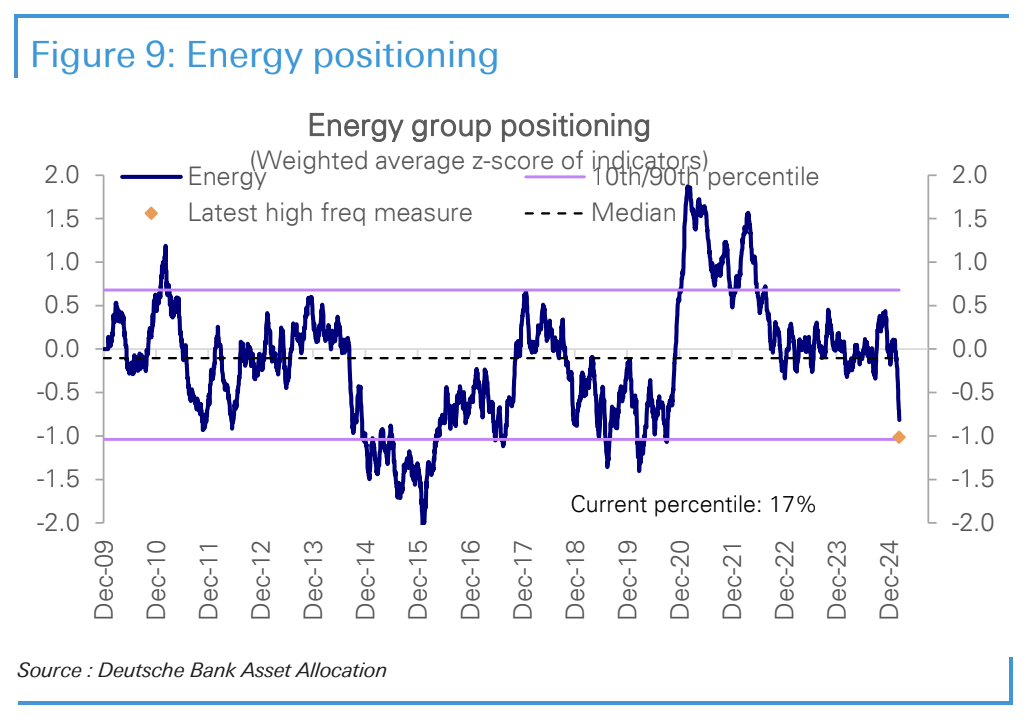
Energy positioning
Source: Deutsche Bank

Even as natural gas has been a bright spot, enthusiasm for energy stocks has dimmed due to both supply and demand factors. On the supply side, OPEC+ is soon adding crude to the market (somewhat unexpectedly, given a downdraft in prices that's seen West Texas Intermediate futures drop 6% year-to-date), while growth fears are escalating some concern about consumer and business demand for fuel.

Strategists led by Parag Thatte note that this low exposure to energy stocks is “approaching extremes.”

The bank uses net call volumes, short interest, fund flow data, sell-side price targets, and the correlation between mutual funds’ excess returns and sector performance to create this positioning indicator.

More Markets

See all Markets
markets

Ford raises its full-year guidance, receives $1.3 billion tariff refund

Ford reported its first-quarter results after markets closed on Wednesday. The automaker’s shares climbed roughly 7% in after-hours trading on the news.

For Q1, Ford reported:

  • Adjusted earnings of $0.66 per share, compared to the $0.18 per share expected by Wall Street analysts polled by FactSet. The figure includes Ford’s tariff reimbursement.

  • $43.25 in total revenue, vs. the $42.66 billion consensus forecast. Automotive revenue came in at $39.8 billion, compared to estimates of $38.9 billion.

  • A $1.3 billion tariff refund.

Ford boosted its full-year guidance for adjusted earnings before interest and taxes to between $8.5 billion and $10.5 billion, up from between $8 billion and $10 billion.

Late last year, Ford announced it would take $19.5 billion in charges — one of the largest write-downs ever — relating mostly to its EV business. Of those charges, $7 billion will be spread across this year and next, the company said.

Earlier this month, Ford recorded an 8.8% drop in Q1 sales from the same period last year, a similar result to Detroit rival GM, which posted a 9.7% sales drop.

markets

Microsoft beats on revenue and earnings in Q3, but only meets expectations for cloud growth

Microsoft shares dipped after the company reported strong Q3 earnings postmarket Wednesday, posting ​​sales of $82.9 billion for the quarter, beating FactSet analyst estimates of $81.4 billion. Earnings per share were $4.27, handily beating estimates of $4.05. 

In a closely watched number, Microsoft’s Azure cloud business increased 40% year on year, just above the 39.7% estimated. The metric technically beat expectations, but may not be the beat investors were looking for.

Total capital expenditure for the quarter was $31.9 billion, up 49% year on year, above estimates of $27.5 billion and down from Q2’s $37.5 billion.

One thing investors were eager to find out: how is the company doing in its effort to fulfill the billions in backlogged commercial bookings? Last quarter, the company reported a staggering $625 billion in remaining performance obligations, and 45% of that was for just one customer — OpenAI.

For the third quarter, Microsoft reported a backlog of $627 billion, up 99% year on year. The company said the RPO increase was 26% — in line with “historical seasonality” — when excluding OpenAI.

Breaking down the results by the company’s business lines:

  • ☁️ 🤖 Intelligent Cloud (Azure, server products): $34.7 billion in revenue, up 30% year on year.

  • 📝 📊 Productivity and Business Processes (Microsoft 365, LinkedIn, Dynamics): $35 billion in revenue, up 17% year on year.

  • 💻 🎮 More Personal Computing (Windows, Xbox, Bing): $13.2 billion in revenue, down 1% year on year.

Microsoft CFO Amy Hood said in the earnings release:

“We delivered results that exceeded expectations across revenue, operating income, and earnings per share, reflecting strong execution and growing demand for the Microsoft Cloud.”

Latest Stories

Sherwood Media, LLC produces fresh and unique perspectives on topical financial news and is a fully owned subsidiary of Robinhood Markets, Inc., and any views expressed here do not necessarily reflect the views of any other Robinhood affiliate, including Robinhood Markets, Inc., Robinhood Financial LLC, Robinhood Securities, LLC, Robinhood Crypto, LLC, Robinhood Derivatives, LLC, or Robinhood Money, LLC. Futures and event contracts are offered through Robinhood Derivatives, LLC.
