
Markets
2024-04-29-yen-FINAL-NEW

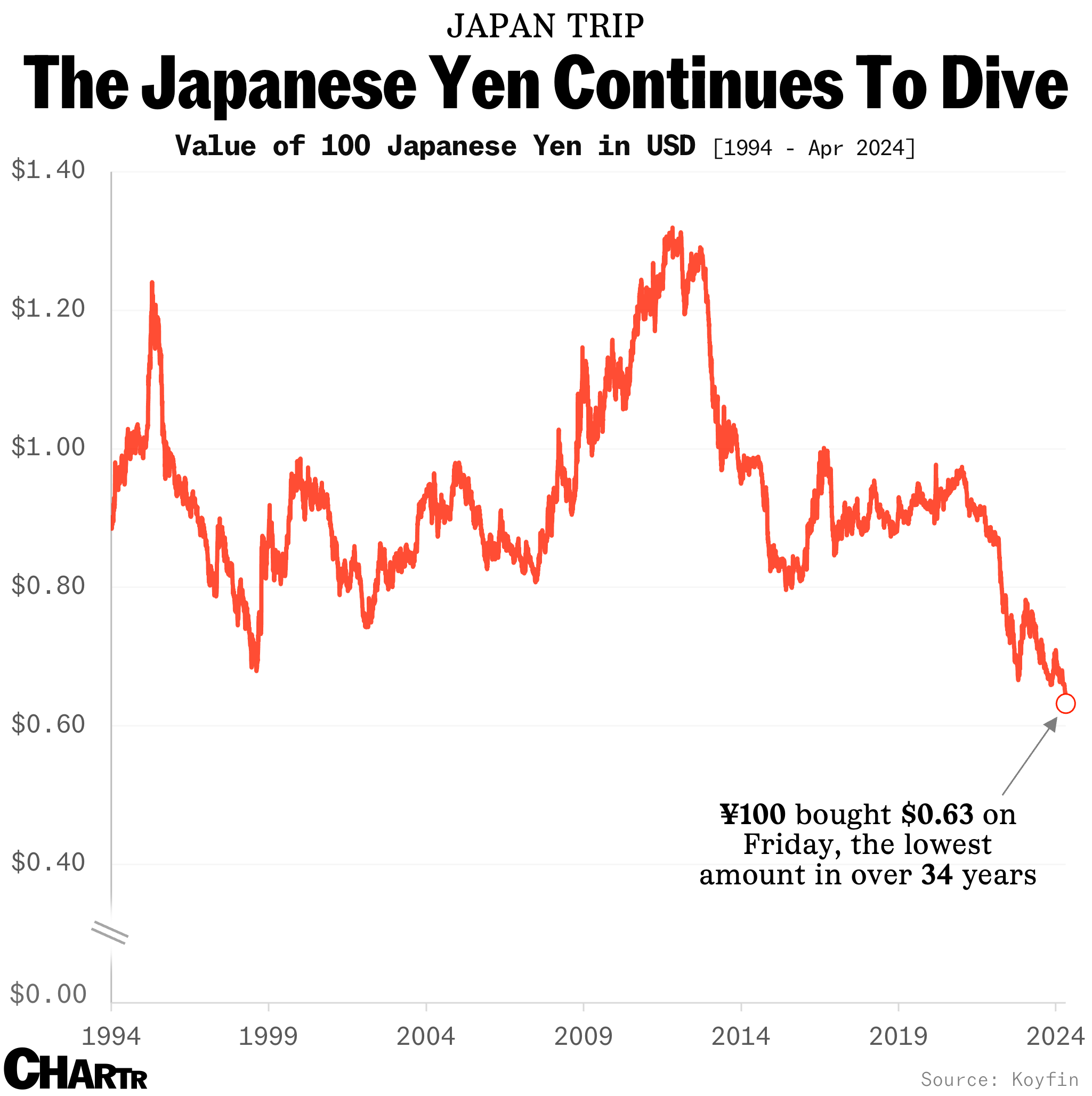
The yen has dropped to its lowest value in over 34 years

Yen descend

The currency of the world’s fourth largest economy is plummeting, with ¥100 buying just $0.63 on Friday — its lowest rate in over 34 years, just as Japan's Golden Week holiday period kicks off.

The weaker yen is a boon for Japanese exporters and foreign visitors, who have been increasingly flocking to the country in recent times. Indeed, last month a record 3.08M foreign travelers visited the island nation, which was slower than others to re-open borders after the pandemic, only relaxing restrictions in October 2022.

The yen's depreciation is a perfect case study for economics teachers around the world. While most major central banks have aggressively hiked rates to combat inflation, Japan's rates remain near zero — fueling a classic “carry trade”, where investors borrow the currency cheaply and sell it to invest in higher-yielding currencies or assets (i.e. stuff that’s likely not in Japan), driving down the buying power of yen.

The US, meanwhile, is at a different stage in its cycle, attracting buyers for its currency as the Federal Reserve signals it might need to maintain higher interest rates for longer amidst lingering inflation.

A weaker yen could reshape the Japanese economy, making the country’s exports more competitive and foreign imports more expensive. In the short term, Japanese authorities have appeared publicly sanguine about the devaluation, although a sharp jump in yen this morning has been met with strong suspicions that the government may have moved to support the currency.

More Markets

See all Markets
markets

Hardware stocks jump thanks to server demand and record Lenovo revenue

Server stocks are rallying as Dell, Super Micro Computer, and Hewlett Packard Enterprise ride the momentum of Hong Kong-based Lenovo. The PC makers stock rose 19% on Friday, hitting an all-time high, on record Q4 earnings.

Powering the positive earnings report was the companys AI-related revenue, which grew 84% in the fourth quarter and now makes up over a third of total revenue. Investors seem to think the increased demand for servers could have trickle-down effects for other companies.

The companys results and commentary reinforced the outlook for strong AI-infrastructure demand while indicating resilient broader traditional server and storage spending, wrote Woo Jin Ho, a senior technology analyst at Bloomberg Intelligence. Lenovos $21 billion AI-server pipeline and remarks that demand is outpacing supply support Dells AI-demand momentum and point to robust orders.

AIs insatiable computing demand is reshaping the hardware industry and driving up server demand.

Dell will report first-quarter earnings on Thursday, May 28.

Policeman with Piercing Eyes

Take-Two’s “GTA 6” forecast feels absurdly conservative

Take-Two issued a 2027 net bookings forecast about $1 billion below Wall Street’s estimates. The stock is falling on Friday.

The D-Wave 2X quantum system, is operated at the NASA Advanced Supercomputing facility's Quantum Artificial Intelligence Laboratory at NASA's Ames Research Center in Mountain View, Calif., as seen on Tuesday December 8, 2015.

Quantum computing CEOs hope “validating” government backing proves their technology is no longer speculative

The government funding is a push to boost the foundational elements of quantum computing to get the industry ready for prime time. The CEOs of Infleqtion and D-Wave give us their thoughts.

markets

Ross Stores surges as Q1 results beat expectations, full-year guidance raised

Ross shares are rising after the company delivered strong Q1 results, with sales topping Wall Street’s projections.

The stock soared 6.3% just after the open.

Key numbers:

  • Earnings per share of $2.02 vs. $1.47 year over year (estimate: $1.72).

  • Sales of $6.01 billion, up 21% year over year (estimate: $5.61 billion).

  • Comparable sales growth of 17% (estimate: 8.58%).

CEO Jim Conroy attributed the results to better traffic in stores. “Customer traffic was the primary driver of the strong sales trend as compelling merchandise assortments, higher customer acquisition and engagement from our ongoing marketing initiatives, and an improved in‑store experience are resonating with shoppers.”

The company also noted that transaction volume grew across all key demographics, including “income levels, ethnicities, and age groups, including younger customers.” Sales were also likely buoyed by standard seasonal tailwinds, including consumer spending from tax refunds.

Backed by the strong quarter, the company lifted its full-year targets. Ross now projects same-store sales growth of 6% to 7%, up from the prior forecast of 3% to 4%, topping Wall Street’s estimate of 4.64%. It boosted its annual EPS guidance to a range of $7.50 to $7.74, versus the prior outlook of $7.02 to $7.36.

Ross Stores has been one of the retail sector’s standout performers this year, rising around 20% year to date as of Thursday’s close.

Latest Stories

Sherwood Media, LLC and Chartr Limited produce fresh and unique perspectives on topical financial news and are fully owned subsidiaries of Robinhood Markets, Inc., and any views expressed here do not necessarily reflect the views of any other Robinhood affiliate, including Robinhood Markets, Inc., Robinhood Financial LLC, Robinhood Securities, LLC, Robinhood Crypto, LLC, Robinhood Money, LLC, Robinhood U.K. Ltd, Robinhood Derivatives, LLC, Robinhood Gold, LLC, Robinhood Asset Management, LLC, Robinhood Credit, Inc., Robinhood Ventures DE, LLC and, where applicable, its managed investment vehicles.

