
Markets
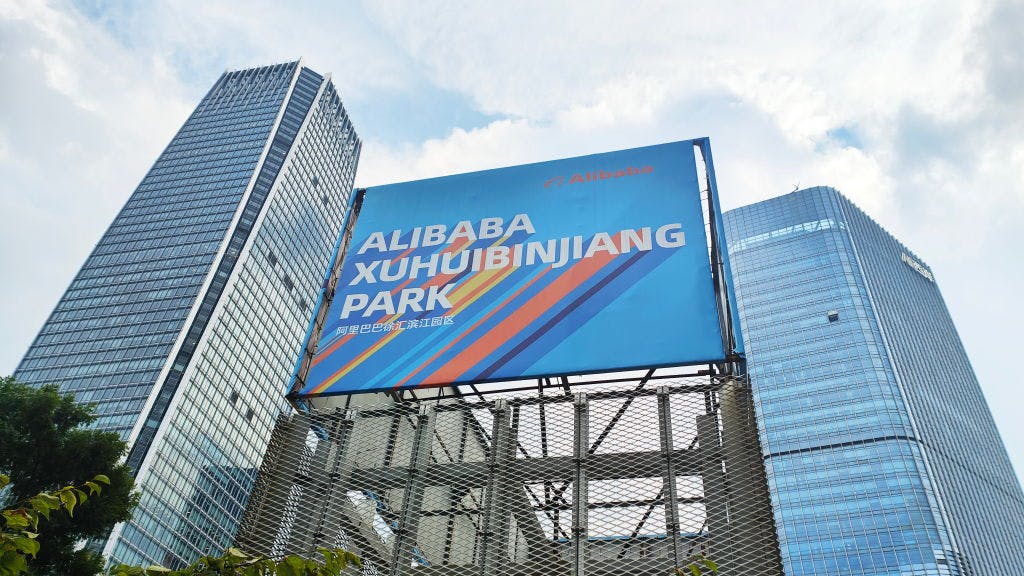
Alibaba High tech Business Park in Shanghai
A view of the Alibaba High tech Business Park in Shanghai, China (CFOTO/Getty Images)
Answering the call

JPMorgan’s options trades for a world of Chinese AI outperformance

Alibaba, Baidu, BYD, Tencent, Xiaomi, and XPeng in the spotlight.

Luke Kawa

The equity derivatives strategists at JPMorgan have a plan to benefit from a new phase of the AI trade in which Chinese companies downstream from the picks-and-shovels semiconductor firms pull away from the pack.

“While the US has led in AI infrastructure investment, Chinese tech companies are rapidly advancing AI applications, setting the stage for outperformance,” a group led by Tony SK Lee wrote. “Our strategists and equity analysts expect declining costs in LLM training and inference are unlocking the commercialization of AI-driven services that were previously uneconomical.”
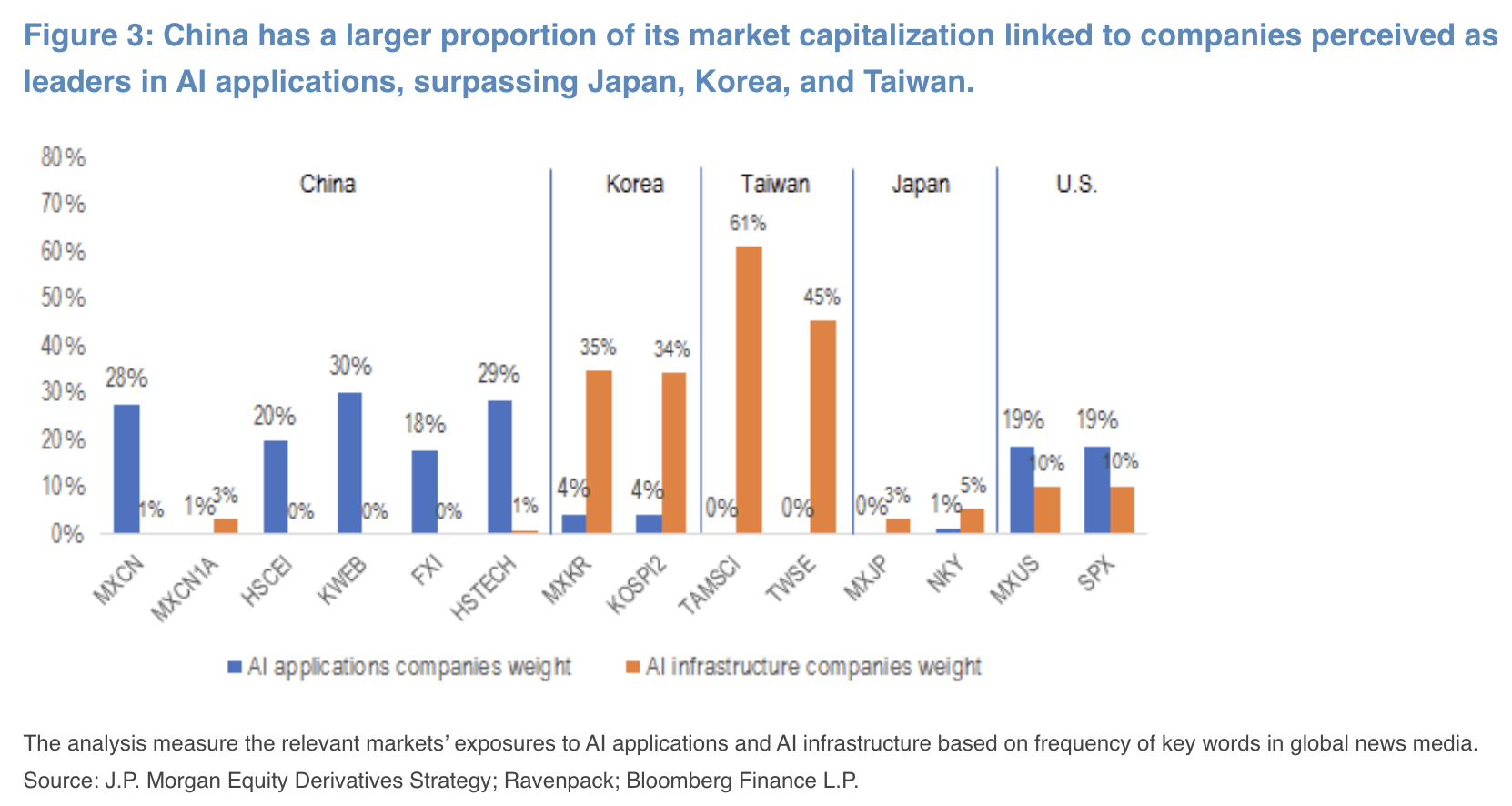
JPM China AI application
Source; JPM

(In March 2022, JPMorgan analysts described Chinese internet companies as “uninvestable,” later saying that word was published in error. What a long way we’ve come…)

They posit that Chinese AI application leaders could deliver the kind of standout earnings growth that the so-called Magnificent 7 cohort of US stocks have been able to generate.

In a separate note, the group unpacked their specific tactic: buying worst-of calls, an options strategy that’s relatively inexpensive to implement, but offers the lowest potential payout in the event of upside in all of the underlying stocks.

“This strategy is ideal for investors aiming to capitalize on the growth potential of AI application leaders while reducing initial costs,” they wrote.

The stocks they suggest for such a basket need to have exposure to the AI theme and liquid options, which include:

  • Alibaba: already seeing progress in AI model development; big cloud business

  • Baidu: AI-enhanced search

  • BYD: DeepSeek-integrated tech architecture

  • Tencent: could gain from higher WeChat usage (chatbots)

  • Xiaomi: replacement cycles will pick up steam thanks to the advent and progression of AI applications (just don’t ask Apple about that)

  • XPeng: looking at AI functionality from the design process to the steering of its vehicles

More Markets

See all Markets
markets

Ford raises its full-year guidance, receives $1.3 billion tariff refund

Ford reported its first-quarter results after markets closed on Wednesday. The automaker’s shares climbed roughly 7% in after-hours trading on the news.

For Q1, Ford reported:

  • Adjusted earnings of $0.66 per share, compared to the $0.18 per share expected by Wall Street analysts polled by FactSet. The figure includes Ford’s tariff reimbursement.

  • $43.25 in total revenue, vs. the $42.66 billion consensus forecast. Automotive revenue came in at $39.8 billion, compared to estimates of $38.9 billion.

  • A $1.3 billion tariff refund.

Ford boosted its full-year guidance for adjusted earnings before interest and taxes to between $8.5 billion and $10.5 billion, up from between $8 billion and $10 billion.

Late last year, Ford announced it would take $19.5 billion in charges — one of the largest write-downs ever — relating mostly to its EV business. Of those charges, $7 billion will be spread across this year and next, the company said.

Earlier this month, Ford recorded an 8.8% drop in Q1 sales from the same period last year, a similar result to Detroit rival GM, which posted a 9.7% sales drop.

markets

Microsoft beats on revenue and earnings in Q3, but only meets expectations for cloud growth

Microsoft shares dipped after the company reported strong Q3 earnings postmarket Wednesday, posting ​​sales of $82.9 billion for the quarter, beating FactSet analyst estimates of $81.4 billion. Earnings per share were $4.27, handily beating estimates of $4.05. 

In a closely watched number, Microsoft’s Azure cloud business increased 40% year on year, just above the 39.7% estimated. The metric technically beat expectations, but may not be the beat investors were looking for.

Total capital expenditure for the quarter was $31.9 billion, up 49% year on year, above estimates of $27.5 billion and down from Q2’s $37.5 billion.

One thing investors were eager to find out: how is the company doing in its effort to fulfill the billions in backlogged commercial bookings? Last quarter, the company reported a staggering $625 billion in remaining performance obligations, and 45% of that was for just one customer — OpenAI.

For the third quarter, Microsoft reported a backlog of $627 billion, up 99% year on year. The company said the RPO increase was 26% — in line with “historical seasonality” — when excluding OpenAI.

Breaking down the results by the company’s business lines:

  • ☁️ 🤖 Intelligent Cloud (Azure, server products): $34.7 billion in revenue, up 30% year on year.

  • 📝 📊 Productivity and Business Processes (Microsoft 365, LinkedIn, Dynamics): $35 billion in revenue, up 17% year on year.

  • 💻 🎮 More Personal Computing (Windows, Xbox, Bing): $13.2 billion in revenue, down 1% year on year.

Microsoft CFO Amy Hood said in the earnings release:

“We delivered results that exceeded expectations across revenue, operating income, and earnings per share, reflecting strong execution and growing demand for the Microsoft Cloud.”

Latest Stories

Sherwood Media, LLC produces fresh and unique perspectives on topical financial news and is a fully owned subsidiary of Robinhood Markets, Inc., and any views expressed here do not necessarily reflect the views of any other Robinhood affiliate, including Robinhood Markets, Inc., Robinhood Financial LLC, Robinhood Securities, LLC, Robinhood Crypto, LLC, Robinhood Derivatives, LLC, or Robinhood Money, LLC. Futures and event contracts are offered through Robinhood Derivatives, LLC.

