
Markets
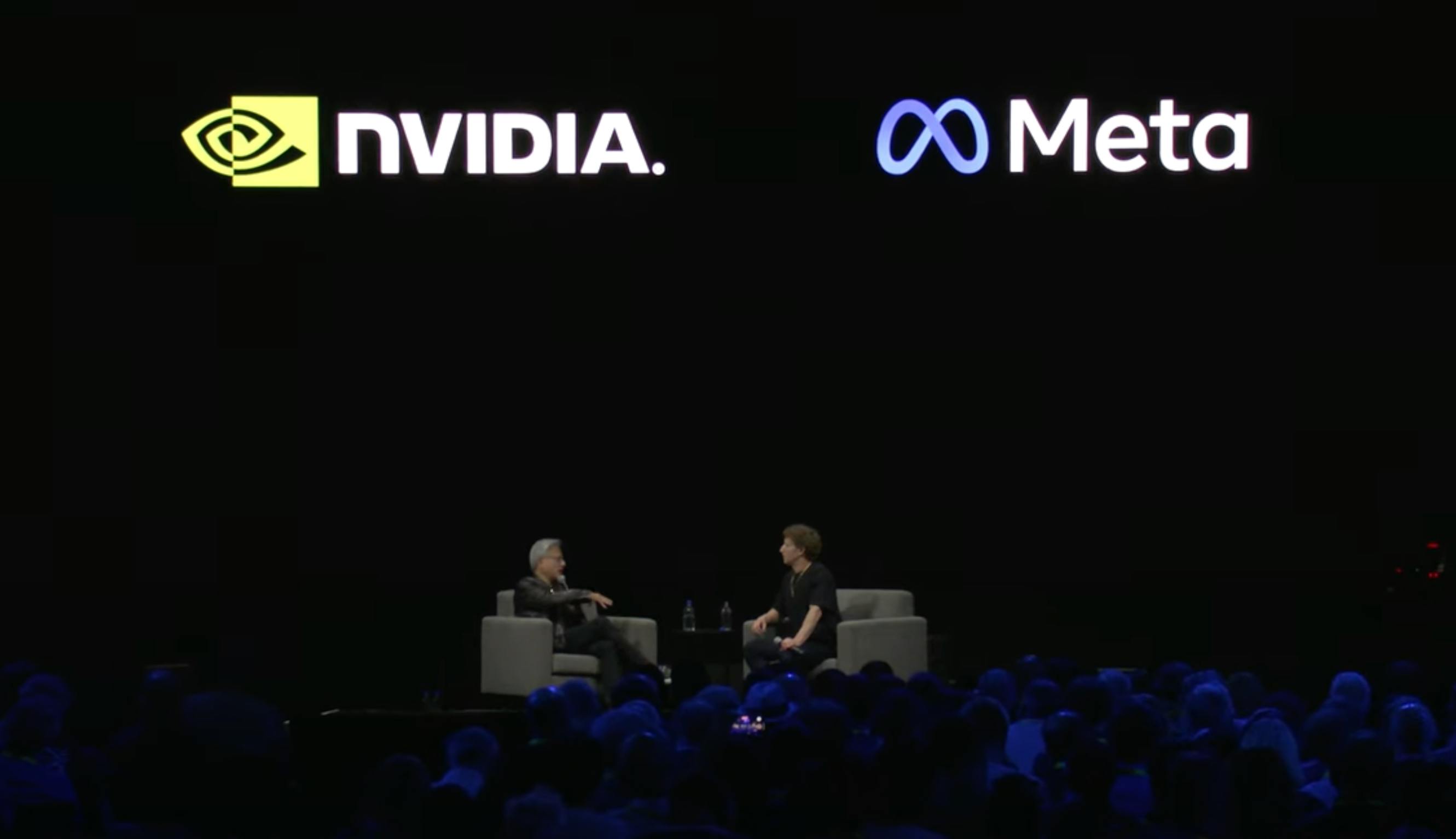
Nvidia CEO Jensen Huang interviews Meta CEO Mark Zuckerberg at the 2024 SIGGRAPH conference in Denver, CO on July 29, 2024.
YouTube

Nvidia enhances partnership with social media giant Meta to deploy “millions” of its GPUs

Winners: Nvidia, ARM. Losers: AMD, Broadcom, Intel, Arista.

Meta is laying it out in no uncertain terms: its AI build-out will be brought to you by Nvidia.

In pair of press releases after the close on Tuesday, the social media giant and chip designer detailed a “multi-year, multi-generational strategic partnership” that “will enable the large-scale deployment of NVIDIA CPUs and millions of NVIDIA Blackwell and Rubin GPUs, as well as the integration of NVIDIA Spectrum-X Ethernet switches for Meta’s Facebook Open Switching System platform.”

There’s also a deeper integration with a very commonly used communications tool at play. “Meta has adopted NVIDIA Confidential Computing for WhatsApp private processing, enabling AI-powered capabilities across the messaging platform,” per the press release, with plans to add these capabilities to other use cases at the Zuckerberg-led firm.

One obvious winner, of course, is Nvidia, as investors may now have a clearer line of sight to millions of GPU sales that includes not only this generation, but future editions, as well. The inclusion of CPUs in this pact, and with an expanded role in data center environments, also appears to be boon for Arm Holdings, whose IP was utilized to develop these products.

Shares of Nvidia, ARM, and Meta rose in after-hours trading, albeit fairly modestly.

The losers?

Nvidia’s competitors in...

AI chips: Advanced Micro Devices and Broadcom, as the dominant incumbent’s big, long-term deal with a hyperscaler seemingly reduce their ability to gain market share.

CPUs: Intel (and AMD again!)

And an established Meta networking client: Arista Networks, who’s seeing Nvidia muscle in on this territory.

Intel was roughly flat in after-hours trading on Tuesday, while the other three stocks fell.

“Meta's partnership with Nvidia — spending tens of billions of dollars on its new family of GPUs and, more importantly, making the first major deployment of Nvidia's stand-alone CPUs for backend CPU servers — suggests rising market share and associated average selling price gains for Arm,” writes Bloomberg Intelligence analyst Oscar Hernandez Tejada. “Increasing server CPU share gains for Nvidia stand to aid Arm's share growth against x86, posing a clear headwind for Intel.”

The press release did not spell out any contractual purchase obligations on Meta’s behalf, but is more of a statement of intent on how aligned the parties plan to be in attempting to deliver on the promise of the AI boom.

Ian Buck, vice president of accelerated computing at Nvidia, said that the companies haven’t assigned a dollar value or timeline to this expanded partnership yet.


More Markets

See all Markets
markets

Applied Digital, WeRide, and Recursion Pharmaceuticals dip as Nvidia exits positions

Three stocks took a dip in after hours trading on Tuesday after Nvidia’s 13F filing showed the chip designer sold its stake over the final three months of 2025:

  • Applied Digital, a data center operator in which Nvidia was the seventh-largest holder as of the end of Q3.

    • That being said, Nvidia still has some quasi-direct Applied Digital exposure through its still-substantial CoreWeave position. The neocloud acquired warrants in APLD last June.

  • WeRide, the Chinese self-driving firm.

  • Recursion Pharmaceuticals, which engages in AI-driven drug development.

Nvidia also sold its holdings of Arm Holdings, but that was offset by some good news: part of Nvidia’s expanded pact with Meta will see Arm-based CPUs assume a more prominent role in data center environments, which may help boost its volumes and selling prices.

Nvidia added positions in Nokia, Intel, and Synopsys in Q4, all of which had been previously announced via press releases. Its Coreweave and Nebius positions were unchanged relative to Q3.

markets

Sandisk drops after Western Digital confirms plan to unload $3 billion in stock

Western Digital is cashing in more of its Sandisk position.

The hard drive seller is exchanging more than $3 billion in Sandisk shares as part of a debt-for-equity swap.

The two companies were once one, but Western Digital spun off a little more than 80% of its flash drive business in February 2025, and already exchanged the lion’s share of what remained in a separate debt-for-equity swap in June.

This move was very, very well telegraphed by Western Digital, which recently confirmed plans to monetize its Sandisk position before the one-year anniversary of that split (February 21). And Sandisk’s press release makes clear that the company is not the one selling more stock or making any money off of this.

That being said, being a high-flying stock that has a Bloomberg headline with “secondary offering” in it could, in theory, spark some turbulence.

Shares of Sandisk have indeed extended the day’s losses to more than 8% in the after-hours session before paring some of that decline.

The two companies were once one, but Western Digital spun off a little more than 80% of its flash drive business in February 2025, and already exchanged the lion’s share of what remained in a separate debt-for-equity swap in June.

This move was very, very well telegraphed by Western Digital, which recently confirmed plans to monetize its Sandisk position before the one-year anniversary of that split (February 21). And Sandisk’s press release makes clear that the company is not the one selling more stock or making any money off of this.

That being said, being a high-flying stock that has a Bloomberg headline with “secondary offering” in it could, in theory, spark some turbulence.

Shares of Sandisk have indeed extended the day’s losses to more than 8% in the after-hours session before paring some of that decline.

markets

Cadence Design Systems jumps after Q4 earnings, 2026 profit outlook, and sales backlog exceed estimates

Cadence Design Systems jumped in after-hours trading on Tuesday, briefly erasing the day’s big losses, after posting better-than-expected Q4 earnings, a big pipeline of future business, and a solid profit outlook for 2026.

For Q4, the electronic design automation company reported:

  • Sales of $1.44 billion (estimate: $1.42 billion).

  • Adjusted earnings per share of $1.99 (estimate: $1.91).

  • Remaining performance obligations (RPO) of $7.8 billion (estimate: $7.25 billion).

Management said that 2026 adjusted earnings per share would range between $8.05 and $8.15, above the consensus call for $8.03.

In recent weeks, investors have worried that Cadence’s software business, which is used by chip designers, could suffer competitive pressure from AI tools. At the very least, that RPO figure says there’s billions of dollars standing between Cadence and any more disrupted future.

Latest Stories

Sherwood Media, LLC produces fresh and unique perspectives on topical financial news and is a fully owned subsidiary of Robinhood Markets, Inc., and any views expressed here do not necessarily reflect the views of any other Robinhood affiliate, including Robinhood Markets, Inc., Robinhood Financial LLC, Robinhood Securities, LLC, Robinhood Crypto, LLC, or Robinhood Money, LLC.