

Markets
markets
Luke Kawa

One big difference between GameStop’s 2021 meme-stock rally and some of the newest targets

One common feature of stocks that get the meme stock treatment is that they’re highly shorted.

The reasons for this are, in my mind, pretty simple:

  • When you’re buying a stock without much in the way of a fundamental catalyst, it helps to have a ready-made “greater fool” in hand who “has” to buy from you at some level.

  • It creates an “us against them” mentality that’s useful in forming and binding together a group of committed buyers.

The basic thinking is either that short sellers will be forced to close their positions because of losses, or they will be unable to hold that position because the borrow rate on the stock gets too high to justify keeping the position. (In addition, people who might want to short would be deterred by the high cost of borrowing shares to sell them short.)

Some maximalist versions of this line of thinking loomed large in GameStop’s surge to all-time highs in 2021.

When it comes to Kohl’s and Rocket Cos, two such stocks that have received some bursts of love from retail traders recently, that is decidedly not happening this time around.

“Market makers appear well-positioned to provide liquidity in the latest rallies of Kohl’s and Rocket Companies, as reflected by implied lending rates. After the initial hype, borrowing costs have snapped back to moderate levels around 10% annualized,” wrote Garrett DeSimone, Ph.D. and head of quantitative research at OptionMetrics. “This stands in stark contrast to GameStop’s (GME) January 2021 run, when lending costs soared to nearly 80% annualized, making the stock virtually impossible to borrow. Overall, this suggests that the potential for an extreme short squeeze is likely limited.”
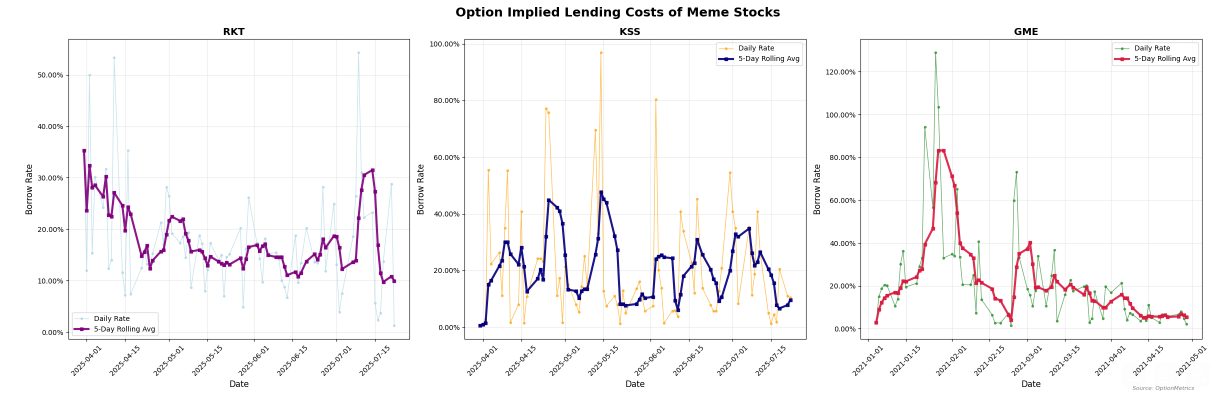
Option Implied Lending Costs
Source: OptionMetrics

Disclosure: I own some shares of Rocket Cos, and wrestling with what to do with a stock you own that gets some meme love has been annoying <world’s tiniest violin plays>.

More Markets

See all Markets
markets

Corning spikes after Nvidia invests $500 million in the fiber-optics company

Corning is spiking after Nvidia dropped $500 million for the right to buy up to 18 million of its shares.

The deal comes as part of a multiyear partnership that will see Corning “increase its U.S.-based optical connectivity manufacturing capacity by 10x and expand its U.S. fiber production capacity by more than 50% to meet the accelerating demand driven by AI factory buildouts,” per the press release.

The deal is structured around Corning issuing Nvidia two types of warrants:

  • “Pre-funded” warrants for 3 million Corning shares (which account for the bulk of the $500 million to the fiber-optics company).

  • “Traditional” warrants that enable Nvidia to buy 15 million shares at $180, thereby benefiting from Corning’s share price trading above that level within three years’ time (unless this partnership is terminated or Corning makes a “fundamental transaction” before that). If and when Nvidia exercises those warrants in full, CEO Jensen Huang will be cutting a much heftier check to Corning.

So while on the surface this deal may not look as big as Nvidia’s recent $2 billion investments in Marvell Technology, Coherent, and Lumentum, once all the dust settles, it could turn out to be considerably more!

markets

AMC gains as strong Q1 results give breathing room for balance sheet improvements

AMC shares are rising in early Wednesday trading after the theater chain reported Q1 earnings results with revenue exceeding estimates after the bell Tuesday.

Key numbers:

  • Revenue of $1.05 billion (compared to analyst estimates of $972.6 million).

  • Adjusted EBITDA of $38.3 million (estimate: $7.7 million).

Attendance reached 30.7 million in the US and 16.9 million internationally, with improving demand thanks to recently released movies like Project Hail Mary, The Super Mario Galaxy Movie, and Michael.

A prolonged string of positive operating results like these will be needed to improve AMC’s balance sheet over time. AMC is still carrying around $4 billion in debt, which management is aiming to refinance and pay down over time.

Refinancing has bought time to delever amid the stop-and-go box-office rebound as film supply is set to improve, Bloomberg Intelligence analysts Kevin Near and Geetha Ranganathan wrote in the wake of this release. AMC expects to close more underperforming theaters this year and hinted that positive free cash flow may hinge on a strong 2027 movie slate.

Analysts at Benchmark upgraded the stock to buyfrom hold following these Q1 results.

Mickey Goofy Donald baseball

Disney rises after quarterly revenue beat, boosted by streaming and theme park growth

Disney reported its second-quarter results before markets opened on Wednesday.

Latest Stories

Sherwood Media, LLC produces fresh and unique perspectives on topical financial news and is a fully owned subsidiary of Robinhood Markets, Inc., and any views expressed here do not necessarily reflect the views of any other Robinhood affiliate, including Robinhood Markets, Inc., Robinhood Financial LLC, Robinhood Securities, LLC, Robinhood Crypto, LLC, Robinhood Derivatives, LLC, or Robinhood Money, LLC. Futures and event contracts are offered through Robinhood Derivatives, LLC.
