
Markets
Palantir CEO Alex Karp
Palantir CEO Alex Karp: selling again (Stefani Reynolds/Getty Images)

Palantir’s Alex Karp made $6.8 billion last year

It’s good to be the boss.

Matt Phillips

Palantir’s Alex Karp was compensated $6.8 billion in 2024, the company reported Friday, a remarkable figure that would seem to rank among the largest annual pay packages ever recorded for America’s well-remunerated CEO class.

The number was produced as part of the proxy statement the defense, security, and AI software company published on Friday.
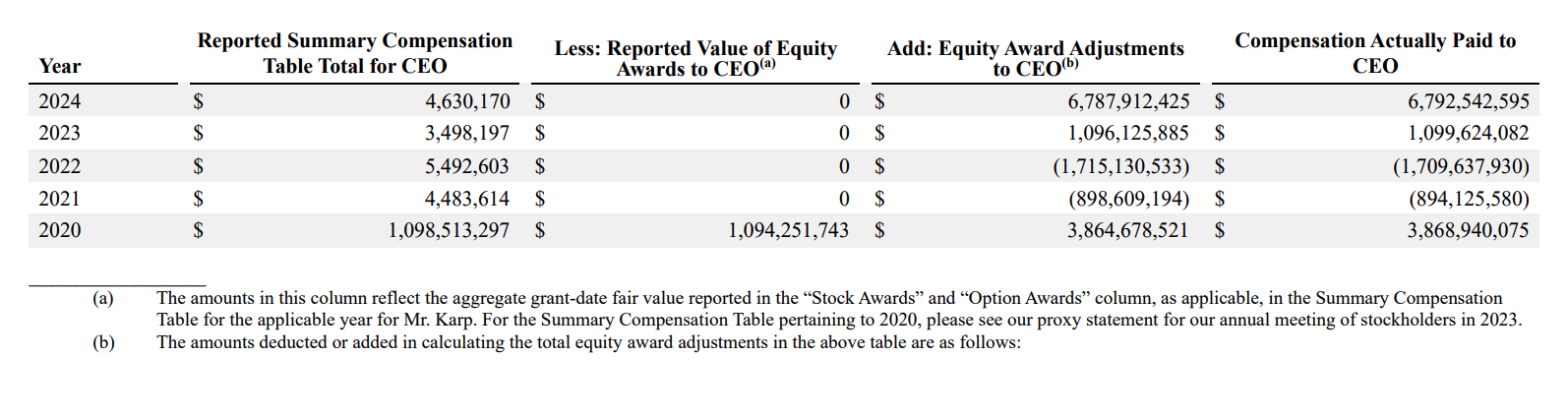
Palantir CEO Alex Karp pay package
Proxy statement on actual compensation paid to Palantir CEO Alex Karp

This comes from the table in the proxy statement labeled “Compensation Actually Paid to CEO,” which is a relatively new measure of compensation the SEC began to require a couple years back. It takes into account the stock and options grants that companies use to pay executives. Palantir reports a separate “summary compensation” table that puts Karp’s pay at just $4.6 million.

The “compensation actually paid” line was added as a means of trying to better capture the total pay that executives receive, accounting for fluctuating values of stock options and other equity awards. Here’s how The New York Times’ Jeff Sommer described it last year:

“The new approach is supposed to help shareholders determine whether an executive’s compensation is aligned with their company’s stock market return. It emphasizes the annual changes in value of an executive’s current and potential stock holdings, in contrast with the traditional approach, which provides a snapshot of the estimated value of a pay package when it is granted.”

Now, given the year that Palantir’s shares had last year — it rose 340% and was the top stock in the S&P 500 — it’s perhaps not surprising that Karp would enjoy a massive payout.

OK, fine. But there’s massive, and there’s massive.

By some rankings, Karp’s “compensation actually paid” number from 2023, $1.1 billion, made him the second-highest-compensated chief executive in the US, after Tesla’s Elon Musk, who made $1.4 billion in 2023 by this measure. (Tesla hasn’t published its proxy statement for 2024.)

Once the total tally of riches reaped by CEOs last year is finalized, we wouldn’t be surprised to see Karp sitting on top.

Now for the record, some companies claim this measure overstates what top executives earn. Palantir would seem to be one of them. In a footnote below the the “compensation actually paid table,” proxy statement included this somewhat Orwellian qualification. 

The term “compensation actually paid” or “CAP” does not reflect the amount of compensation actually paid, earned or received by him during the applicable year. Per relevant rules, Mr. Karp’s CAP was calculated by adjusting the Summary Compensation Table Total values for CEO for the applicable year. 

That’s true as far as it goes. But the “summary compensation table” number for Karp would also seem to be a pretty remarkable understatement of his earnings in 2024. As we know, he sold more than $2 billion worth of stock last year.


More Markets

See all Markets
markets

OpenAI reportedly seeking alternatives to Nvidia chips, unhappy with inference performance

Reuters reports that OpenAI is “unsatisfied” with Nvidia’s latest AI chips and has been seeking alternatives since last year, citing a whopping eight sources familiar with the matter.

This news comes on the heels of a recent report from The Wall Street Journal that Nvidia’s plan to invest $100 billion in OpenAI had stalled.

Nvidia CEO Jensen Huang seemingly confirmed the WSJ reporting in comments to the press over the weekend, but still struck a positive public tone on OpenAI, indicating that the chip designer would be participating in its upcoming funding round.

Sources inside OpenAI appear to be choosing a more combative response.

Per Reuters, the specific shortcoming OpenAI sees in Nvidia’s offering involves inference, or the “thinking” being done by AI models.

Now, the idea that OpenAI is seeking alternatives to Nvidia, or at least additional sources, is well known: the ChatGPT maker struck highly publicized deals in October with Advanced Micro Devices that the chip designer said would “deliver tens of billions of dollars in revenue” as well as custom chip specialist Broadcom to develop and deploy 10 gigawatts of custom AI accelerators.

So this really has the feel of, “I dumped her, she didn’t dump me!”

markets

Microsoft is the biggest drag on the US stock market since Gemini 3’s launch

Microsoft is the publicly traded company that, due to its partnership with OpenAI, had a place of pride at the epicenter of the AI boom.

It doesn’t have that much to show for it.

Thanks to last week’s plunge following the release of its earnings, the tech behemoth is now trailing the SPDR S&P 500 ETF for the first time since November 30, 2022 — the day ChatGPT was released. It’s the only member of the so-called Magnificent 7 to trail the fund that tracks the benchmark US stock index over this stretch.

The OpenAI relationship has been more of a burden than a boon for the company as of late, as the ChatGPT maker’s cash burn and competitive pressures have cast a pall over its partners.

Per data from Bloomberg, Microsoft has been the biggest drag on SPY since the release of Gemini 3, shaving off 80 basis points. Alphabet, on the other hand, has been the largest driver of the ETF’s advance over this period.

Airline stocks climb as oil prices retreat on easing US-Iran tensions

West Texas Intermediate crude futures fell more than 5% on Monday, following President Trump’s comments over the weekend that Iran was “seriously talking” with the US — a sign that tensions between the countries could be easing.

That drop-off boosted major US airlines, which stand to benefit from lower fuel costs. Shares of carriers including Frontier, United Airlines, JetBlue, and Delta Air Lines were all up in the mid- to high single digits.

Latest Stories

Sherwood Media, LLC produces fresh and unique perspectives on topical financial news and is a fully owned subsidiary of Robinhood Markets, Inc., and any views expressed here do not necessarily reflect the views of any other Robinhood affiliate, including Robinhood Markets, Inc., Robinhood Financial LLC, Robinhood Securities, LLC, Robinhood Crypto, LLC, or Robinhood Money, LLC.