Markets
markets

Pop Mart expects 350% profit spike as fan frenzy lifts sales

Chinese toymaker Pop Mart is expecting at least a 350% increase in net profit and an over 200% jump in revenue for the first half of 2025, the company announced Tuesday.

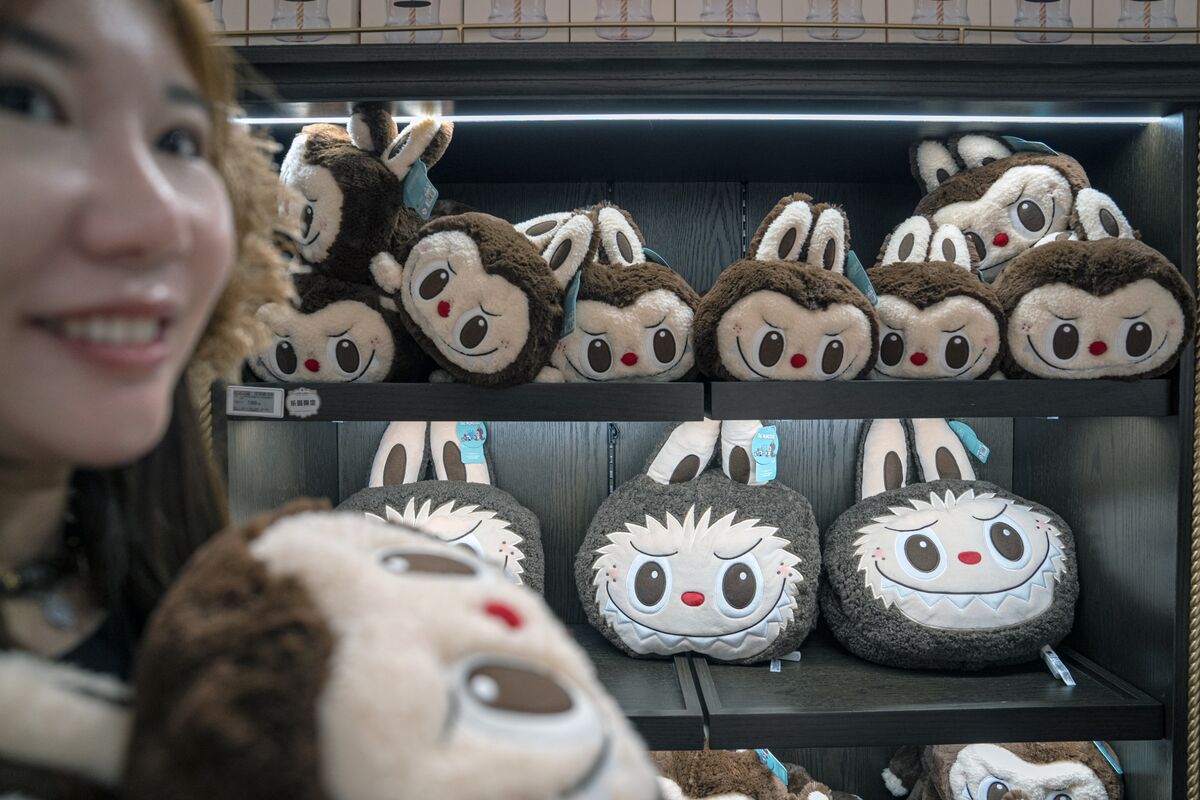
The 15-year-old Chinese designer toy company has catapulted into the global spotlight, with shoppers lining up for hours to snag its signature Labubu doll — a pointy-eared, mischievous figure with a toothy grin thats become a collectors obsession and has been seen dangling from celebrities handbags.

popmart
Sherwood News

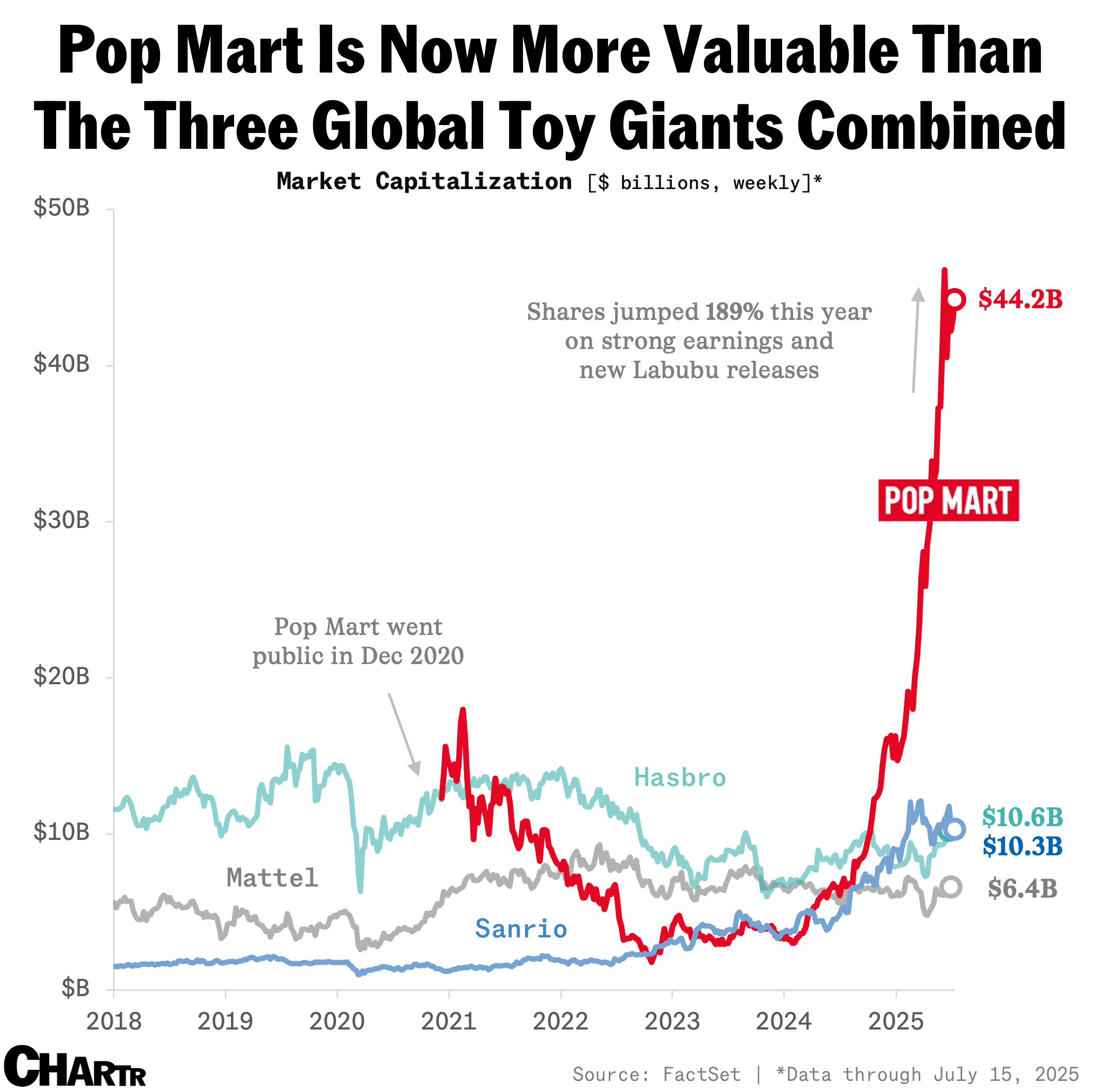
Since its rocky post-IPO debut in 2020, the company has staged a sharp turnaround, with shares rising nearly 600% over the past 12 months. That’s left Pop Mart with a market cap north of $44 billion, more than the combined value of Sanrio, Hasbro, and Mattel — the toy giants behind Hello Kitty, Transformers, and Barbie, respectively.

The company attributed its massive bottom-line growth not only to rising brand recognition but also to constant product costs optimization and strengthened expense control, according to Tuesdays statement.

Go Deeper: Pop Mart is now worth more than the makers of Barbie, Hello Kitty, and Transformers — combined
popmart
Sherwood News

Since its rocky post-IPO debut in 2020, the company has staged a sharp turnaround, with shares rising nearly 600% over the past 12 months. That’s left Pop Mart with a market cap north of $44 billion, more than the combined value of Sanrio, Hasbro, and Mattel — the toy giants behind Hello Kitty, Transformers, and Barbie, respectively.

The company attributed its massive bottom-line growth not only to rising brand recognition but also to constant product costs optimization and strengthened expense control, according to Tuesdays statement.

Go Deeper: Pop Mart is now worth more than the makers of Barbie, Hello Kitty, and Transformers — combined

More Markets

See all Markets
markets

Snowflake sinks as weak margin forecast overshadows Q3 beat

Snowflake is down 9% in premarket trading on Thursday after the cloud company gave an operating margin outlook that fell short of analyst expectations, reflecting investors’ worries about the profitability of new AI-based products.

The company now expects its adjusted operating income margin for the three months ending in January to come in around 7%, lower than 8.5% projected by analyst data compiled by Bloomberg. Snowflake also sees product revenue of around $1.2 billion for the coming quarter.

Despite the softer outlook, Snowflake’s most recent quarter was a pretty solid one, with Q3 revenue jumping 29% year-over-year to $1.21 billion (2% ahead of consensus estimates), driven by higher product revenue, on which CEO Sridhar Ramaswamy commented in a press release that “Snowflake Intelligence, our enterprise AI agent, saw the fastest adoption ramp in Snowflake history.” Earnings also beat, with adjusted EPS coming in at at $0.35, 13% ahead of estimates.

The stock’s drop shows how “the bar was high” for Snowflake going into earnings, according to BNP Paribas analyst Stefan Slowinski, as investors had high hopes for the company that rose nearly 70% this year even when rival stocks slumped in fears of AI disruption.

On Wednesday, the company also announced a $200 million multi-year deal with Anthropic that would make the AI startup’s Claude model available within the Snowflake data environment to more than “12,600 global customers across Amazon Bedrock, Google Cloud Vertex AI, and Microsoft Azure.”

markets

Seagate, Western Digital stumble amid reports of customer resistance to AI

Hard disk drive makers Seagate Technology Holdings and Western Digital slumped Wednesday following a report from The Information that Microsoft is facing pushback from software clients who don’t want to pay more for AI-optimized products.

Microsoft contested the report, issuing a statement saying it hadn’t lowered sales quotas or targets. But the story hit squarely on the core issue facing the market right now: whether AI will ever produce enough revenue to pay for the massive investments hyperscalers are making.

As the tumble for hard disk makers shows, this is a market-wide issue. Share prices of hard disk makers have boomed amid expectations that the soaring demand for data storage related to AI investment will juice sales of these cheap storage devices for the foreseeable future.

Seagate and Western Digital are still the second- and third-best-performing stocks in the S&P 500 this year, with gains of roughly 200% and 250%, respectively.

markets

Micron announces exit from consumer business to focus on AI demand

With a lot of AI mouths to feed amid a supply crunch for memory chips, Micron has made the decision to exit its consumer chip business (which goes by the brand name “Crucial”).

“The AI-driven growth in the data center has led to a surge in demand for memory and storage. Micron has made the difficult decision to exit the Crucial consumer business in order to improve supply and support for our larger, strategic customers in faster-growing segments,” said Sumit Sadana, EVP and chief business officer.

Memory chip prices have been surging thanks to demand from the AI boom, with South Korean memory giant SK Hynix saying that it’s already sold out all of next year’s production.

Per the press release, Micron will cease shipments of Crucial-branded items at the end of February 2026.

The product line has been a bit of a misnomer for the memory chip specialist as of late. Sales of Crucial-branded products fall under its mobile and client business unit, and the brand enjoyed a 25% jump in revenues year on year as of its most recent quarter. While impressive growth, that pales in comparison to the more than 200% surge in revenues for its cloud memory business unit, which focuses on high-bandwidth memory chip sales to hyperscalers.

Operating margins in the mobile and client business unit were 29% in its most recent quarter, compared to 48% for the cloud-centric division.

markets

Boeing falls as FTC requires it to divest Spirit AeroSystems assets to complete its $8.3 billion merger

The FTC said on Wednesday that the $8.3 billion merger between Boeing and its key supplier, Spirit AeroSystems, cannot proceed unless Boeing significantly divests Spirit assets.

Boeing shares fell more than 2% on the FTC’s proposed order, which said that Boeing should divest Spirit businesses that supply aerostructures (wings, doors, etc.) to rival Airbus. The assets, including personnel, will be divested to Airbus, the FTC statement said.

The moves would resolve antitrust allegations that Boeing’s acquisition of Spirit — which was spun out of Boeing in 2005 — would allow the plane maker to raise costs on Airbus or degrade its access to certain necessary parts. Boeing, the FTC alleged, could also have the ability to see sensitive information about its competitors.

The public now has 30 days to submit comments on the proposed order.

The moves would resolve antitrust allegations that Boeing’s acquisition of Spirit — which was spun out of Boeing in 2005 — would allow the plane maker to raise costs on Airbus or degrade its access to certain necessary parts. Boeing, the FTC alleged, could also have the ability to see sensitive information about its competitors.

The public now has 30 days to submit comments on the proposed order.

Latest Stories

Sherwood Media, LLC produces fresh and unique perspectives on topical financial news and is a fully owned subsidiary of Robinhood Markets, Inc., and any views expressed here do not necessarily reflect the views of any other Robinhood affiliate, including Robinhood Markets, Inc., Robinhood Financial LLC, Robinhood Securities, LLC, Robinhood Crypto, LLC, or Robinhood Money, LLC.