
Markets
New York Yankees vs Baltimore Orioles
Yogi Berra, the creator of Yogi-isms (Getty Images)

Q1 earnings season is déjà vu all over again for a market that has swapped tariffs for war

Glass half full: stock prices catch up to earnings estimates as geopolitical risk fades. Glass half empty: geopolitical and recession risks rise from here, or investors keep shrugging off better-than-expected tech earnings.

Luke Kawa

After reeling from a shock delivered by the White House, US stocks are rebounding vigorously heading into Q1 earnings season.

If you’re having déjà vu, that’s because the setup for April 2026 is strikingly similar to what was transpiring about a year ago.

The glass-half-full view would suggest that earnings season offers a fantastic opportunity for stock prices to catch up to profit estimates as geopolitical risk continues to fade. More pessimistic soothsayers might presume that a return of kinetic conflict in the Middle East could boost recession risks and steal the spotlight from corporate results, or that traders will simply keep shrugging off better-than-expected tech earnings.

While the reporting period a year ago may have been all about how companies were planning for the tariffs that pushed the S&P 500 to the brink of a bear market, it turned out that those results poured jet fuel on a market recovery spurred by President Trump reducing the severity of his restrictive trade policies.

Trump slashed reciprocal tariffs on April 9, two days before JPMorgan’s results unofficially kicked off earnings season. The ensuing big bottom-line beats showed that Corporate America was in a much better starting position than previously thought to grapple with the levies on cross-border commerce.

A repeat of that outcome would see the recent unprecedented divergence between stock prices (falling) and earnings estimates (rising) reconciled by corporate results that inspire the former to catch up with the latter.
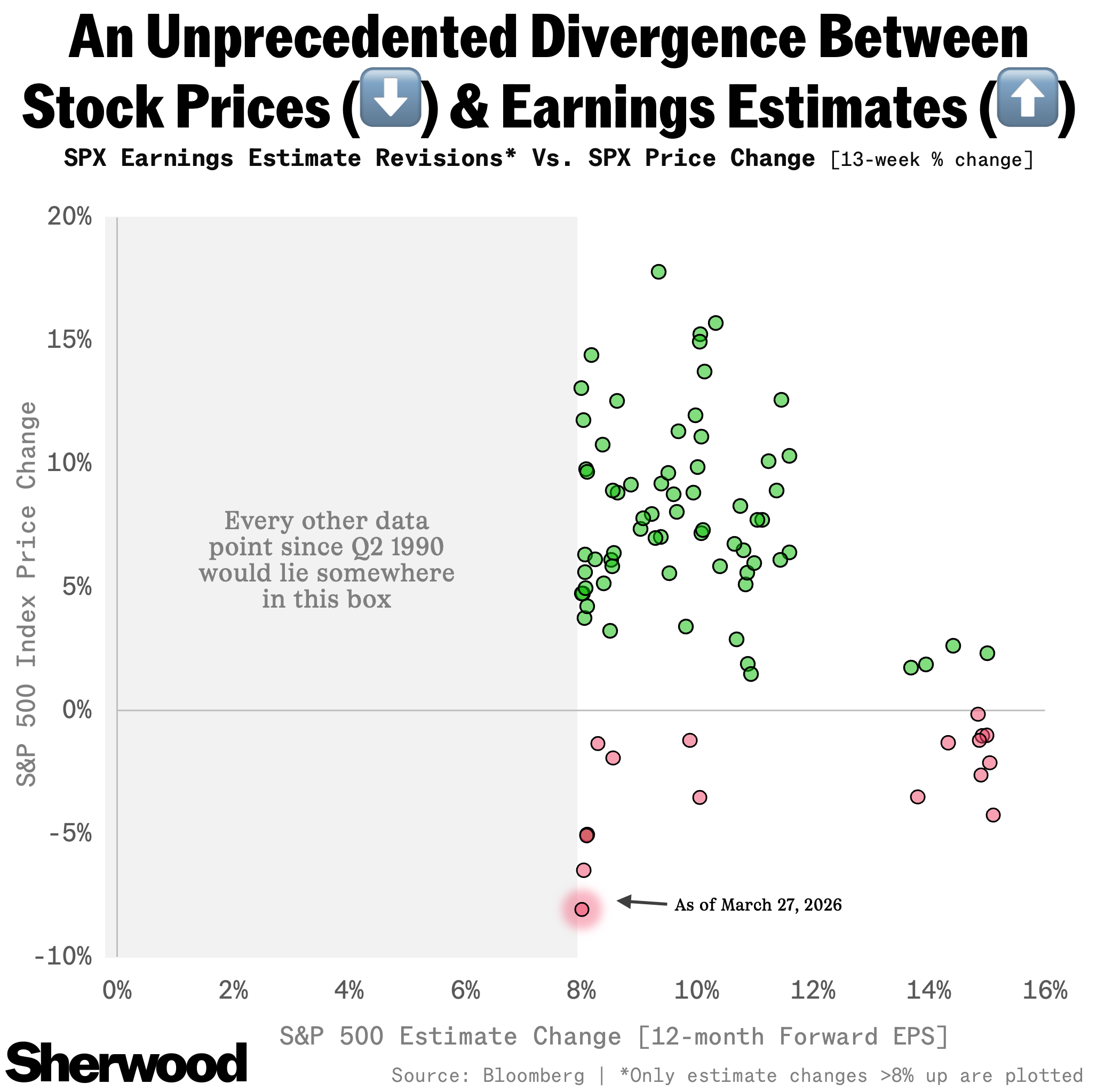
Stock Prices vs Earnings estimates

But that of course assumes the two-week ceasefire between the US and Iran will lead to a longer-lasting agreement, and that the damage already done to global energy markets won’t materially weigh on economic activity going forward. While tariff rate hikes can be quickly reversed, damage to energy infrastructure can’t be undone via executive orders.

A bigger distinction between April 2025 and 2026 lies in what’s expected from Corporate America — and how little that’s mattered to traders lately.

Last year, S&P 500 12-month forward earnings estimates had started to roll over as analysts began to incorporate their views on how tariffs would weigh on profitability.

By contrast, FactSet Senior Earnings Analyst John Butters notes that the share of S&P 500 companies issuing positive earnings-per-share guidance this quarter is the highest since Q3 2021, when the economic reopening from the pandemic was kicking into an even higher gear.

Zooming out to 12-month forward earnings revisions, there are two standout sectors that have seen profit estimates soar since the end of 2025: energy and tech.

You can’t blame LPL Financial Chief Equity Strategist Jeffrey Buchbinder and Chief Technical Strategist Adam Turnquist for prefacing their Q1 earnings outlook by quipping, “At the risk of writing about something that markets may not care much about right now...”

The Mideast war that’s dominated investor discourse is the cause of this brighter outlook for energy companies’ bottom lines. The relative performance of the Energy Select Sector SPDR Fund versus the SPDR S&P 500 ETF typically tracks whatever crude oil futures have been doing. So if the energy sector’s relative performance and earnings outlook is getting sharply better from here, it’s probably a bad-news story for markets about further disruption to global energy supplies.

And traders’ “that don’t impress me much” attitude toward tech profits also predates US strikes against Iran. Despite tech companies handily besting profit expectations last reporting period, their stocks tended to fall thereafter.

While much of this is down to structural pessimism over AI tools usurping established software companies, semiconductor stocks weren’t immune from this trend either.

The medium-term outlook for return on AI investments, which will both govern the longevity of the boom for chip companies and also inform how quickly most hyperscalers can get back to generating ever-growing billions in free cash flow, has resulted in a much more cautious stance and pick-your-spots approach for the theme in 2026 versus 2025. The positive reaction to Amazon’s commitment to “investing to be the meaningful leader” in AI on Thursday is more the exception than the rule..

But with Goldman Sachs spotlighting attractive valuations in tech when judged against relative profit growth, perhaps another quarter of better-than-expected earnings will prompt investors to shift their focus away from long-term displacement and near-term cash flow stresses.

More Markets

See all Markets
markets

Micron and Sandisk rally on new Street-high price targets from Susquehanna

Micron and Sandisk both hit fresh all-time highs in early trading after Susquehanna bestowed new Wall Street-high price targets on the two memory stocks.

Analyst Mehdi Hosseini upped his view on the former to $1,750 from $600, and to $3,250 from $2,000 for the latter.

“Supply is now expected to remain tight through 2027, sustaining elevated margins and thus warranting valuation re-rating,” he wrote, per Bloomberg.

It’s the fifth time in the past year that the average price target on Micron has gone up by more than 10% in a week. UBS’s Tim Arcuri more than tripled his price target on Micron earlier this week, and has already lost the title of “most bullish.”

But even as analysts are tripping over themselves to raise their price targets on these stocks, the ferocity of the rally in Micron has outpaced their best efforts.

The high-bandwidth memory specialist traded at a record premium to the consensus Wall Street price target this week, based on data going back to 2008.

markets

Okta soars on Q1 earnings beat, raised outlook driven by AI security demand

Okta shares are surging in early trading Friday after the identity security provider posted Q1 fiscal 2027 financial results that exceeded Wall Street estimates. The strong results are fueled by accelerating corporate demand for cybersecurity software, as well as the deployment of autonomous AI systems.

Key numbers:

  • Adjusted earnings per share of $0.91 compared to analysts estimate of $0.85.

  • Revenue of $765 million compared to an estimate of $752.7 million.

The company generated subscription revenue of $750 million, up 11% year over year. Okta also has $271 million in free cash flow, up from $238 million in the prior years quarter.

While standard cybersecurity software protects human workers, the latest catalyst sparking Oktas strong corporate performance is the rapid emergence of autonomous AI agents that can access sensitive corporate databases and interact with privileged executive accounts.

“AI agents are rapidly becoming a new workforce inside every organization, creating a wave of identities that must be secured and governed alongside human users,” said Todd McKinnon, CEO and cofounder of Okta. “We’re expanding our opportunity as the world’s leading independent and neutral identity provider and helping customers make identity the unified control plane for their secure agentic enterprise.”

Okta raised its fiscal 2027 revenue guidance to between $3.185 billion and $3.205 billion, roughly in line with estimates of $3.18 billion. The company formally dropped its long-term projected non-GAAP tax rate from 26% down to 21%. This adjustment is a direct byproduct of the federal corporate tax frameworks under the One Big Beautiful Bill Act.

Shares of Okta have risen around 9% since the beginning of this year.

markets

HPE, SMCI surge after Dell’s Q1 beat on strong AI server demand

HP Enterprise and Super Micro Computer shares are surging in premarket trading, getting a big boost from rival Dell’s strong Q1 results.

Dell’s $16.1 billion in AI-optimized server sales for the quarter alone proved that enterprise data center demand is accelerating faster than Wall Street had anticipated. The company posted revenue of $43.8 billion, exceeding Street estimates of $35.5 billion. Management now sees full-year sales of about $167 billion, well above the $142 billion expected by analysts.

The read-through is particularly relevant for Super Micro, one of the largest suppliers of Nvidia-powered AI server systems, and HPE, which has been expanding its AI infrastructure and liquid-cooling offerings through its partnership with Nvidia.

The moves suggest investors view AI infrastructure as a broad spending cycle that benefits server makers across the entire ecosystem.

markets

AST SpaceMobile plummets after Blue Origin rocket explosion

Shares of AST SpaceMobile plunged as much as 15% before the bell on Friday after a Blue Origin rocket exploded yesterday evening on the launchpad.

The New Glenn rocket blew up in what the Jeff Bezos-backed company described on X as “an anomaly” during a hotfire test at the launchpad, only days before it’s due to launch satellites for Amazon’s Project Kuiper next week. Bezos added via X that “it’s too early to know the root cause but we’re already working to find it.” Videos of the explosion circulating on social media show an enormous fireball.

Though AST SpaceMobile’s satellites are not directly affected by the latest explosion, the company partnered with Blue Origin in November 2024 to use its New Glenn rocket to deliver AST’s next-generation Block 2 Bluebird satellites to low-Earth orbit. Citing multiple unidentified employees, the Financial Times reported that an initial assessment of the site showed severe damage to Blue Origin’s equipment, including its only launchpad.

The explosion is a stumbling block for AST’s goals to place at least 45 satellites in orbit by the end of the year. The journey to reach that goal already hit a pretty major speed bump in April, after Blue Origin reported that its New Glenn vehicle put AST SpaceMobile’s BlueBird 7 satellite at an altitude too low to maintain operations.

markets

MongoDB sees knee-jerk drubbing then massive gains after impressive Q1 results, boost to full-year guidance

At first, it looked like another case of a software company selling off despite reporting strong results, with traders (or algorithms) sending MongoDB 21% lower in postmarket trading. That drubbing came even as the distributed database platform company beat Wall Street estimates on the top and bottom lines and lifted its full-year fiscal 2027 guidance.

What a difference seven minutes make. Those losses vanished, and then the stock proceeded to trade more than 20% higher.

Here are the Q1 numbers:

  • Revenue of $687.6 million (compared to analyst estimates of $664.5 million).

  • Adjusted earnings per share of $1.32 (estimate: $1.19).

Management hiked its full-year adjusted EPS guidance to a range of $5.95 to $6.14, up from a previous view of $5.75 to $5.93 and north of the $5.88 that analysts are anticipating. The annual sales outlook was also lifted to a range of $2.92 billion to $2.96 billion, up $600 million from its prior guidance and above the $2.9 billion consensus estimate.

The Q2 outlook provided by the company also bettered what the Street had penciled in for the top and bottom lines.

So for those keeping score at home, that’s a $5.6 billion drop in market cap as a knee-jerk reaction, followed by a $12.6 billion surge in value off the lows. Price discovery; it’s truly a beautiful thing.

Shares are still down year to date even after today’s volatility, but hey, the way things have been going, just give it a few minutes.

Latest Stories

Sherwood Media, LLC and Chartr Limited produce fresh and unique perspectives on topical financial news and are fully owned subsidiaries of Robinhood Markets, Inc., and any views expressed here do not necessarily reflect the views of any other Robinhood affiliate, including Robinhood Markets, Inc., Robinhood Financial LLC, Robinhood Securities, LLC, Robinhood Crypto, LLC, Robinhood Money, LLC, Robinhood U.K. Ltd, Robinhood Derivatives, LLC, Robinhood Gold, LLC, Robinhood Asset Management, LLC, Robinhood Credit, Inc., Robinhood Ventures DE, LLC and, where applicable, its managed investment vehicles.

