


“Retail traders are breaking all records,” says JPMorgan
Sentiment among individual stock traders hits the highest on record.
Deep attachment to the AI boom and bets that Big Tech’s ties to the Trump administration will pay off have chummed the waters for the increasingly involved ranks of retail stock traders, with their activity now surpassing even the meme-stock mania of January 2021.
In a note published Wednesday titled “Retail Traders are Breaking all Records,” JPMorgan analysts paint the picture of extreme levels of trading centered on the biggest technology companies — the so-called Magnificent 7. They wrote:
“Retail traders are on track to break all records. Their daily inflow exceeded $2B twice last week — a level reached only 9 times (as of last Friday) in the past 3 years with 5 times occurring this year after the Inauguration...
Unlike previous weeks when the net inflows were dominated by broad-market ETFs, the past two days saw minimal ETF inflows with interests evenly split between Fixed Income and Equities (top picks: iShares 0-3 Month Treasury Bond ETF, iShares Bitcoin Trust, SPDR Gold Shares ETF, Vanguard S&P 500 Value ETF, SPDR S&P 500 Trust).
Within single stocks, they set records with a net imbalance of $3.2B on Tuesday, ~$1B more than the second largest in March 2020. ~70% inflows went to Mag7, the largest on record. Nvidia led the inflows with a $1.3B net purchase, slightly lower than last June’s level following the stock split. Demand for Tesla remained strong at $632Mn (99th %ile over the past 5Y).”
For the record, imbalance is the dollar-based metric — essentially shares multiplied by price — that JPM analysts use to try to assess traders’ stance on a company. A positive imbalance means retail traders, as a group, are buyers, while a negative imbalance suggests they are sellers, on the whole. By comparing these imbalances to historical levels, they try to assess how bullish or bearish retail traders seem to be. At the moment they’re off-the-charts bullish. Here’s a snapshot from the note.
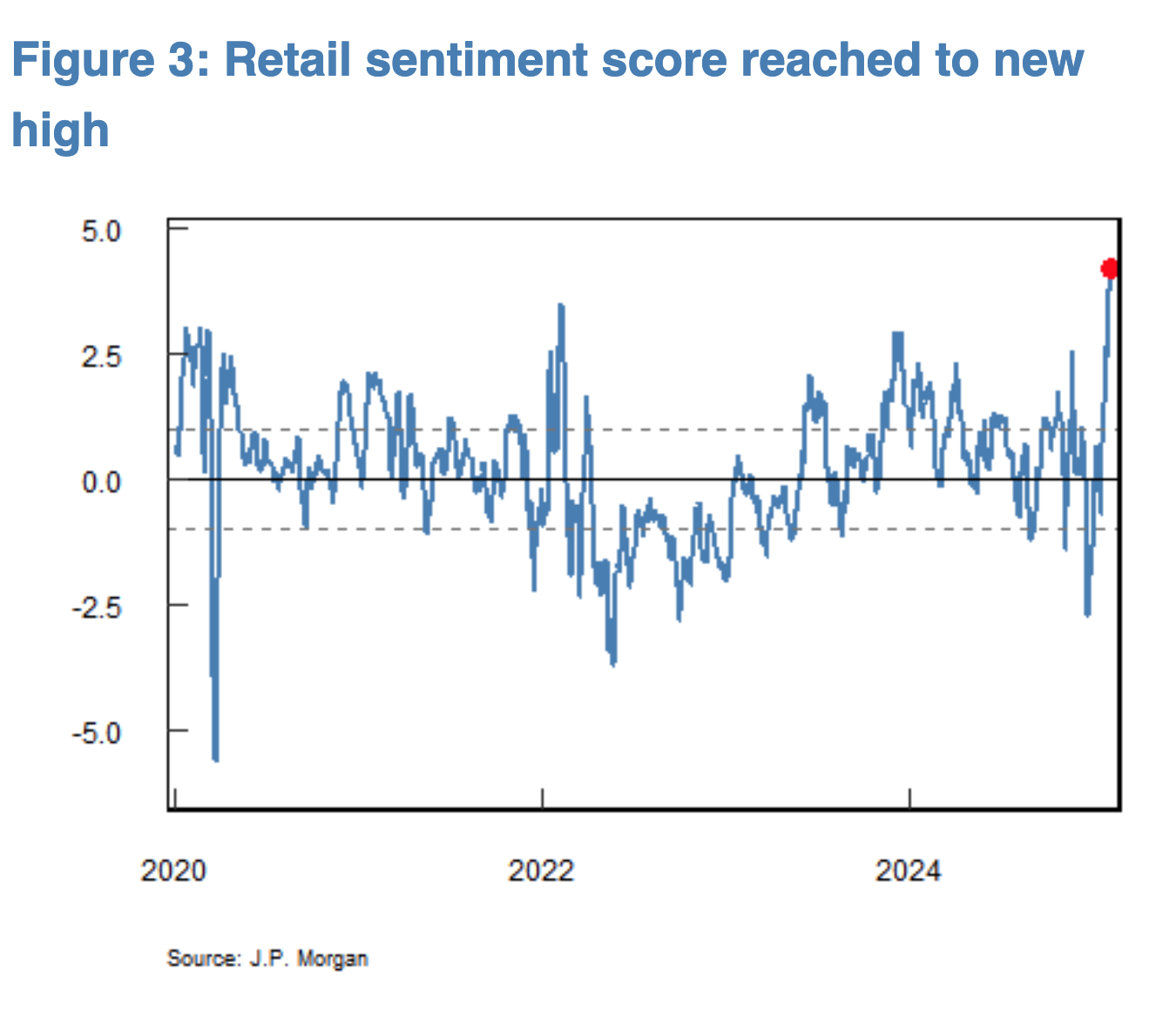
Is this a good thing? On Wall Street, such levels of retail ebullience would traditionally be seen as a contrarian indicator suggesting a downturn might be in the future, as buying power has been largely spent. But JPM analysts argue that actually, extreme levels of retail buying tend to portend an upturn in the markets over the near term.
“We find market generally outperforms following extreme retail buying and underperforms after extreme retail selling in short-term,” they wrote.




