

Markets
markets
Luke Kawa

Retail traders are buying the dip in Nvidia and selling the rip in Google

As many tech companies hit the skids in the sessions following the release of Nvidia’s second-quarter earnings, retail traders stepped up to make their most purchases of US single stocks in two months, per JPMorgan.

Retail traders bought $1.4 billion in US single stocks in the five sessions ended September 3, according to strategists led by Arun Jain — with nearly all of the net buying ($1.2 billion) in the $4 trillion chip designer. Tesla and Palantir were No. 2 and No. 3, respectively, on the retail-buying leaderboard. But even the combined retail purchases of those two stocks were only a little more than half of what was seen in Nvidia.

However, the persistent selling that’s pushed shares of the world’s most valuable company below its 50-day moving average seems to be fraying retail’s patience with buy-the-dip strategies.

“While NVDA was still a favorite this week (+$1.2 billion), retail investors’ post-earnings enthusiasm soon faced exhaustion as the stock continued to underperform, with daily purchases declining from $444 million on Aug 28th to $146 million yesterday [Tuesday] and $75 million today [Wednesday],” the JPMorgan analysts wrote.

Meanwhile, retail traders were sellers of the biggest one-day gain in Alphabet since April 9 (the session when US President Donald Trump watered down reciprocal tariffs), with the search giant bolstered by a court ruling in which it avoided worst-case scenarios and had its operational status quo more or less reaffirmed. $154 million in Alphabet was sold by retail, on net, which JPM noted is nearly 3 standard deviations worse than the typical activity from this cohort. Apple, which was also buoyed by the court ruling, saw $190 million in net sales over the past five sessions, an amount not that much below average, per JPM’s calculations.
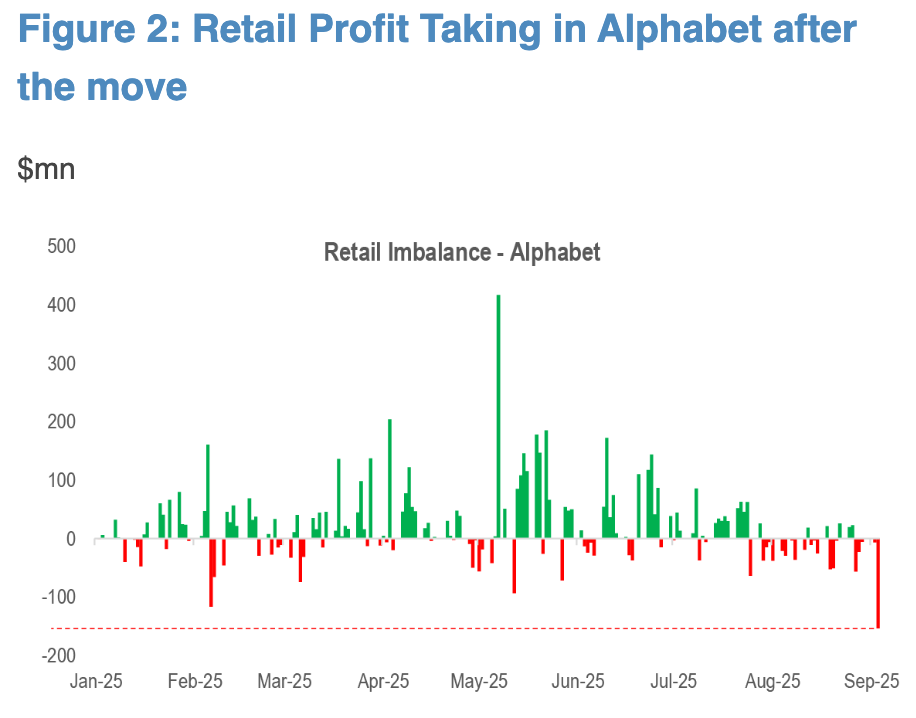
Retail imbalance in Alphabet
Source: JPMorgan Equity Strategy & Quantitative Research

[Disclosure: I own some Alphabet stock, but it’s not enough to change my life even if it duodecupled.]

More Markets

See all Markets
markets

Broadcom jumps after locking down Google as a customer for future generations of TPUs

Shares of Broadcom rose more than 3% in postmarket trading on Monday after its most important customer doubled down on the custom chip specialist’s ability to produce its most valuable commodity.

In a filing, Broadcom said that it entered into a long-term agreement with Google to supply future generations of TPUs (custom AI accelerator chips) as well as a supply assurance agreement for networking and other equipment “through up to 2031.”

Bernstein analyst Stacy Rasgon indicated that Broadcom’s investor relations team told him that Google’s long-term agreement “has revenue commitments that go along with it through the timeline.”

Gemini 3 launched to rave reviews in November. The model was trained on TPUs co-developed by Broadcom and Google.

The same Monday filing showed that Broadcom, Google, and Anthropic expanded a partnership that will see the Claude developer access 3.5 gigawatts of AI compute capacity beginning in 2027, powered by the TPUs co-designed by the custom chip specialist and the search giant.

Bernstein’s Rasgon added that Broadcom’s team suggested these 3.5 gigawatts are “only part of a larger partnership over time.” He thinks Broadcom’s fiscal year 2027 guidance for AI revenues of $100 billion “is looking increasingly light” thanks to this news.

For what it’s worth, the enhanced pact with Anthropic hinges upon the firm’s ability to afford AI compute. But based on the insane trajectory of its run-rate revenue that may not be a big hurdle to clear.

“Broadcom’s expanded agreements with Google and Anthropic add rare multi-year visibility, reinforcing a $40-$50 billion AI revenue opportunity tied to Anthropic’s 3.5 gigawatt deployment starting in 2027, while building on the previously disclosed 1GW ($10 billion) starting in 2H,” wrote Bloomberg Intelligence analysts Kunjan Sobhani and Oscar Hernandez Tejada.

markets

Health insurers surge after Medicare agrees to pay 2.48% more in 2027, a bigger-than-expected boost

Health insurance stocks are surging after the Centers for Medicare & Medicaid Services said it plans to boost Medicare Advantage and Part D payments by 2.48% in calendar year 2027.

The likes of CVS, Humana, UnitedHealth, Molina Healthcare, Oscar Health, and Elevance Health are gaining in postmarket trading.

Wall Street analysts had anticipated that rates for 2027 would go up between roughly 1% and 1.5%.

These stocks had gotten crushed in late January when the Trump administration proposed relatively flat federal payment rates.

Insurance companies that provide government-sponsored plans, like Medicare Advantage, faced headwinds from higher-than-expected costs in 2025.

markets

Iran war winners Dow, LyondellBasell downgraded by Bank of America

Dow, Inc. and LyondellBasell — two petrochemicals stocks that surged as markets priced in shortages due to the closure of the Strait of Hormuz — should decline as investors focus on the long-term outlook for normalized petrochemical prices once the war resolves, Bank of America analysts wrote in a note downgrading the two stocks Monday.

BofA moved its rating on the shares from “neutral” to “underperform,” writing:

“Over time, as chemical markets normalize, we expect 1) investor focus to shiſt back to ‘normal’ or ‘sustainable’ earnings profiles and 2) the conflict to resolve without material asset rationalization, both of which likely bias shares lower over the next twelve months.”

Analysts also lowered their stance on another petrochemicals and building materials stock, Westlake, to “neutral” from “buy.”

While cutting those ratings, BofA actually raised its more near-term price targets for the shares. It upped LyondellBasell to $68 from $55, and Dow to $35 from $31.

But those price targets still imply declines of more than 10% compared to where both shares were trading late Monday morning. Both stocks are up roughly 30% since the start of the Iran war.

Latest Stories

Sherwood Media, LLC produces fresh and unique perspectives on topical financial news and is a fully owned subsidiary of Robinhood Markets, Inc., and any views expressed here do not necessarily reflect the views of any other Robinhood affiliate, including Robinhood Markets, Inc., Robinhood Financial LLC, Robinhood Securities, LLC, Robinhood Crypto, LLC, Robinhood Derivatives, LLC, or Robinhood Money, LLC. Futures and event contracts are offered through Robinhood Derivatives, LLC.