

Markets
markets
Luke Kawa

Retail traders are starting off 2026 with another AI shopping spree

It’s a new year, and retail traders have an appetite for the same main course.

“Retail investors quickly refocused their attention to their trading portfolios as the New Year began, leading to the second-highest weekly buying levels in nearly eight months and daily purchases consistently exceeding the 85th percentile [relative to its one-year average] since January 2,” JPMorgan strategist Arun Jain wrote.
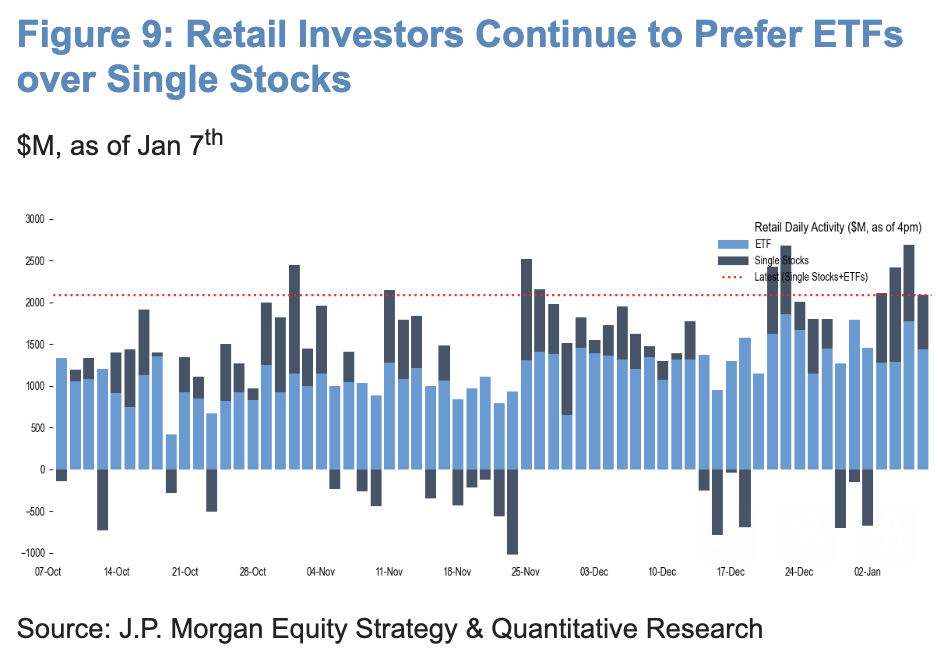
JPM early 2026 retail

While retail investors continued to buy into ETFs over individual equities overall, so far in 2026, most of traders’ single-stock money is going into names retail investors took a shining to in 2025: the AI beneficiaries.

Per Jain, Tesla, Nvidia, Amazon, Palantir Technologies, Advanced Micro Devices, and Micron are the most purchased stocks by retail so far this year. The cohort has also made some big purchases of Halliburton and Chevron after the US ousted Venezuelan President Nicolás Maduro.

“After earning more than $20 billion in options on our platform over the course of the year, retail investors enter January armed with capital to deploy,” added Scott Rubner, Citadel Securities’ head of equity derivatives strategy. “This demand remains a steady source of upside pressure, amplifying early-year flows and contributing to January momentum.”

More Markets

See all Markets
markets

Albemarle and fellow lithium miners jump on Zimbabwe export ban

Lithium miners Albemarle Corp., Lithium Argentina, Lithium Americas, and Sociedad Quimica y Minera are all rising in early trading on Wednesday after Zimbabwe suspended its export of all raw minerals and lithium concentrates.

The latest move accelerates a ban that was reportedly expected to come into effect starting January 2027, and will remain in place until further notice. As the top African producer of the metal, Zimbabwe exported some 1.13 million metric tons, or $514 million worth, of lithium-bearing spodumene concentrate in 2025.

Zimbabwe’s mines minister said the ban would remain in effect until companies comply with government requirements, per Bloomberg.

The ban adds further supply pressure into a market that’s already seen prices squeeze higher, with benchmark lithium futures roughly doubling since the end of October 2025. That’s spurred the shares of companies like Albemarle, which has gained more than 90% over the same time frame — a rare bright spot in an EV supply chain that’s generally been pretty depressed recently.

Some Wall Street analysts have gotten more bullish on the sector, too. Albemarle scored an upgrade from Bank of America analysts earlier this month, who cited the lithium market’s improvement in structural fundamentals, as Chinese supply restrictions combined with growing demand for utility-scale battery storage applications provide further support for lithium prices. Futures prices for lithium carbonate remain above $18 per kilogram, having been as high as $21 per kilogram in January.

markets

Joby announces plans to offer air taxi rides in the Uber app in Dubai

Air taxi maker Joby Aviation is climbing in premarket trading on Wednesday following its announcement that Uber Air (a planned partnership to add Joby’s air taxis as a transport option in the Uber app) will launch in Dubai later this year.

Joby shares are up more than 6%.

According to its press release, booking an air taxi through the Uber app will also include an Uber Black pickup and drop-off.

First, Joby will need its air taxis certified for commercial service in the UAE. Last February, the company said it expected to be flying passengers in the country “in late 2025 or early 2026,” though that timeline appears to have been delayed. According to a report by The National in November, UAE authorities said they expect certification in the third quarter.

The company’s progress in the US is slower, though it entered the final stage of its FAA certification process last year and is expected to provide an update to that timeline when it reports its fourth-quarter earnings after the market closes Wednesday.

The announcement marks a deepening of Joby and Uber’s partnership. Last year, Uber said it would add Joby’s Blade helicopter and seaplane services to its ride-hailing app.

According to its press release, booking an air taxi through the Uber app will also include an Uber Black pickup and drop-off.

First, Joby will need its air taxis certified for commercial service in the UAE. Last February, the company said it expected to be flying passengers in the country “in late 2025 or early 2026,” though that timeline appears to have been delayed. According to a report by The National in November, UAE authorities said they expect certification in the third quarter.

The company’s progress in the US is slower, though it entered the final stage of its FAA certification process last year and is expected to provide an update to that timeline when it reports its fourth-quarter earnings after the market closes Wednesday.

The announcement marks a deepening of Joby and Uber’s partnership. Last year, Uber said it would add Joby’s Blade helicopter and seaplane services to its ride-hailing app.

markets

Workday’s miserable year continues after soft revenue guidance sinks the stock

Workday slumped nearly 9% in after-hours trading Tuesday, and continued to languish in the red in early trading on Wednesday, after the HR and finance software company issued a lighter-than-expected subscription revenue outlook.

For the quarter ended January 31, subscription revenue — which makes up over 90% of total revenue — rose 15.7% year over year to $2.36 billion, in line with analysts’ estimates, while adjusted earnings per share of $2.47 topped the $2.32 expected.

However, guidance for the coming quarter, ending April 2026, came in a hair below analysts’ estimates, as did projections for fiscal 2027 subscription revenue of $9.93 billion to $9.95 billion, below the roughly $10 billion estimate on Wall Street.

The outlook comes amid broader AI-driven anxiety among software-as-a-service companies, with investors questioning whether generative-AI tools could displace traditional software vendors.

On the earnings call, CEO Aneel Bhusri pushed back on this narrative, arguing Workday’s domains are really, really hard to build. The company has been prioritizing investment in agentic AI, with its annualized revenue from AI products now topping $400 million.

Still, shares are now down ~45% year to date, marking the stock’s sharpest annual decline since going public in 2012. All told, shares are now 61% down from their all-time high.

markets

President Trump announces data center electricity deals in State of the Union

President Donald Trump said during Tuesdays State of the Union address that hes struck agreements with tech companies to pay more for electricity in areas where they build data centers.

The rate payer protection pledges are intended to insulate consumers from higher bills in regions where new, power-hungry data centers are built. The White House earlier told Politico that the plan meant that tech giants would pay their own way and offset their demand for power causing electricity bills for all ratepayers to increase.

Some tech companies are already trying to get out in front of the publics negative perception of their surging electricity use, and Trumps criticism of it. In January, Microsoft committed to paying up for its data center electricity use. That move came after criticism from the president. As part of the plan, Microsoft said it would ask utilities and public commissions to charge it rates high enough to cover the costs of both data center installation and usage, and support two-tier pricing systems where “Very Large Customers” (like data centers) get charged higher prices.

Coming into the end of 2025, utilities with a footprint on the country’s largest utility grid — the PJM Interconnection, which serves vast swaths of the Eastern Seaboard and Great Lakes region — like Talen Energy, Constellation Energy, and Vistra saw their share prices surge as electricity auction prices hit record highs. So far in 2026, however, that trade has largely reversed.

Some tech companies are already trying to get out in front of the publics negative perception of their surging electricity use, and Trumps criticism of it. In January, Microsoft committed to paying up for its data center electricity use. That move came after criticism from the president. As part of the plan, Microsoft said it would ask utilities and public commissions to charge it rates high enough to cover the costs of both data center installation and usage, and support two-tier pricing systems where “Very Large Customers” (like data centers) get charged higher prices.

Coming into the end of 2025, utilities with a footprint on the country’s largest utility grid — the PJM Interconnection, which serves vast swaths of the Eastern Seaboard and Great Lakes region — like Talen Energy, Constellation Energy, and Vistra saw their share prices surge as electricity auction prices hit record highs. So far in 2026, however, that trade has largely reversed.

Latest Stories

Sherwood Media, LLC produces fresh and unique perspectives on topical financial news and is a fully owned subsidiary of Robinhood Markets, Inc., and any views expressed here do not necessarily reflect the views of any other Robinhood affiliate, including Robinhood Markets, Inc., Robinhood Financial LLC, Robinhood Securities, LLC, Robinhood Crypto, LLC, or Robinhood Money, LLC.