

Markets
BAM Circus Festival Takes Place In Milan
French acrobat Olivier Mathieu mimics recent price action in crypto (Emanuele Cremaschi/Getty Images)
it’s so over

Retail traders are “skipping the dips” to dash for cash and bet against tech stocks

The speculative fever that dominated markets for much of 2025 looks to have broken.

Luke Kawa

Amid recent market turbulence, retail traders are “skipping the dips, selling into rallies, and positioning more defensively,” writes JPMorgan strategist Arun Jain.

Retail purchases in March were roughly cut in half from January and down 40% from February, per JPMorgan.

And still those headline stats understate how cautious the cohort has been of late.

For instance, two products that the retail community stampeded into on Tuesday and Wednesday were the ProShares UltraPro Short QQQ ETF (3x leveraged short the Nasdaq 100) and the iShares 0-3 Month Treasury Bond ETF (cash, more or less), according to Jain.
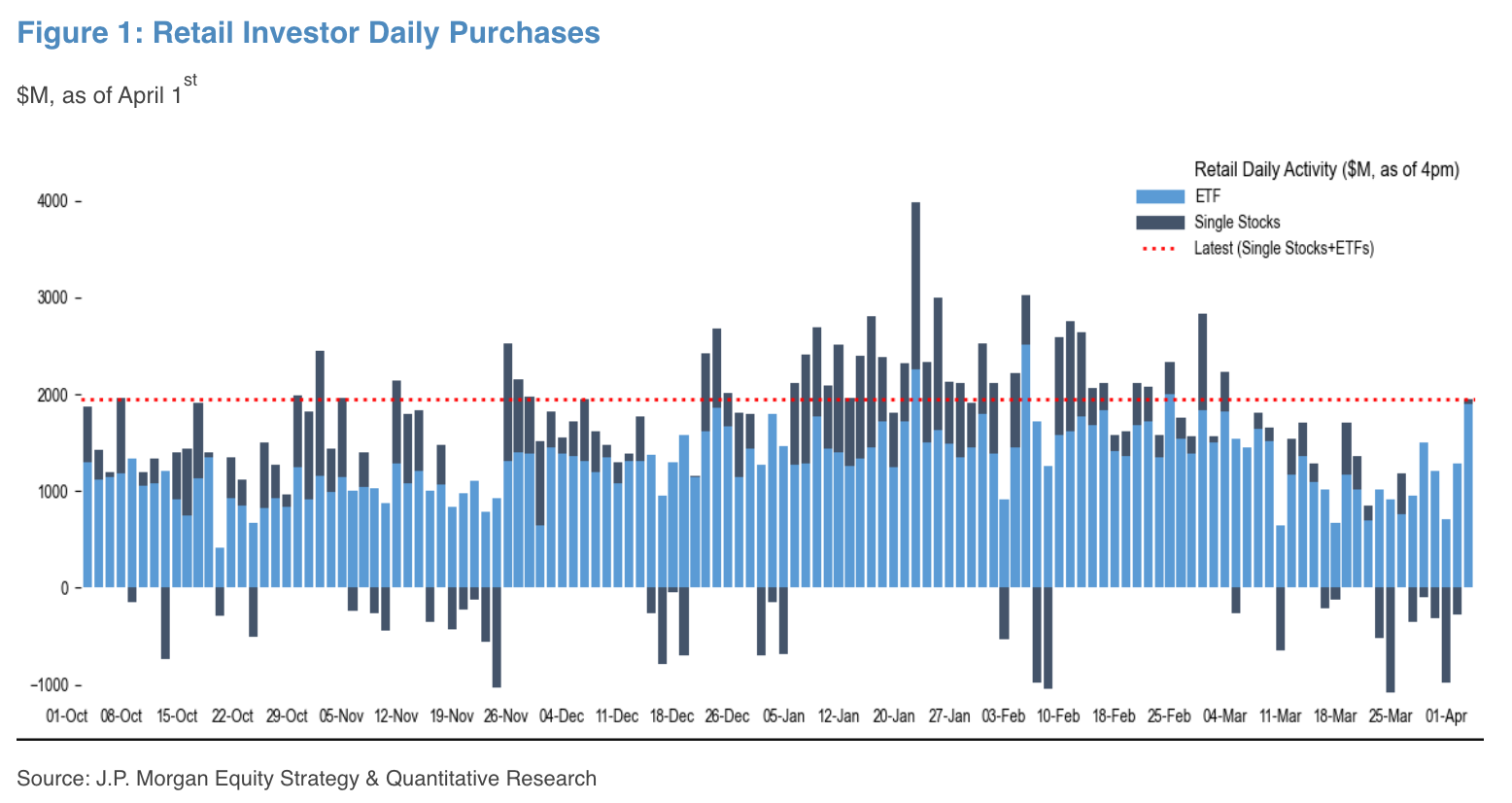
Retail purchases JPMorgan
JPMorgan

In single stocks, Tesla, Nvidia, and Microsoft continue to be bought, but tech more broadly is being sold, with retail positioning in the sector “at its most negative level in six months,” Jain wrote. In particular, Micron and Sandisk have been dumped across the past week on concerns over Google’s TurboQuant algorithm.

Jain’s spotlighting of the newfound risk aversion among retail investors comes roughly a week after Vanda Research said that retail traders had a session in which they sold single stocks, on net, for the first time since November 2023.

Zooming out, the speculative fever that dominated price action for much of 2025 looks to have broken. Call volumes traded across US exchanges (which we highlighted as a key chart to watch for 2026) peaked in October.

That’s also when the Invesco QQQ Trust, Nvidia, bitcoin, quantum computing stocks, and Goldman Sachs’ basket of stocks beloved by retail traders hit all-time closing (or 52-week) highs. (Palantir peaked in early November.)

It will come as absolutely no surprise that another name that reached its zenith along with speculative stocks and bitcoin, the ultimate no-fundamentals asset, is Robinhood Markets, a brokerage that’s become synonymous with retail activity.

(Robinhood Markets Inc. is the parent company of Sherwood Media, an independently operated media company subject to certain legal and regulatory restrictions.)

The put/call ratio suggests bearish activity is now dominant, a rarity over the past six months.

More Markets

See all Markets
markets

SpaceX reportedly plans to IPO in mid-June, chooses to list on Nasdaq

Elon Musk’s aerospace and satellite manufacturer, SpaceX, could price its initial public offering as soon as June 11 and make its public market debut on June 12, Reuters reported Friday. SpaceX is preparing for a monster IPO, reportedly aiming to raise $75 billion at a record $1.75 trillion valuation.

Sources familiar with the matter told Reuters that Musk’s company had chosen to list on the Nasdaq.

SpaceX is moving through its IPO timeline and is said to be ready to hit the road to secure commitments from investors around June 4, according to Reuters.

SpaceX did not immediately respond to requests for comment.

Go Deeper: What happens to Tesla stock when SpaceX goes public?

markets

Figma spikes after raising full-year sales outlook as the software company leverages AI for growth

Figma jumped postmarket Thursday after posting impressive sales in Q1, surpassing Wall Street expectations and raising its full-year guidance. The key numbers:

  • Q1 revenue of $333.4 million (compared to analyst estimates of $316 million).

  • Q2 sales guidance of $348 million to $350 million (estimate: $329.7 million).

  • Full-year revenue between $1.422 billion and $1.428 billion (up from previous guidance of $1.37 billion).

The digital design software firm is the latest company to diminish investor fears about AI-induced disruption by making the technology work for them. Like Atlassian or Datadog, Figma said it was able to use AI to its advantage, bringing more customers on board and getting them to spend more.

In the press release, Praveer Melwani, Figma CFO, said:

As AI gets better, Figma is accelerating and customer usage and workflows on our platform are deepening. Our platform and AI products drove faster growth for both new customer acquisition and expansion within existing accounts.

Revenue grew 46% year over year in Q1 2026, an acceleration from growth of 40% in Q4 2025.

markets
Luke Kawa

Infleqtion reports Q1 adjusted loss, offers modest boost to full-year sales guidance

Infleqtion is falling in postmarket trading after reporting a Q1 adjusted loss from operations of $13.2 million and sales of $9.5 million.

Management modestly upgraded its sales guidance to “at least” $40 million for 2026, adding that language to enhance the target provided in early April. Revenues of $40 million would mark an increase of roughly 23% compared to the $32.5 million generated in 2025, and an acceleration from growth of 12% last year.

The company utilizes neutral-atom technology to make quantum sensors used in clocks and antennas in addition to computers.

“Q1 reinforced our confidence that quantum is gaining momentum as the market shifts toward deployable systems, real applications, and measurable customer value,” said CEO Matt Kinsella. “Across computing, sensing, and software, we are seeing expanding customer activity especially in national security, space, and hybrid quantum-AI applications.”

Shares are roughly flat since February 13, which is just before the company went public via a SPAC, after being down 35% near the end of March, and then up nearly 30% in mid-April.

The quantum computing space benefited from the return of speculative appetite in April after the US and Iran agreed to a ceasefire. The cohort was later bolstered after Nvidia unveiled a suite of open models designed to leverage AI to improve calibration and error correction for quantum computers.

markets
Luke Kawa

Applied Materials rallies after better-than-expected Q2 results, strong sales guidance

Shares of Applied Materials are gaining in postmarket trading after the company reported robust Q2 results and a sales outlook that indicate building momentum.

  • Net sales: $7.9 billion (compared to analyst estimates of $7.7 billion and guidance for $7.65 billion, plus or minus $500 million).

  • Adjusted earnings per share: $2.86 (estimate: $2.68, guidance: $2.68, plus or minus $0.20).

For Q3, the company anticipates net sales of $8.95 billion (plus or minus $500 million; estimate: $8.15 billion) with adjusted EPS of $3.36 (plus or minus $0.20; estimate: $2.88).

“The growth in AI that Applied has been investing for is now in full force,” CFO Brice Hill said in the press release.

Management has consistently indicated that it expects demand to pick up in the second half of this year, but its first-half results have already blown away expectations by a wide margin. All this appetite for semiconductors to support AI compute is fantastic news for companies like Applied Materials that make the equipment to produce these specialized chips.

Shares of Applied Materials closed near a record high ahead of this report, up more than 70% year to date.

Latest Stories

Sherwood Media, LLC and Chartr Limited produce fresh and unique perspectives on topical financial news and are fully owned subsidiaries of Robinhood Markets, Inc., and any views expressed here do not necessarily reflect the views of any other Robinhood affiliate, including Robinhood Markets, Inc., Robinhood Financial LLC, Robinhood Securities, LLC, Robinhood Crypto, LLC, Robinhood Money, LLC, Robinhood U.K. Ltd, Robinhood Derivatives, LLC, Robinhood Gold, LLC, Robinhood Asset Management, LLC, Robinhood Credit, Inc., Robinhood Ventures DE, LLC and, where applicable, its managed investment vehicles.

