

Markets
markets

Retailers’ profits will get clobbered by more than 30% by tariffs, says Morgan Stanley

Analysts at Morgan Stanley crunched the numbers and it turns out tariffs are really, really bad for US retailers.

Acknowledging that “a wide range of outcomes is possible,” the analysts found that recently enacted tariffs would increase prices by 1% and decrease volumes by 3%. This assumes a 145% tariff on China and a 10% tariff on everyone else besides Canada and Mexico.

On average, earnings per share would decline by 33%, with some companies more exposed than others, the analysts wrote.

Among the most exposed companies are Target, Academy, and Restoration Hardware. (If you don’t believe them, I’d point you to the Restoration Hardware CEO’s reaction on an earnings call when seeing the impact of President Trump’s April 2 tariff announcement had on his stock in real time.) The least exposed are grocery stores like Kroger and Albertsons.
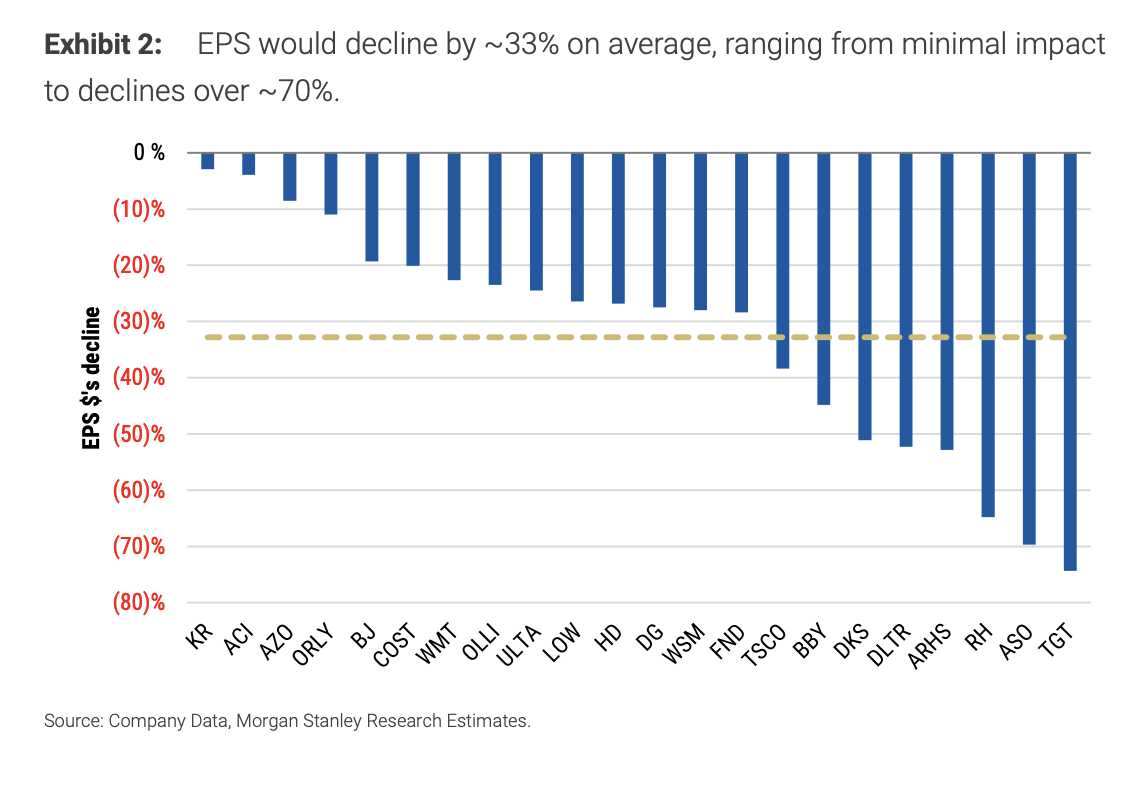
Screenshot 2025-04-16 at 11.42.13 AM
(Morgan Stanley)

More Markets

See all Markets
markets

Boeing touts supply chain improvements, progress in its “war on defects”

Boeing shares are climbing on Thursday, following comments made by one of the plane maker’s executives at a supplier conference on Wednesday evening.

The company says it’s now spending 40% fewer hours fixing issues arising from its supply chain compared to 2024 — a year marred by production and quality issues.

Defects from parts of the chain controlled by Spirit AeroSystems — a fuselage supplier Boeing acquired last year — have dropped by 60% from 2024.

The progress update comes amid the company’s self-declared “war on defects.” Following its 2024 door plug blowout incident, Boeing has worked to improve documentation, simplify instructions, and expand employee training. According to the National Transportation Safety Board, the share of Boeing employees with 10 or more years of experience halved from 50% to 25% over the past decade.

Defects from parts of the chain controlled by Spirit AeroSystems — a fuselage supplier Boeing acquired last year — have dropped by 60% from 2024.

The progress update comes amid the company’s self-declared “war on defects.” Following its 2024 door plug blowout incident, Boeing has worked to improve documentation, simplify instructions, and expand employee training. According to the National Transportation Safety Board, the share of Boeing employees with 10 or more years of experience halved from 50% to 25% over the past decade.

markets

Crocs surges as Q4 results and 2026 earnings guidance exceed every analyst’s projections

Shares of Crocs are up double digits in premarket trading after the footwear maker posted Q4 sales and adjusted earnings per share that exceeded every analyst’s estimates.

The company reported revenues of $957.6 million and adjusted EPS of $2.29 in Q4, trouncing expectations for $916.9 million and $1.92, respectively.

Guidance was similarly stellar:

Management called for adjusted EPS to come in between $12.88 and $13.35; the highest estimate from the 13 analysts polled by Bloomberg was just $12.62, and the average was $12.02.

Full-year sales are projected to be down about 1% to up slightly, while Wall Street had also penciled in a bigger decline.

Crocs will struggle to be in s̶p̶o̶r̶t̶ growth mode this year on the top line because it’s carrying around the anchor that is the HeyDude brand.

Even a fresh marketing effort with Sydney Sweeney unveiled in late September didn’t boost HeyDude, in stark contrast to what American Eagle’s partnership with the actress has done to demand for its denim.

The brand’s quarterly sales were down 17% year on year. All of the drop came from wholesale demand, which tumbled 40.5%, while direct-to-consumer sales were flat.

Management expects HeyDude revenues to be down another 7% to 9% this year.

Crocs HeyDude sales
markets

Cisco slumps as memory price spike weighs on margins

Cisco is falling Thursday, despite delivering a beat-and-raise Q2 result after the previous close. Analysts think surging costs of memory chips are the culprit. Here’s some of what they’re saying.

William Blair: “On the margin front, Cisco guided a contraction in non-GAAP gross margins to 66% in the third quarter (down 150 basis points sequentially), citing elevated memory price inflation and higher mix of hardware.”

Barclays: “While the revenue outlook has improved, and AI orders accelerated, we are not seeing enough translation to EPS growth, particularly given the [gross margin] concerns that recently popped up.”

Citi: “CSCO indicated that memory price increases hit the company with [zero] lead time. That said, the company is working to add more flexibility around their terms & conditions framework in order to pass along memory pricing increases faster.”

Evercore ISI: “Though the guide does imply gross margins will be down ~150bps [quarter over quarter] due to a combination of Mix and Memory inflation, CSCO expects to recover some of these headwinds via price increases and other levers.”

markets

Nebius slumps after Q4 results trail estimates

Nebius tumbled in early trading after reporting underwhelming Q4 results before managing to pare much of those losses.

In the final three months of the year, revenues of $227.7 million were shy of the $247.5 million consensus estimate. Adjusted EBITDA of $15 million also trailed expectations for $22.55 million.

Founder and CEO Arkady Volozh indicated that the neocloud ended 2025 with roughly 170 megawatts of active power capacity, ahead of its 100-megawatt target, and “is on track to end the year with annualized run-rate revenue of $7 billion to $9 billion.” Management raised its capacity guidance for contracted power by year-end to more than 3 gigawatts, up from a prior outlook of more than 2.5 gigawatts issued in November.

During the conference call, CFO Dada Alonso said the company expects to generate between $3 billion and $3.4 billion in sales this year, which she called a “prudent approach.” Analysts polled by Bloomberg were looking for revenues of nearly $4 billion in 2026.

Neoclouds need capital to keep fueling growth, and the potential for over-indebtedness as these aggressive build-outs continue remains a key risk for the cohort.

COO Ophir Nave said the company would be able to finance “60% or maybe even more of all of our capex needs in 2026” through cash flows. The overwhelming majority of the capex budget is dedicated to deploying GPUs within data centers, rather than power or other physical infrastructure.

markets

Memory stocks jump after Japanese chipmaker posts robust guidance

Memory stocks have their mojo back after Japanese chipmaker Kioxia gave strong forecasts along with positive color on AI-driven demand.

The company, which specializes in NAND flash memory, provided guidance for full-year operating income and sales that exceeded analysts’ expectations.

While Kioxia normally signs agreements for customers on a 12-month basis, management indicated that some now want to lock in supply for 2027 and 2028, a testament to the seeming longevity of the supply/demand imbalance in memory. That imbalance is also prompting the company to enjoy “a very sharp increase in selling price,” per CFO Hideki Hanazawa.

Sandisk, a NAND seller that recently extended its joint venture with Kioxia for manufacturing, is the biggest premarket gainer in the memory chip space. Micron, Western Digital, and Seagate Technology Holdings are also trading to the upside.

Memory stocks had previously seen some of the steam come out of their terrific start to 2026, after popular momentum trades came under pressure and investors tried catching a falling knife in beaten-down parts of the market, eroding some enthusiasm for the cohort. But they’ve rebounded smartly in the past couple of sessions, thanks to fresh bad news for software companies; Micron indicating that shipments of next-gen, high-bandwidth chips have started ahead of schedule; and now this positive read-through from Kioxia.

Latest Stories

Sherwood Media, LLC produces fresh and unique perspectives on topical financial news and is a fully owned subsidiary of Robinhood Markets, Inc., and any views expressed here do not necessarily reflect the views of any other Robinhood affiliate, including Robinhood Markets, Inc., Robinhood Financial LLC, Robinhood Securities, LLC, Robinhood Crypto, LLC, or Robinhood Money, LLC.