
Markets
Salesforce slump shows why the AI software trade remains interesting
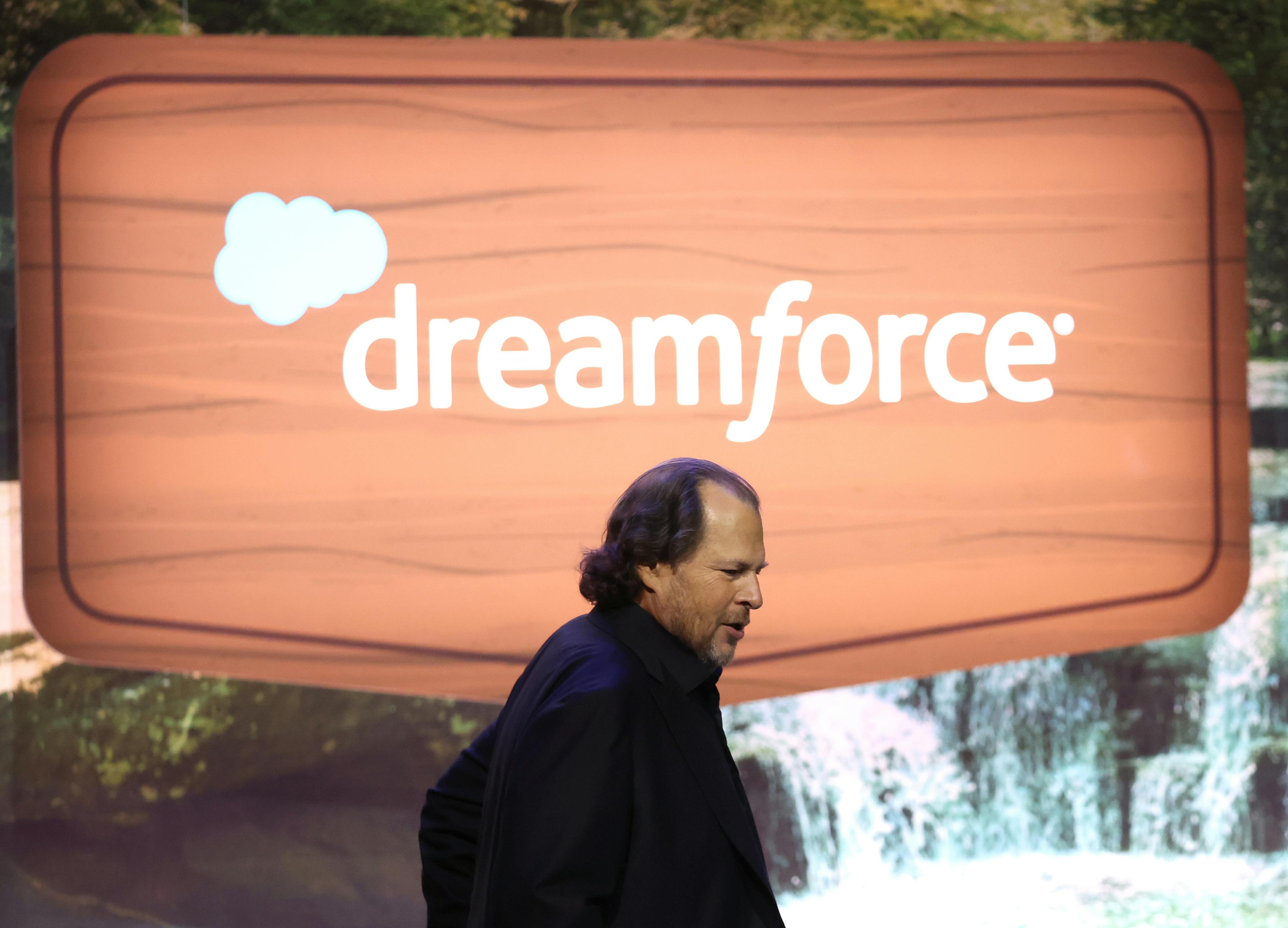
(Justin Sullivan/Getty Images)

Salesforce’s slump shows the market still thinks AI is coming for software. But what if it doesn’t?

There wasn’t much proof of disruption in Salesforce’s numbers. Meanwhile, it’s trading around its lowest price-to-earnings ratio ever.

Matt Phillips

Yesterday, we mentioned recent chatter suggesting that the next big phase of the moveable market feast that is AI could be centered on the software business.

Well if it is, nobody told Salesforce shareholders.

Shares of the maker of customer relationship management software tumbled Thursday despite the company posting better-than-expected fiscal Q2 earnings that beat on both the top and bottom lines.

A somewhat lackluster forecast for next quarter’s sales was universally blamed for the roughly 5% tumble.

But the broader picture is that the market remains skeptical that dominant players in the highly lucrative “software as a service” (SaaS) business, like Salesforce, can avoid being disrupted by cheaper, AI-native companies. The threat is that such companies can develop software quicker and sell it for less, eating the incumbents’ lunch.

That seems worth considering. But there was scant proof of disruption to be found in Salesforce’s numbers. Sales, order backlogs, and operating margins continue to grow at a solid clip. And while the guidance might have been light compared to Wall Street expectations, it still suggests acceleration out of Salesforce’s recent slow patch.

At the same time, Salesforce spotlighted progress on its own AI offerings, noting that the Q2 annual run rate for its Agentforce and Data Cloud products hit $1.2 billion, up 120% from the previous year.

The stock’s tumble Thursday suggests investors haven’t been won over by such numbers about Salesforce’s next chapter as an agentic AI giant.

Morgan Stanley analysts suggest the company’s detailed presentation at its October Agentforce conference — where it will demo the next generation of the software and offer testimonials from customers about its value — could bolster confidence in the stock.

But in the meantime, Salesforce, down about 27% this year, remains pretty cheap for a large-cap tech name. It’s trading at roughly 20x expected earnings over the next year, near the lowest level in its 20-odd years as a publicly traded company.

“Bottom line, this strong positioning to benefit from the expanded capabilities of GenAI remains unappreciated in a marketplace thinking ‘SaaS is dead,” Morgan Stanley analysts wrote. “We see a positive risk/reward in [Salesforce] and remain firmly overweight.”

More Markets

See all Markets
markets

NuScale Power falls on disappointing drop in Q1 sales

Nuscale shares are dropping in the early trading session after it released Q1 earnings yesterday after the bell that are failing to rejuvenate any excitement in the once high-flying, early-stage nuclear energy company.

The company announced Q1 revenue of just $560,000, well below the $10.5 million estimate, with sales down materially year over year thanks to old licensing and design deals that have since been completed.

The lack of financial progress has made NuScale Power more of a momentum-driven way to play the intersection of clean energy and AI infrastructure, particularly as hyperscalers and data center operators search for long-term power sources.

“The demand for reliable, carbon-free power has never been greater, and NuScale is the only SMR technology provider with a U.S. Nuclear Regulatory Commission approved design, an established supply chain and NPM components currently in production for commercial use to meet this essential need,” said John Hopkins, NuScale president and CEO. “We are building the infrastructure that this pivotal moment requires.”

Analysts at Goldman Sachs trimmed their price target to $9 from $10 in the wake of this report.

The company ended this quarter with cash, cash equivalents, and short- and long-term investments of $1.0 billion. The stock has dropped more than 25% year to date.

markets

Nintendo falls, will hike Switch 2 price amid memory crunch

Gaming giant Nintendo reported the results for its fourth quarter, which ended in March, on Friday morning. Its US-traded ADR fell nearly 4% in premarket trading.

Most notably, Nintendo announced it will raise the price of its Switch 2 console in the US by $50 to $499.99 in September. Investors have been waiting for Nintendo to join its rivals Sony and Microsoft in boosting the price of its flagship console, but the company had thus far been unwilling to do so this early in the Switch 2’s life cycle.

Nintendo shares have fallen about 45% over the past 12 months, as the company has been hit by tariffs and costs have increased due to AI’s memory demand and higher global shipping rates amid the war in Iran.

For its fiscal 2026, Nintendo reported:

  • 2.313 trillion yen ($14.8 billion) in total revenue, compared to estimates of 2.31 trillion yen ($14.78 billion) from Wall Street analysts polled by FactSet.

  • 19.86 million Switch 2 sales, compared to its 19 million forecast.

For the fiscal year ahead (which will end in March 2027), Nintendo forecast 16.5 million Switch 2 sales. The company is guiding for 2.050 trillion yen ($13.1 billion) in sales for the full year, compared to Wall Street estimates of 2.5 trillion yen ($16.1 billion).

markets

Fluence Energy keeps surging after hyperscaler supply agreements outweigh soft quarter

Fluence Energy is building on Thursday’s massive gains in the premarket on Friday amid optimism about data center demand for its energy storage solutions.

Though the company delivered underwhelming Q2 results after the close on Wednesday, management announced the signing of new master supply agreements with two major hyperscalers and expects to convert its first order soon. During the conference call, CEO Julian Nebreda indicated that the company has a 12-gigawatt pipeline tied to data center projects.

Analysts at JPMorgan, Canaccord, Jefferies, Goldman Sachs, and Roth Capital raised their price targets on Fluence in the wake of this news.

“The sentiment on FLNC was negative going into the quarter and the hyperscaler announcement came sooner than expected,” noted Citi analyst Vikram Bagri, per Bloomberg.

Latest Stories

Sherwood Media, LLC produces fresh and unique perspectives on topical financial news and is a fully owned subsidiary of Robinhood Markets, Inc., and any views expressed here do not necessarily reflect the views of any other Robinhood affiliate, including Robinhood Markets, Inc., Robinhood Financial LLC, Robinhood Securities, LLC, Robinhood Crypto, LLC, Robinhood Derivatives, LLC, or Robinhood Money, LLC. Futures and event contracts are offered through Robinhood Derivatives, LLC.

